

100% Free Real Updated AZ-104 Questions & Answers Pass Your Exam Easily
Easily To Pass New AZ-104 Verified & Correct Answers
To prepare for the Microsoft AZ-104 Certification Exam, candidates should have a strong understanding of cloud computing principles and be familiar with the Azure portal, Azure PowerShell, and Azure CLI. They should also have experience in managing Azure services and be able to implement and monitor Azure solutions, configure Azure storage, and manage Azure virtual networks. Candidates who pass the exam will earn the Microsoft Certified: Azure Administrator Associate certification, which demonstrates their expertise in managing Azure resources and services. Microsoft Azure Administrator certification is recognized by employers worldwide and can lead to career advancement opportunities in cloud computing and IT infrastructure management.
Microsoft AZ-104 certification exam is an excellent opportunity for professionals who want to demonstrate their skills and knowledge in Azure administration. Microsoft Azure Administrator certification exam covers a broad range of topics, including Azure identity and governance, Azure compute, Azure storage, Azure networking, and Azure monitoring and backup. Passing the exam will demonstrate the candidate's ability to manage Azure resources, implement and manage storage, configure and manage virtual networks, and monitor and backup Azure resources.
Microsoft Azure is a cloud computing platform that offers a wide range of services such as virtual machines, storage, databases, analytics, and much more. It has become a popular choice among businesses for its scalability, security, and cost-effectiveness. With the increasing demand for cloud computing, there is a need for professionals who can manage and administer these services effectively.
NEW QUESTION # 247
You need to the appropriate sizes for the Azure virtual for Server2.
What should you do? To answer, select the appropriate options in the answer area.
NOTE: Each correct selection is worth one point.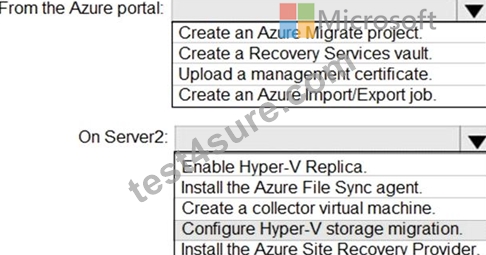
Answer:
Explanation: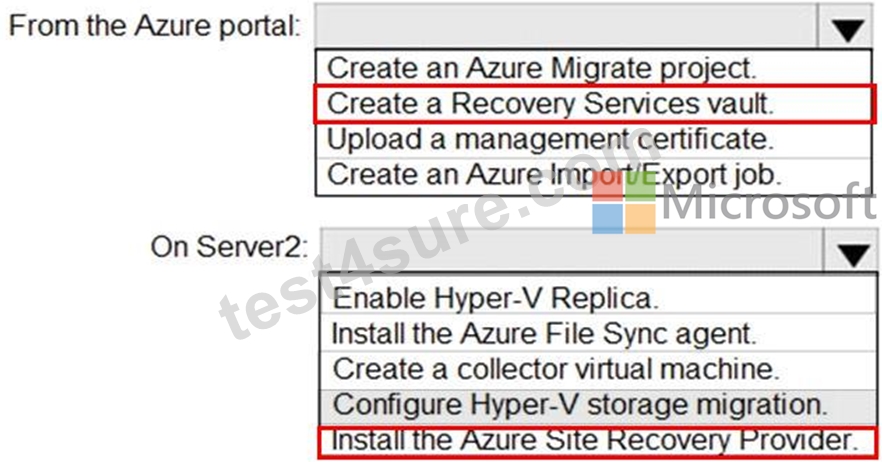
Reference:
https://docs.microsoft.com/en-us/azure/site-recovery/migrate-tutorial-on-premises-azure
NEW QUESTION # 248
You have an Azure subscription that contains an Azure Service Bus named Bus1.
Your company plans to deploy two Azure web apps named App1 and App2. The web apps will create messages that have the following requirements:
Each message created by App1 must be consumed by only a single consumer Each message created by App2 will be consumed by multiple consumers.
Which resource should you create for each web app? To answer, drag the appropriate resources to the correct web apps. Each resource may be used once, more than once, or not at all. You may need to drag the split bar between panes or scroll to view content.
NOTE: Each correct selection is worth one point.
Answer:
Explanation:
Reference:
https://docs.microsoft.com/en-us/azure/service-bus-messaging/service-bus-queues-topics-subscriptions
NEW QUESTION # 249
You have an Azure Active Directory (Azure AD) tenant named contosocloud.onmicrosoft.com.
Your company has a public DNS zone for contoso.com.
You add contoso.com as a custom domain name to Azure AD.
You need to ensure that Azure can verify the domain name.
Which type of DNS record should you create?
- A. MX
- B. PTR
- C. NSEC3
- D. RRSIG
Answer: A
Explanation:
Explanation
TXT or MX : Correct
You can use either a TXT or MX record to verify the custom domain in the Azure AD. MX records can serve the purpose of TXT records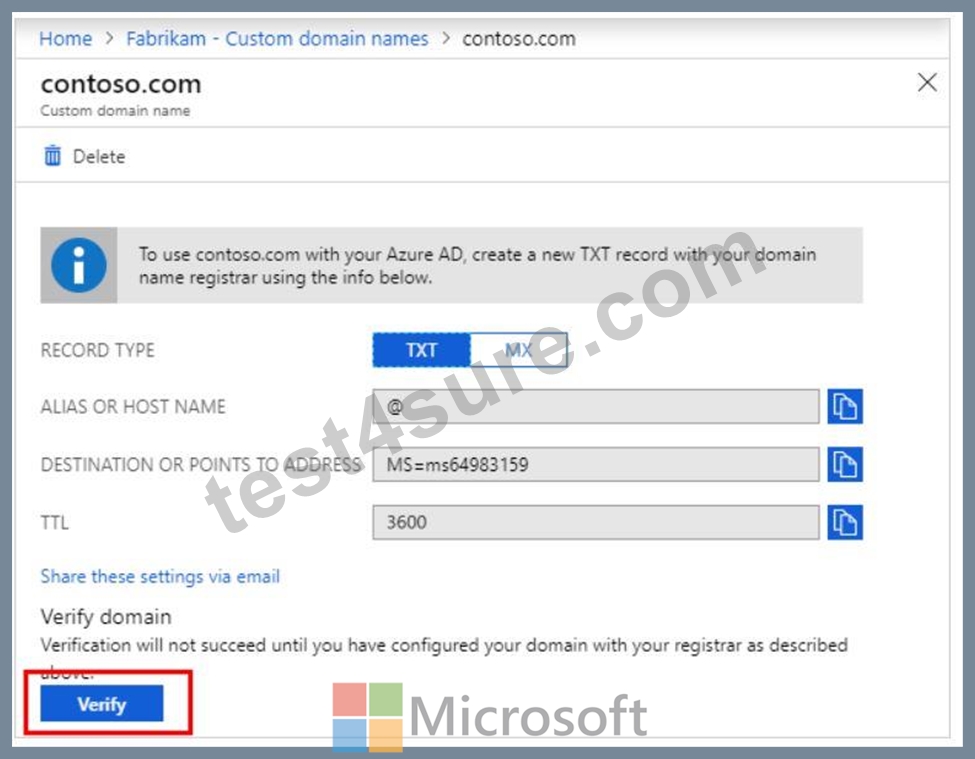
SRV : Incorrect
SRV records are used by various services to specify server locations. When specifying an SRV record in Azure DNS DNSKEY : Incorrect Choice This will verify that the records are originating from an authorized sender.
NSEC : Incorrect Choice
This is Part of DNSSEC. This is used for explicit denial-of-existence of a DNS record. It is used to prove a name does not exist.
Reference:
https://docs.microsoft.com/en-us/azure/dns/dns-web-sites-custom-domain
https://docs.microsoft.com/en-us/azure/active-directory/fundamentals/add-custom-domain#verify-your-custom-d
https://www.cloudflare.com/dns/dnssec/how-dnssec-works/#:~:text=DNSKEY%20%2D%20Contains%20a%20p
NEW QUESTION # 250
You have an Azure subscription named Subscription1 that contains the resources shown in the following table.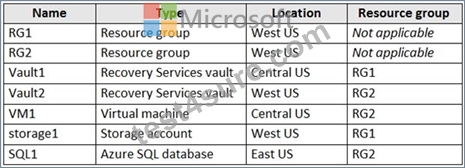
In storage1, you create a blob container named blob1 and a file share named share1.
Which resources can be backed up to Vault1 and Vault2? To answer, select the appropriate options in the answer area.
NOTE: Each correct selection is worth one point.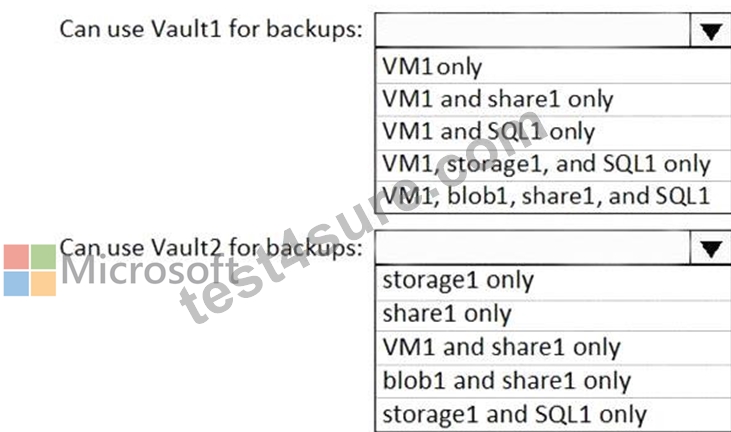
Answer:
Explanation: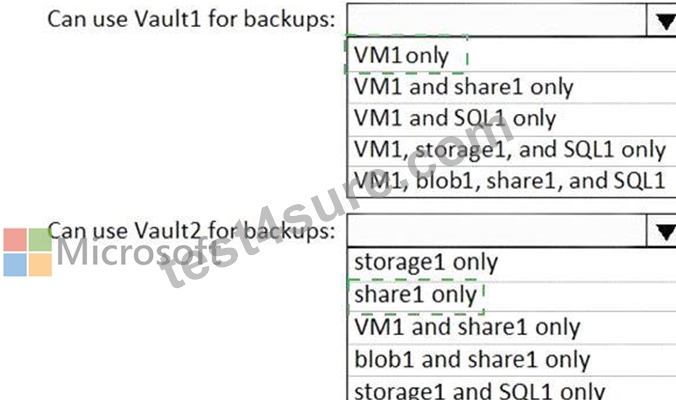
Explanation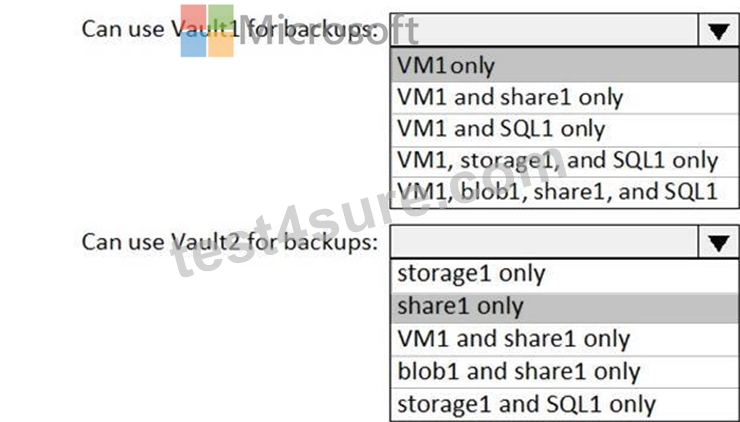
Box 1: VM1 only
VM1 is in the same region as Vault1.
File1 is not in the same region as Vautl1.
SQL is not in the same region as Vault1.
Blobs cannot be backup up to service vaults.
Note: To create a vault to protect virtual machines, the vault must be in the same region as the virtual machines.
Box 2: Share1 only.
Storage1 is in the same region (West USA) as Vault2. Share1 is in Storage1.
Note: After you select Backup, the Backup pane opens and prompts you to select a storage account from a list of discovered supported storage accounts. They're either associated with this vault or present in the same region as the vault, but not yet associated to any Recovery Services vault.
References:
https://docs.microsoft.com/bs-cyrl-ba/azure/backup/backup-create-rs-vault
https://docs.microsoft.com/en-us/azure/backup/backup-afs
NEW QUESTION # 251
You have an Azure subscription that contains the resources shown in the following table.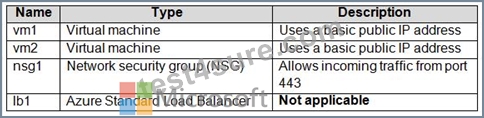
You need to load balance HTTPS connections to vm1 and vm2 by using lb1.
Which three actions should you perform in sequence? To answer, move the appropriate actions from the list of actions to the answer area and arrange them in the correct order.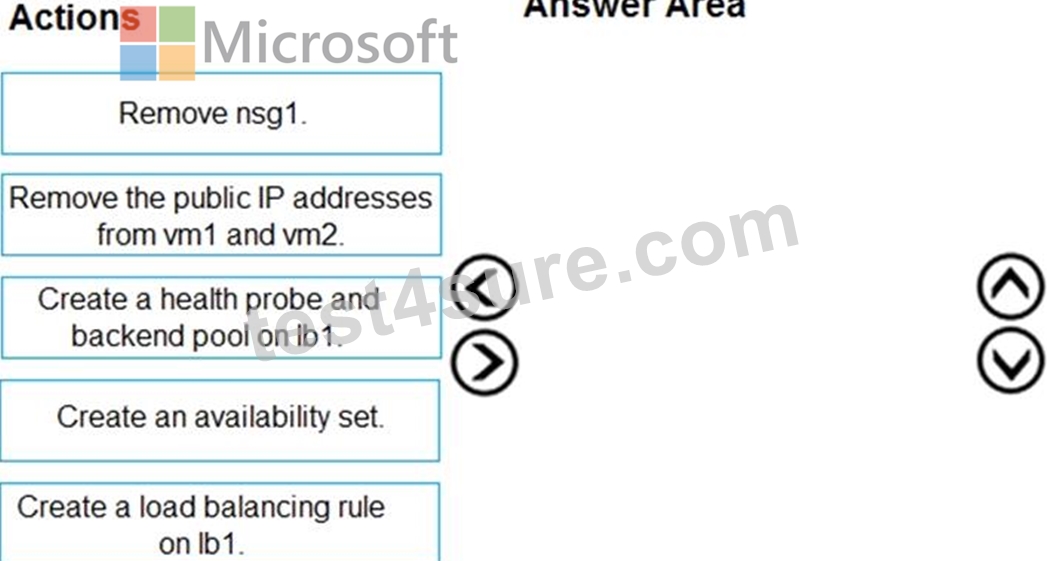
Answer:
Explanation: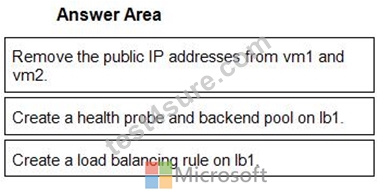
1 - Remove the public IP addresses from vm1 and vm2.
2 - Create a health probe and backend pool on lb1.
3 - Create a load balancing rule on lb1.
Reference:
https://docs.microsoft.com/en-us/azure/load-balancer/tutorial-load-balancer-standard-public-zone-redundant-portal
NEW QUESTION # 252
Hotspot Question
You have several Azure virtual machines on a virtual network named VNet1.
You configure an Azure Storage account as shown in the following exhibit.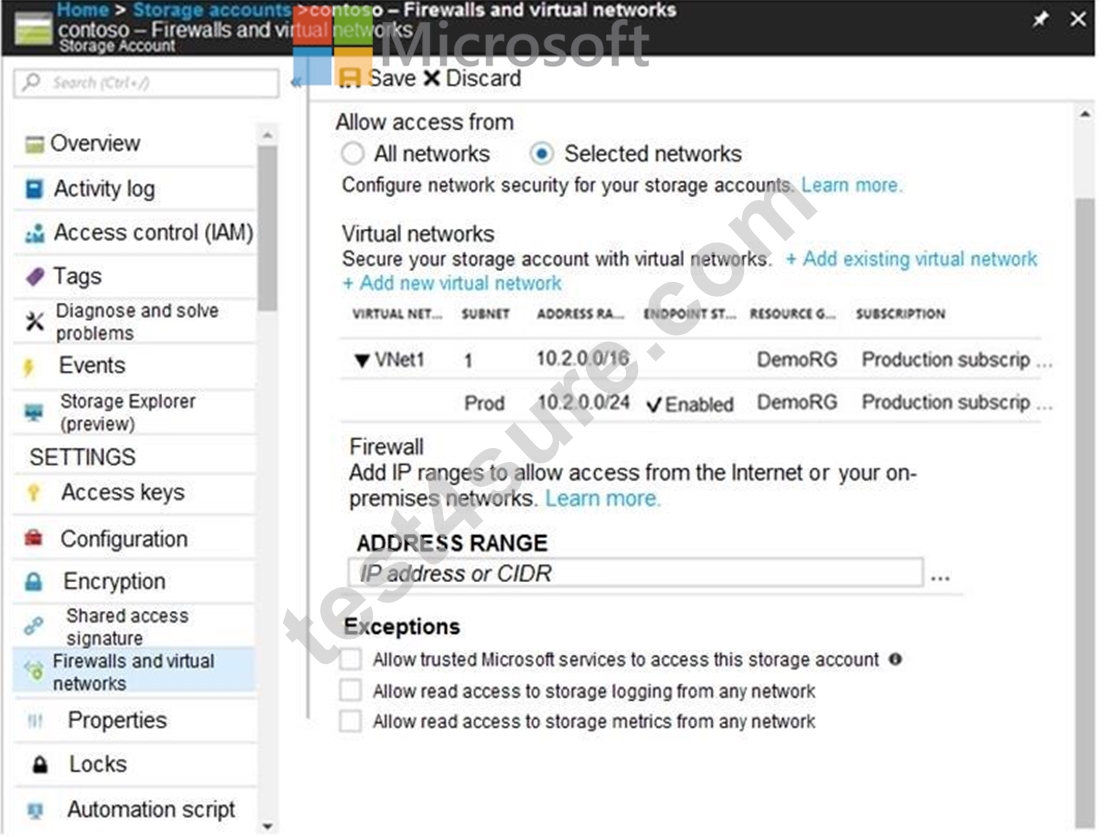
Use the drop-down menus to select the answer choice that completes each statement based on the information presented in the graphic.
NOTE: Each correct selection is worth one point.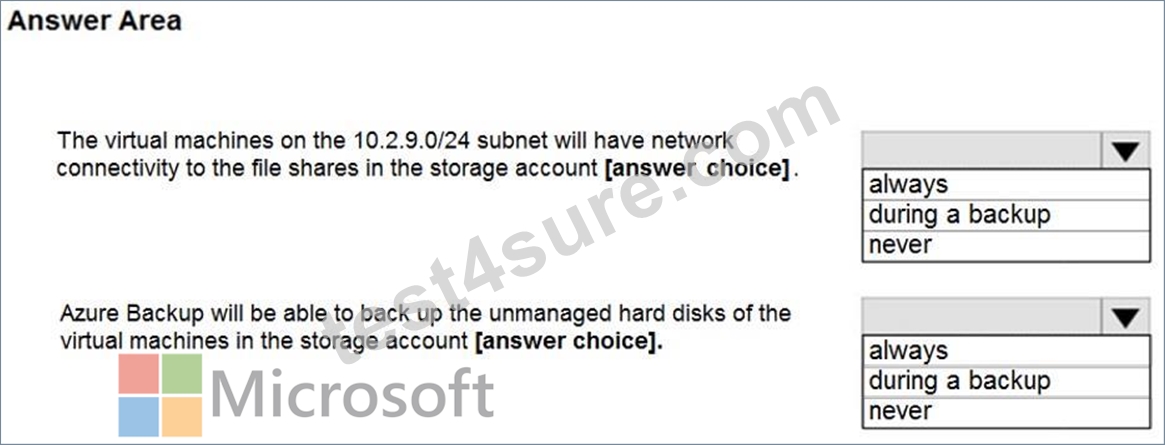
Answer:
Explanation: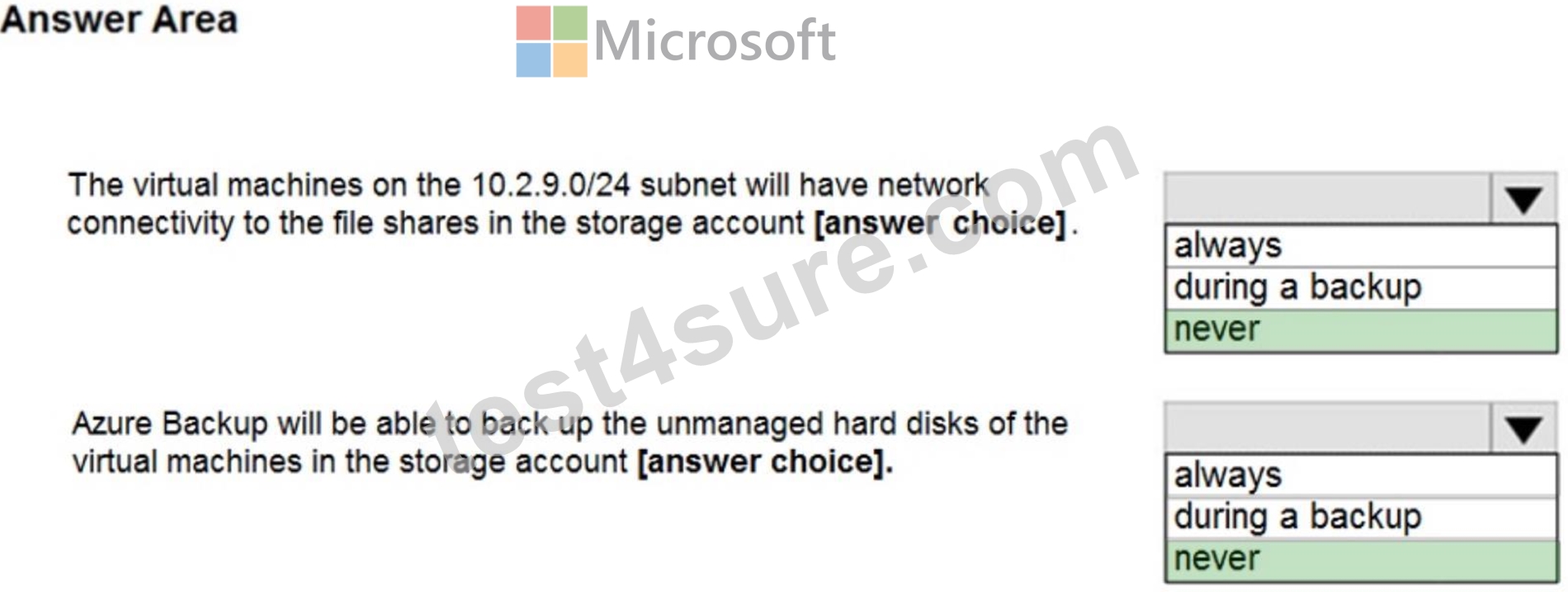
Explanation:
Box 1: Never
The 10.2.9.0/24 is part of the first subnet listed in the exhibit. The endpoint status is not enabled.
Box 2: Never
After you configure firewall and virtual network settings for your storage account, select Allow trusted Microsoft services to access this storage account as an exception to enable Azure Backup service to access the network restricted storage account.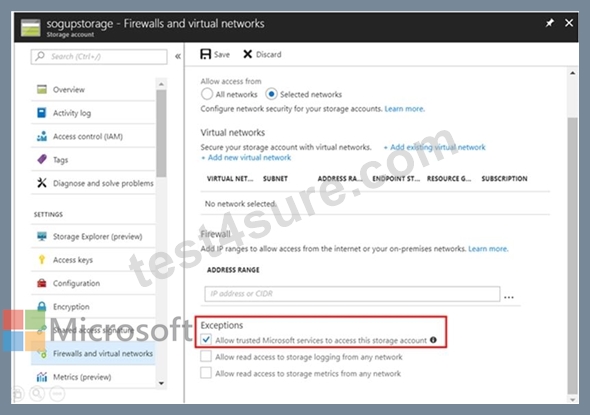
Reference:
https://docs.microsoft.com/en-us/azure/storage/files/storage-how-to-use-files-windows
https://azure.microsoft.com/en-us/blog/azure-backup-now-supports-storage-accounts-secured- with-azure-storage-firewalls-and-virtual-networks/
NEW QUESTION # 253
You have three Azure subscriptions named Sub1, Sub2, and Sub3 that are linked to an Azure AD tenant.
The tenant contains a user named User1, a security group named Group1, and a management group named MG1. User1 is a member of Group1.
Sub1 and Sub2 are members of MG1. Sub1 contains a resource group named RG1. RG1 contains five Azure functions.
You create the following role assignments for MG1:
* Group1: Reader
* User1: User Access Administrator
You assign User1 the Virtual Machine Contributor role for Sub1 and Sub2.
You assign User1 the Contributor role for RG1.
For each of the following statements, select Yes if the statement is true. Otherwise, select No.
NOTE: Each correct selection is worth one point.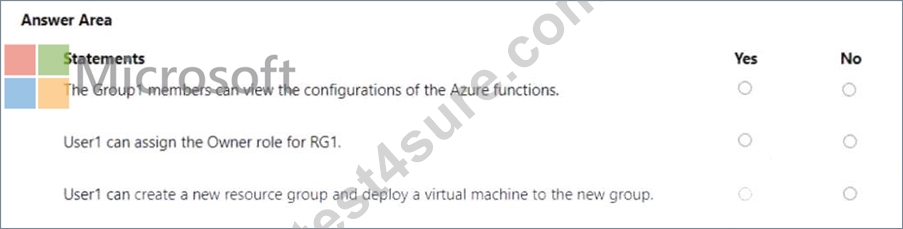
Answer:
Explanation: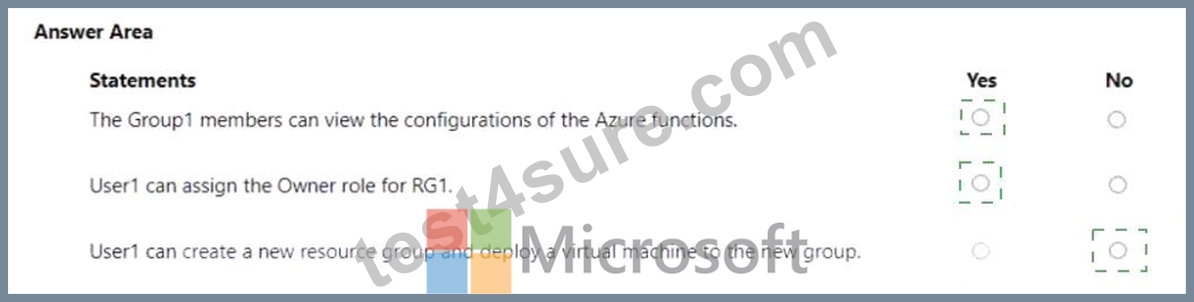
Explanation: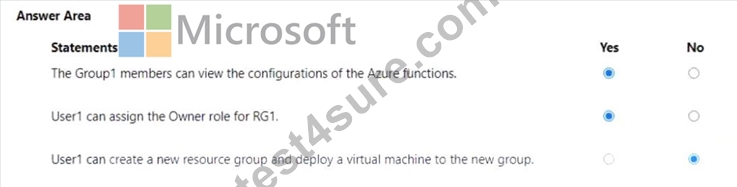
NEW QUESTION # 254
You need to create storage5. The solution must support the planned changes.
Which type of storage account should you use, and which account should you configure as the destination storage account? To answer, select the appropriate options in the answer area.
NOTE: Each correct selection is worth one point.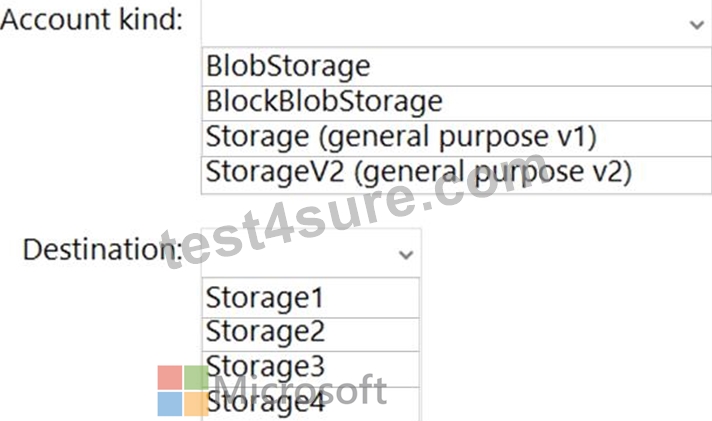
Answer:
Explanation: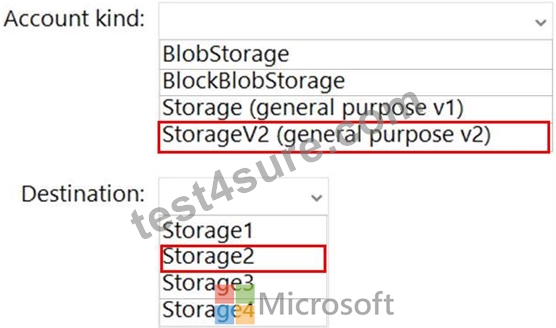
Reference:
https://docs.microsoft.com/en-us/azure/storage/blobs/object-replication-configure?tabs=portal
NEW QUESTION # 255
You have an Azure subscription that contains a storage account.
You have an on-premises server named Server1 that runs Window Server 2016. Server1 has 2 TB of data.
You need to transfer the data to the storage account by using the Azure Import/Export service.
In which order should you perform the actions? To answer, move all actions from the list of actions to the answer area and arrange them in the correct order.
NOTE: More than one order of answer choices is correct. You will receive credit for any of the correct orders you select.
Answer:
Explanation: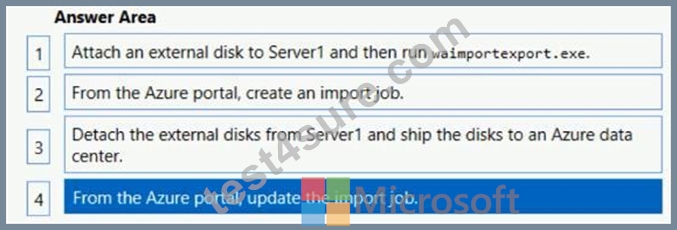
At a high level, an import job involves the following steps:
Step 1: Attach an external disk to Server1 and then run waimportexport.exe Determine data to be imported, number of drives you need, destination blob location for your data in Azure storage.
Use the WAImportExport tool to copy data to disk drives. Encrypt the disk drives with BitLocker.
Step 2: From the Azure portal, create an import job.
Create an import job in your target storage account in Azure portal. Upload the drive journal files.
Step 3: Detach the external disks from Server1 and ship the disks to an Azure data center.
Provide the return address and carrier account number for shipping the drives back to you.
Ship the disk drives to the shipping address provided during job creation.
Step 4: From the Azure portal, update the import job
Update the delivery tracking number in the import job details and submit the import job.
The drives are received and processed at the Azure data center.
The drives are shipped using your carrier account to the return address provided in the import job.
References:
https://docs.microsoft.com/en-us/azure/storage/common/storage-import-export-service
NEW QUESTION # 256
You have an Azure subscription.
You deploy a virtual machine scale set that is configured as shown in the following exhibit.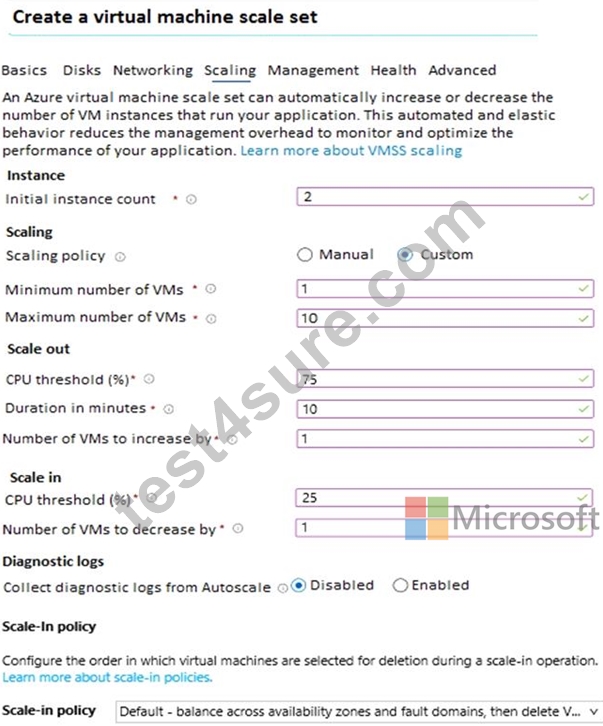
Use the drop-down menus to select the answer choice that answers each question based on the information presented in the graphic
NOTE: Each correct selection is worth one point.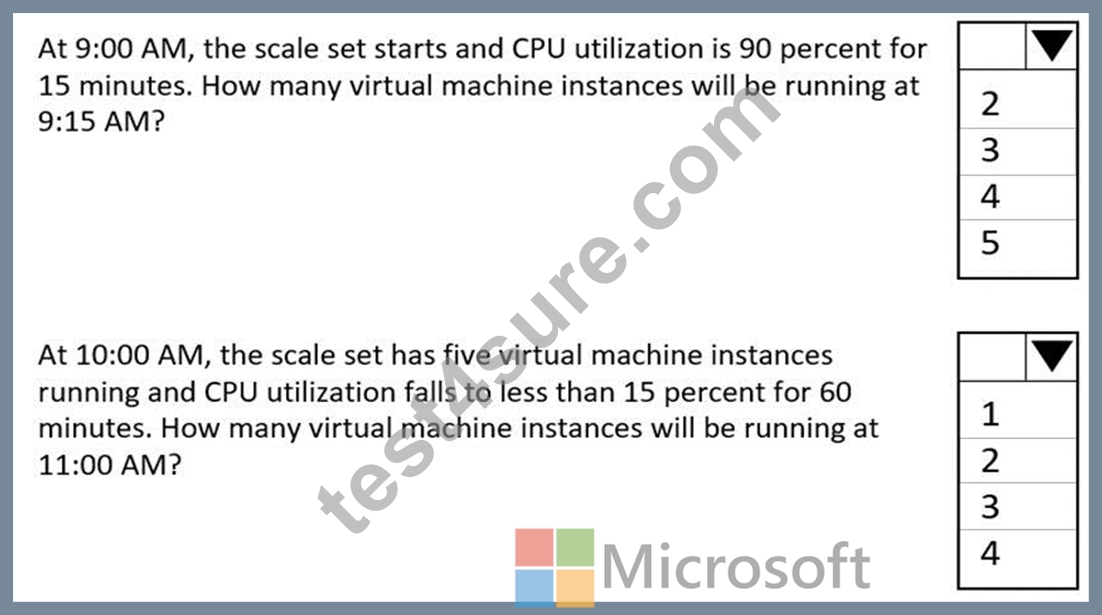
Answer:
Explanation: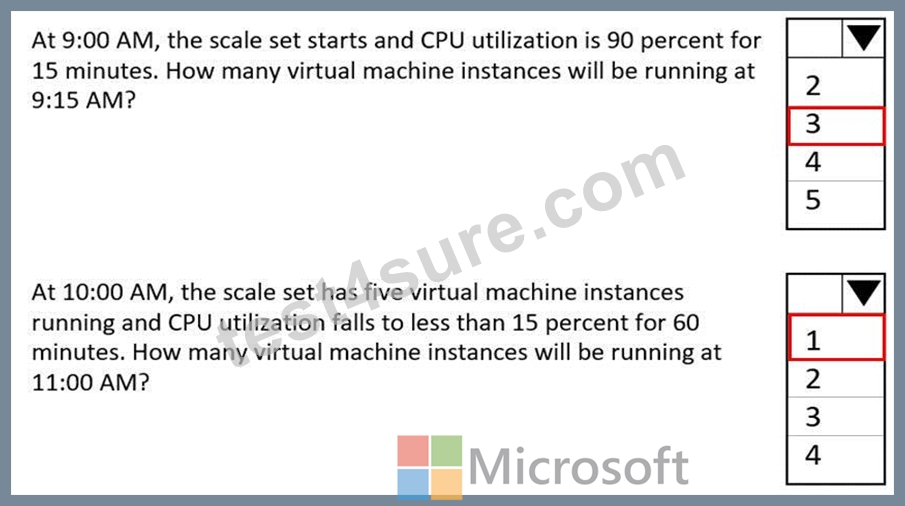
Reference:
https://docs.microsoft.com/en-us/azure/virtual-machine-scale-sets/virtual-machine-scale-sets-autoscale-portal
NEW QUESTION # 257
You have an Azure subscription named Subscription1 that contains an Azure Log Analytics workspace named Workspace1.
You need to view the error event from a table named Event.
Which query should you run in Workspace1?
- A. select * from Event where EventType == "error"
- B. Event | search "error"
- C. Event | where EventType is "error"
- D. Get-Event Event | where {$_.EventType == "error"}
Answer: B
Explanation:
Reference:
https://docs.microsoft.com/en-us/azure/azure-monitor/log-query/search-queries
https://docs.microsoft.com/en-us/azure/azure-monitor/log-query/get-started-portal
https://docs.microsoft.com/en-us/azure/data-explorer/kusto/query/searchoperator?pivots=azuredataexplorer
NEW QUESTION # 258
A company has the following virtual networks defined in Azure.
The following virtual machines have been defined as well:
Which of the following can be used by the security department to check for any network intrusions?
- A. IP Flow Verify
- B. Variable packet capture
- C. Application Insights
- D. Azure connection monitor
Answer: B
Explanation: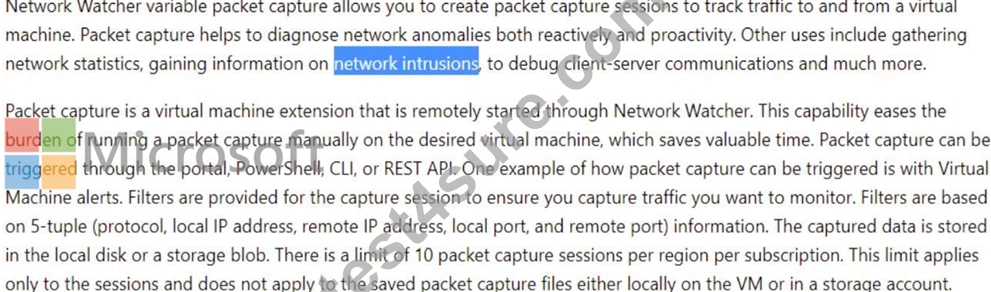
https://docs.microsoft.com/en-us/azure/network-watcher/network-watcher-packet-capture- overview
NEW QUESTION # 259
You have five Azure virtual machines that run Windows Server 2016. The virtual machines are configured as web servers. You have an Azure load balancer named LB1 that provides load balancing services for the virtual machines. You need to ensure that visitors are serviced by the same web server for each request. What should you configure?
- A. Session persistence to None
- B. Session persistence to Client IP protocol
- C. a health probe
- D. Floating IP (direct server return) to Disabled
Answer: B
NEW QUESTION # 260
You need to implement Role1.
Which command should you run before you create Role1? To answer, select the appropriate options in the answer area.
NOTE: Each correct selection is worth one point.
Answer:
Explanation: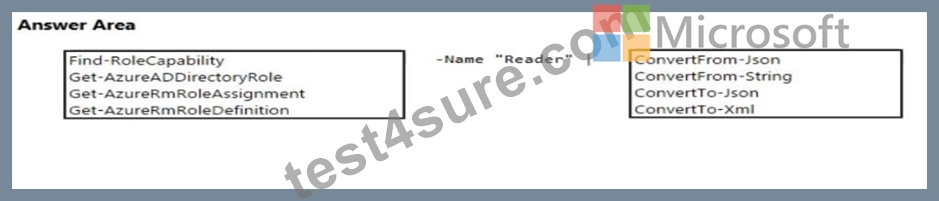
Explanation: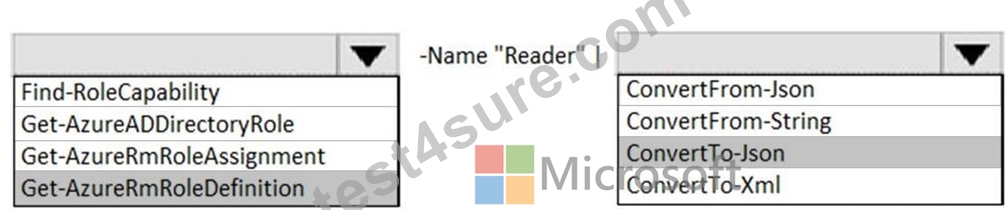
https://docs.microsoft.com/en-us/azure/role-based-access-control/tutorial-custom-role-powershell Get-AzRoleDefinition -Name "Reader" | ConvertTo-Json
https://docs.microsoft.com/en-us/powershell/module/az.resources/get-azroledefinition?view=azps-5.9.0
https://docs.microsoft.com/en-us/azure/role-based-access-control/tutorial-custom-role-powershell
https://docs.microsoft.com/en-us/powershell/module/microsoft.powershell.utility/convertto-json?
view=powershell-7.1
https://docs.microsoft.com/en-us/powershell/module/azuread/get-azureaddirectoryrole?view=azureadps-2.0
NEW QUESTION # 261
You deploy an Azure Kubernetes Service (AKS) cluster that has the network profile shown in the following exhibit.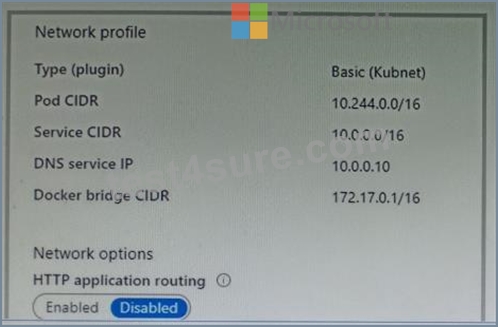
Use the drop-down menus to select the answer choice that completes each statement based on the information presented in the graphic. NOTE: Each correct selection is worth one point.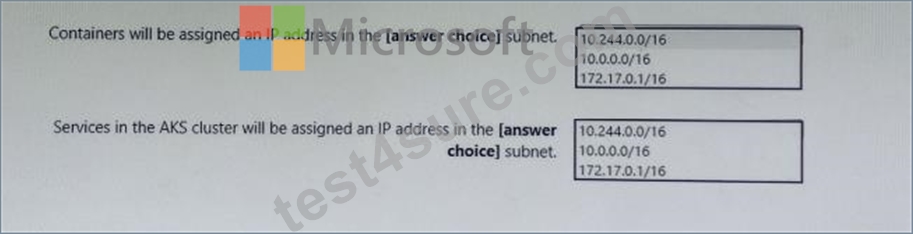
Answer:
Explanation: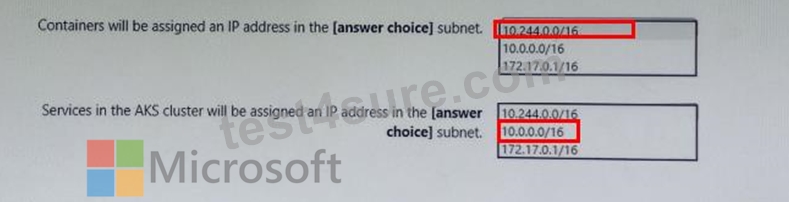
Reference:
https://docs.microsoft.com/en-us/azure/aks/configure-azure-cni
NEW QUESTION # 262
You are the global administrator for an Azure Active Directory (Azure AD) tenet named adatum.com.
You need to enable two-step verification for Azure users.
What should you do?
- A. Create and configure the Identity Hub.
- B. Enable Azure AD Privileged Identity Management.
- C. Create a sign-in risk policy in Azure AD Identity Protection
- D. Configure a security policy in Azure Security Center.
Answer: C
Explanation:
Identity Protection analyzes signals from each sign-in, both real-time and offline, and calculates a risk score based on the probability that the sign-in wasn't performed by the user. Administrators can make a decision based on this risk score signal to enforce organizational requirements. Administrators can choose to block access, allow access, or allow access but require multi-factor authentication.
If risk is detected, users can perform multi-factor authentication to self-remediate and close the risky sign-in event to prevent unnecessary noise for administrators.
With Azure Active Directory Identity Protection, you can:
* require users to register for multi-factor authentication
* handle risky sign-ins and compromised users
References:
https://docs.microsoft.com/en-us/azure/active-directory/identity-protection/flows
NEW QUESTION # 263
You have an Azure subscription named Subscription1. Subscription1 contains the resources in the following table.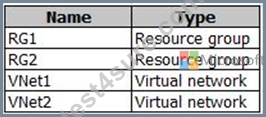
VNet1 is in RG1. VNet2 is in RG2. There is no connectivity between VNet1 and Vnet2.
An administrator named Admin1 creates an Azure virtual machine named VM1 in RG1. VM1 uses a disk named Disk1 and connects to VNet1. Admin1 then installs a custom application in VM1.
You need to move the custom application to Vnet2. The solution must minimize administrative effort.
Which two actions should you perform? To answer, select the appropriate options in the answer area.
NOTE: Each correct selection is worth one point.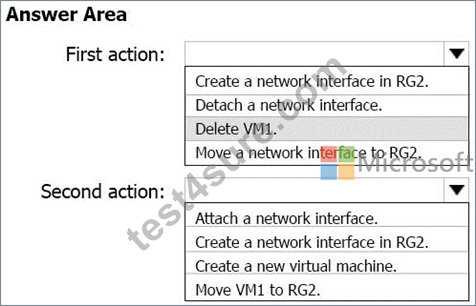
Answer:
Explanation: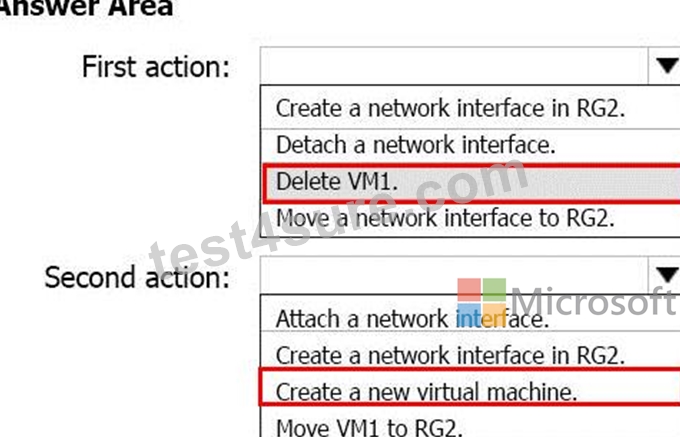
Explanation:
We cannot just move a virtual machine between networks. What we need to do is identify the disk used by the VM, delete the VM itself while retaining the disk, and recreate the VM in the target virtual network and then attach the original disk to it.
First action: Delete VM1
Second action: Create a new virtual machine
Reference:
https://docs.microsoft.com/en-us/archive/blogs/canitpro/step-by-step-move-a-vm-to-a-different-vnet-on-azure
https://4sysops.com/archives/move-an-azure-vm-to-another-virtual-network-vnet/#migrate-an-azure-vmbetween-vnets
NEW QUESTION # 264
You have an Azure subscription named Subscription1 that contains an Azure Log Analytics workspace named Workspace1.
You need to view the error event from a table named Event.
Which query should you run in Workspace1?
- A. select * from Event where EventType == "error"
- B. Event | search "error"
- C. Event | where EventType is "error"
- D. Get-Event Event | where {$_.EventType == "error"}
Answer: B
Explanation:
Section: [none]
Explanation:
The search operator provides a multi-table/multi-column search experience.
The syntax is:
Table_name | search "search term"
Note:
There are several versions of this question in the exam. The question has three possible correct answers:
1. search in (Event) "error"
2. Event | search "error"
3. Event | where EventType == "error"
Other incorrect answer options you may see on the exam include the following:
1. Get-Event Event | where {$_.EventTye -eq "error"}
2. select * from Event where EventType is "error"
3. search in (Event) * | where EventType -eq "error"
Reference:
https://docs.microsoft.com/en-us/azure/azure-monitor/log-query/search-queries
https://docs.microsoft.com/en-us/azure/azure-monitor/log-query/get-started-portal
https://docs.microsoft.com/en-us/azure/data-explorer/kusto/query/searchoperator?pivots=azuredataexplorer
NEW QUESTION # 265
You download an Azure Resource Manager template based on an existing virtual machine. The template will be used to deploy 100 virtual machines.
You need to modify the template to reference an administrative password. You must prevent the password from being stored in plain text.
What should you create to store the password?
- A. an Azure Key Vault and an access policy
- B. a Recovery Services vault and a backup policy
- C. an Azure Storage account and an access policy
- D. Azure Active Directory (AD) Identity Protection and an Azure policy
Answer: A
Explanation:
You can use a template that allows you to deploy a simple Windows VM by retrieving the password that is stored in a Key Vault. Therefore the password is never put in plain text in the template parameter file.
NEW QUESTION # 266
You have an Azure subscription that contains a virtual machine named VM1. VM1 hosts a line-of-business application that is available 24 hours a day. VM1 has one network interface and one managed disk. VM1 uses the D4s v3 size.
You plan to make the following changes to VM1:
Change the size to D8s v3.
Add a 500-GB managed disk.
Add the Puppet Agent extension.
Attach an additional network interface.
Which change will cause downtime for VM1?
- A. Add the Puppet Agent extension.
- B. Add a 500-GB managed disk.
- C. Change the size to D8s v3.
- D. Attach an additional network interface.
Answer: C
Explanation:
While resizing the VM it must be in a stopped state.
NEW QUESTION # 267
You have an Azure subscription that uses Azure Container Instances.
You have a computer that has Azure Command-Line Interface (CLI) and Docker installed.
You create a container image named image1.
You need to provision a new Azure container registry and add image1 to the registry.
Which command should you run for each requirement? To answer, select the options in the answer area NOTE: Each correct answer is worth one point.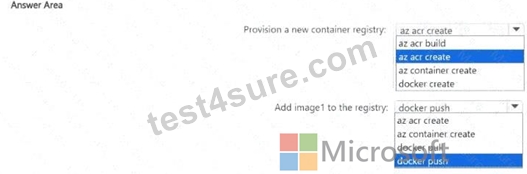
Answer:
Explanation: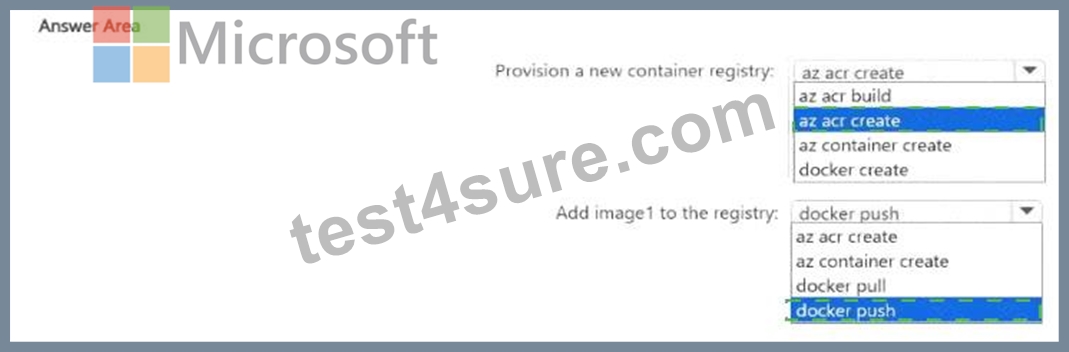
Explanation:
This scenario requires two distinct tasks related to Azure Container Registry (ACR): creating the registry itself and uploading a container image into it. Microsoft Azure Administrator documentation clearly separates these responsibilities between Azure CLI and Docker CLI.
To provision a new Azure Container Registry, Microsoft documentation states that administrators must use the Azure CLI az acr create command. This command creates a private, managed Docker registry in Azure that can store and manage container images. The az acr create command defines the registry name, resource group, and pricing tier (Basic, Standard, or Premium). It is the only supported CLI command used to create an ACR resource. Commands such as az acr build, az container create, or docker create do not create a registry and therefore do not meet the requirement.
Once the registry exists, the container image must be uploaded to it. According to the Microsoft Azure Container Registry documentation, images are uploaded using standard Docker commands. After authenticating to the registry and tagging the image with the registry's login server name, the image is transferred using the docker push command. Microsoft explicitly states that Azure CLI does not upload local images directly to ACR; instead, Docker is responsible for pushing images.
The documented workflow is:
* Create the registry using az acr create.
* Authenticate Docker to the registry.
* Tag the image with the registry address.
* Upload the image using docker push.
Therefore, the only commands that correctly satisfy the requirements are:
* az acr create to provision the registry
* docker push to add image1 to the registry
Final Verified Answer:
* Provision a new container registry: az acr create
* Add image1 to the registry: docker push
NEW QUESTION # 268
You have a sync group named Sync1 that has a cloud endpoint. The cloud endpoint includes a file named File1.txt.
You on-premises network contains servers that run Windows Server 2016. The servers are configured as shown in the following table.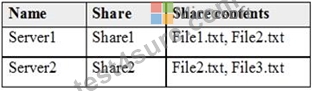
You add Share1 as an endpoint for Sync1. One hour later, you add Share2 as an endpoint for Sync1.
For each of the following statements, select Yes if the statement is true. Otherwise, select No.
NOTE: Each correct selection is worth one point.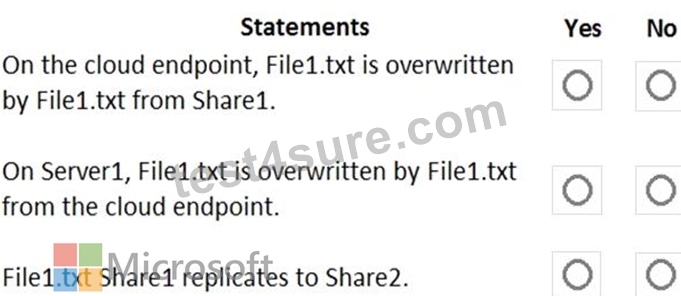
Answer:
Explanation: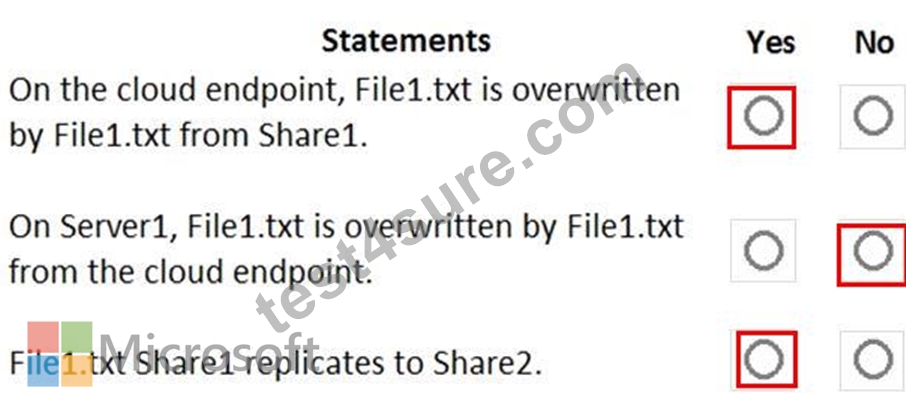
Reference:
https://docs.microsoft.com/en-us/azure/storage/files/storage-sync-files-planning
http://techgenix.com/azure-file-sync-replicating-data/
NEW QUESTION # 269
......
Free AZ-104 Exam Files Downloaded Instantly: https://www.test4sure.com/AZ-104-pass4sure-vce.html
Verified & Latest AZ-104 Dump Q&As with Correct Answers: https://drive.google.com/open?id=1WA-1XSKLsCwCIQJDxEPoj9RgH5V1GFYg