

[Jan-2026] Dumps Brief Outline Of The 201 Exam - Test4Sure
201 Training & Certification Get Latest F5 Networks Certification Study Materials
F5 201 Exam consists of 80 multiple-choice questions and has a time limit of 90 minutes. The questions are designed to test the candidate's knowledge of BIG-IP system architecture, networking, security, and application delivery. 201 exam is administered by Pearson VUE and can be taken at any of their authorized testing centers worldwide.
NEW QUESTION # 56
Refer to the exhibit.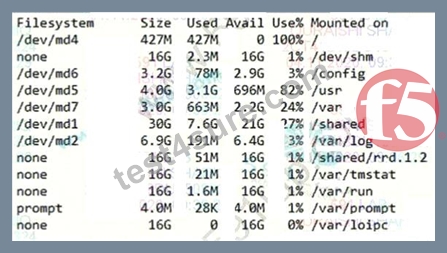
The BIG-IP Administrator is investigating disk utilization on the BIG-IP device.
What should the BIG-IP Administrator check next?
- A. Results from the platform diagnostics test
- B. Results from the EUD test
- C. Large files on /usr file system
- D. Large files on the / file system
Answer: D
NEW QUESTION # 57
A BIG-IP Administrator must configure the BIG-IP device to send system log messages to a remote syslog server In addition, the log messages need to be sent over TCP for guaranteed delivery. What should the BIG-IP Administrator configure?
- A. HSL Logging
- B. Remote Logging
- C. syslog-ng
- D. Request Logging Profile
Answer: B
NEW QUESTION # 58
A BIG-IP Administrator is creating a new Trunk on the BIG-IP device. What objects should be added to the new Trunk being created?
- A. Interfaces
- B. IP addresses
- C. VLANS
- D. Network routes
Answer: A
Explanation:
trunk is a portchannel, you need to add a physical interface.
NEW QUESTION # 59
DNS queries from two internal DNS servers are being load balanced to external DNS Servers via a Virtual Server on a BIG-P device. The DNS queries originate from 192.168.101.100 and 192.168.101.200 and target 192.168.21.50 All DNS queries destined for the external DNS Servers fail Which property change should the BIG-IP Administrator make in the Virtual Server to resolve this issue?
- A. Protocol to UDP
- B. Source Address to 192.168.101.0/24
- C. Protocol Profile (Client) to DNS-OPTIMZED
- D. Type to Performance (HTTP)
Answer: A
NEW QUESTION # 60
A BIG-IP Administrator creates an HTTP Virtual Server using an iApp template. After the Virtual Server is created, the user requests to change the destination IP addresses. The BIG-IP Administrator tries to change the destination IP address from 10.1.1.1 to 10.2.1.1 in Virtual Server settings, but receives the following error:
The application service must be updated using an application management interface What is causing this error?
- A. The Application Services have Strict Updates enabled.
- B. The IP addresses are already in use.
- C. The Application Service was NOT deleted before making the IP address change.
- D. The IP addresses used are NOT from the same subnet as the Self IP.
Answer: A
Explanation:
Strict Updates : Indicates whether the application service is tied to the template, so when the template is updated, the application service changes to reflect the updates.
NEW QUESTION # 61
A BIG-IP Administrator configures remote authentication and needs to make sure that users can still login even when the remote authentication server is unavailable.
Which action should the BIG-IP Administrators in the remote authentication configuration to meet this requirement?
- A. Configure a remote role grove
- B. Configure a second remote user directory
- C. Enable the Fallback to Local option
- D. Set partition access to "All"
Answer: C
NEW QUESTION # 62
A custom HTTP monitor is failing to a pool member 10.10.3.75:8080 that serves up www.example.com.
A ping works to the pool member address.
The SEND string that the monitor is using is: GET/HTTP/l.l/r/n/Host.www.example.com/r/n/Connection Close/r/n/r/n Which CLI tool syntax will show that the web server returns the correct HTTP response?
- A. curlhttp://10.10.10.3.75:8080/www.example.com/index.html
- B. curl-header 'Host:www.example.com' http://10.10.3.75:8080/
- C. tracepath 10.10.3.75:8080 GET /index
- D. tracepath 'http://www.example.com:80
Answer: B
NEW QUESTION # 63
Which two statements are true concerning the default communication between a redundant pair of BIG-IP systems? (Choose two.)
- A. Connection mirroring data is shared through the serial fail over cable unless network failover is enabled.
- B. Persistence mirroring data is shared via a TCP connection using port 1028.
- C. Connection mirroring data is shared via a TCP connection using port 1028.
- D. Synchronization occurs via a TCP connection using ports 683 and 684.
Answer: B,C
NEW QUESTION # 64
Where is persistence mirroring configured.
- A. It is part of a virtual server definition.
- B. It is part of a pool definition.
- C. It is part of a profile definition.
- D. It is always enabled.
Answer: C
NEW QUESTION # 65
Refer to the exhibit.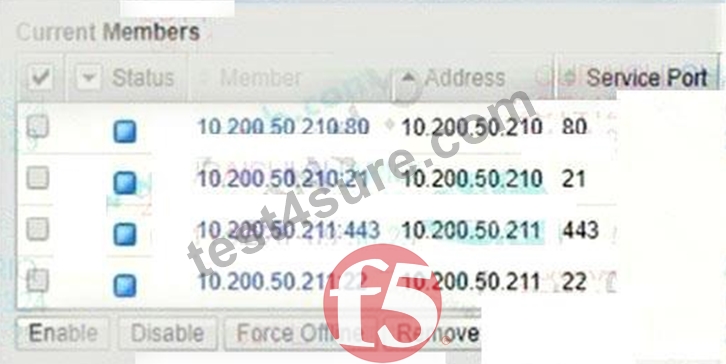
A BIG-IP Administrator needs to configure health monitors for a newly configured server pool named Pool_B.
Which health monitor settings will ensure that all pool members will be accurately marked as available or unavailable?
- A. HTTPS, HTTP, FTP, and SSH with the Availability Requirement of all health monitors
- B. HTTPS and HTTP with the Availability Requirement of at least one health monitor
- C. HTTPS, HTTP, FTP, and SSH, with the Availability Requirement of at least one monitor
- D. HTTPS, HTTP, FTP, and ICMP, with the Availability Requirement of all health monitors
Answer: C
Explanation:
Explanation
From the port, the four members are HTTP, FTP, HTTPS, and SSH applications. If you want to monitor at the same time, you must configure at least one.
NEW QUESTION # 66
The BIG-IP Administrator needs to perform a BIG-IP device upgrade to the latest version of TMOS. Where can the administrator obtain F5 documentation on upgrade requirements?
- A. DevCentral
- B. iHealth
- C. Bug Tracker
- D. AskF5
Answer: D
NEW QUESTION # 67
Users are unable to reach an application. The BIG-IP Administrator checks the Configuration Utility and observes that the Virtual Server has a red diamond in front of the status. What is causing this issue?
- A. All pool members have been disabled.
- B. The Virtual Server is receiving HTTPS traffic over HTTP virtual.
- C. The Virtual Server is disabled.
- D. All pool members are down.
Answer: D
NEW QUESTION # 68
A node is a member of various pools and hosts different web applications. If a web application is unavailable, the BIG-IP appliance needs to mark the pool member down for that application pool. What should a BIG-IP Administrator deploy at the pool level to accomplish this?
- A. An HTTP monitor with custom send/receive strings
- B. A UDP monitor with a custom interval/timeout
- C. A TCP monitor with a custom interval/timeout
- D. A combination of ICMP + TCP monitor
Answer: A
Explanation:
Requiring all traffic to be HTTPS access requires HTTP requests to be redirected directly to HTTPS.
NEW QUESTION # 69
A set of servers is used for an FTP application as well as an HTTP website via separate BIG-IP Pools. The server support team reports that some servers are receiving a lot more traffic than others.
Which Load Balancing Method should the BIG-IP Administrator apply to even out the connection count?
- A. Least Connections (Member)
- B. Ratio (Node)
- C. Ratio (Member)
- D. Least Connections (Node)
Answer: D
Explanation:
Explanation
The connection is required to be balanced, and the unit is the server and the application port is the unit, so it is node.
NEW QUESTION # 70
The 8IG-IP Administrator generates a qkview using "qkview -SO" and needs to transfer the output file via SCP.
Which directory contains the output file?
- A. /var/config
- B. /var/local
- C. /var/log
- D. /var/tmp
Answer: D
NEW QUESTION # 71
A BIG-IP Administrator uses a device group to share the workload and needs to perform service on a BIG-IP device currently active for a traffic group. The administrator needs to enable the traffic group to run on another BIG-IP device in the device group. What should the administrator do to meet the requirement?
- A. Select Traffic Group on Primary Unit and then select Demote
- B. Select Traffic Group and then select Failover
- C. Create a new Traffic Group and then fail to Standby Unit
- D. Select Traffic Group and then select Force to Standby
Answer: D
NEW QUESTION # 72
A virtual server is listening at 10.10.1.100:80 and has the following
iRule associated with it: when HTTP_REQUEST { if { [HTTP::header UserElAgent] contains "MSIE" } { pool MSIE_pool } else { pool Mozilla_pool } If a user connects to http://10.10.1.100/foo.html and their browser does not specify a UserElAgent, which pool will receive the request.
- A. None. The request will be dropped.
- B. MSIE_pool
- C. Unknown. The pool cannot be determined from the information provided.
- D. Mozilla_pool
Answer: D
NEW QUESTION # 73
A site wishes to perform source address translation on packets arriving from the Internet for clients using some pools but not others. The determination is not based on the client's IP address, but on the pool they are load balanced to. What could best accomplish this goal.
- A. The decision to perform source address translation is always based on VLAN. Thus, the goal cannot be achieved.
- B. A SNAT for all addresses could
be defined,
and then disable the SNAT processing for select pools. - C. The decision to perform source address translation is always based on a client's address (or network). Thus, this goal cannot be achieved.
- D. For each virtual server, regardless their default load balancing pools, association with SNAT pools could vary dependent upon need.
Answer: B
NEW QUESTION # 74
Which statement accurately describes the difference between two loadbalancing modes specified as "member" and "node"?
- A. When the loadbalancing choice references "node", priority group activation is unavailable.
- B. Loadbalancing options referencing "nodes" are available only when the pool members are defined for the "any" port.
- C. There is no difference; the two terms are referenced for backward compatibility purposes.
- D. When the loadbalancing choice references "node", the addresses' parameters are used to make the loadbalancing choice rather than the member's parameters.
Answer: A
NEW QUESTION # 75
A BIG-IP Administrator need to ensure that a pool member and down by the monitor the BIG-IP system sends existing connections to another be pool member.
Which should the BIG-IP Administrator perform to meet this goal?
- A. Reconfigure the pool motor members as UP.
- B. Set Action Service Down setting under the pool configuration to reselect.
- C. Enable mirroring within the persistence profile.
- D. Set Action on Service Down sing under the server configuration to reselect.
Answer: B
NEW QUESTION # 76
Which cookie persistence method requires the fewest configuration changes on the web servers to be implemented correctly?
- A. passive
- B. session
- C. insert
- D. rewrite
Answer: C
NEW QUESTION # 77
When can a single virtual server be associated with multiple profiles?
- A. Rarely. One combination, using both the TCP and HTTP profile does occur, but it is the exception.
- B. Never. Each virtual server has a maximum of one profile.
- C. Unlimited. Profiles can work together in any combination to ensure that all traffic types are supported in a given virtual server.
- D. Often. Profiles work on different layers and combining profiles is common.
Answer: D
NEW QUESTION # 78
......
To become certified as an F5 201 (BIG-IP Administrator), candidates must pass the certification exam. 201 exam is administered by F5 Networks, a leading provider of application delivery networking (ADN) technology. 201 exam consists of multiple-choice questions and is timed at two hours. Candidates must achieve a score of 69% or higher to pass the exam and earn certification.
Certification Training for 201 Exam Dumps Test Engine: https://www.test4sure.com/201-pass4sure-vce.html
F5 Networks Certification Study Materials 201 Real Exam Questions and Answers FREE Updated: https://drive.google.com/open?id=1VagPqOjh90FGiAi530-E1O_zucA8w5cf