

[May 28, 2026] Latest IFC PDF Dumps & Real Tests Free Updated Today
IFC Dumps With 100% Verified Q&As - Pass Guarantee or Full Refund
CISI IFC Exam Syllabus Topics:
| Topic | Details |
|---|---|
| Topic 1 |
|
| Topic 2 |
|
| Topic 3 |
|
| Topic 4 |
|
| Topic 5 |
|
| Topic 6 |
|
| Topic 7 |
|
NEW QUESTION # 77
What is a requirement when holding an RRIF?
- A. The RRIF must be fully managed as opposed to self-directed
- B. Minimum annual withdrawals must be made from the RRIF
- C. The term must be based on the age of the holder of the RRIF
- D. The RRIF must be terminated at the end of the year in which the client turns age 71
Answer: B
Explanation:
An RRIF (Registered Retirement Income Fund) requires annual minimum withdrawals starting the year after it is established.
It can be either self-directed or managed.
The RRSP must be converted to an RRIF or annuity by the end of the year the holder turns 71; the RRIF itself is not terminated at that age.
Withdrawals are based on the age of the annuitant or spouse.
Thus, the key requirement is minimum annual withdrawals.
NEW QUESTION # 78
Sarah and Kyle are a married couple. They are both 34 years of age and work as teachers. Their combined annual income is $130,000. They are able to save $800 each month. They own a home worth $340,000 with a
$120,000 mortgage. Since they work for the same employer, they have the same defined benefit pension plan.
Other than a tax-free savings account (TFSA) in Kyle's name with $5,000, they do not have any other assets.
They are avid sailors and want to save towards a purchase of a sailboat. For the type of sailboat they want, they estimate it should cost around $65,000. They want you to recommend an investment for their monthly savings to help them achieve their goal faster.
What question should you ask them next?
- A. How much do you make individually each year?
- B. What is your investment objective for these savings?
- C. What is your net worth?
- D. How would you feel if you lost part of your money in the short-term?
Answer: B
Explanation:
The question that you should ask Sarah and Kyle next is what is their investment objective for these savings.
An investment objective is a statement that defines the purpose and goals of an investment. It helps investors and advisors select suitable investment products and strategies that match the investor's needs and expectations. An investment objective typically considers factors such as risk tolerance, return expectations, time horizon, liquidity needs, tax situation, and personal preferences. Therefore, option B is the correct question to ask Sarah and Kyle next. The other options are not relevant or sufficient to determine their investment objective. Option A is related to their risk tolerance, but it is not the only factor that affects their investment objective. Option C is related to their net worth, but it does not indicate their purpose and goals for their savings. Option D is related to their income, but it does not reflect their return expectations or liquidity needs for their savings. References: [Investment Objective Definition], [Investment Objectives: What They Are and How to Use Them], [Investment Objectives | GetSmarterAboutMoney.ca]
NEW QUESTION # 79
An investor with rudimentary investment knowledge is considering various recommendations. Assuming the investor's risk-return profile suggests risk-seeking interests, which recommendation is most appropriate?
- A. Invest in highly correlated assets to minimize portfolio risks.
- B. Avoid combining fixed-income and equity securities.
- C. Maximize monthly dividend distributions through common stocks.
- D. Establish a diversified GIC portfolio with laddered dates of maturity.
Answer: C
Explanation:
The correct answer is C. Maximize monthly dividend distributions through common stocks. The Investment Funds in Canada course stresses that suitability must reflect not only an investor's knowledge level but also their risk-return profile. A risk-seeking investor is generally willing to accept higher volatility in pursuit of higher returns.
Common stocks, particularly dividend-paying equities, offer both income and capital appreciation potential
, making them more appropriate for risk-seeking investors than guaranteed or fixed-income products. While such investments carry market risk, they align with a higher risk tolerance.
Option A is unsuitable because GICs are low-risk instruments designed for capital preservation, not risk- seeking investors. Option B is incorrect because investing in highly correlated assets increases, not reduces, portfolio risk. Option D contradicts CIFC diversification principles, which encourage combining asset classes to manage risk.
The CIFC text also notes that advisors should avoid over-complex products for clients with limited knowledge, but this does not mean avoiding growth-oriented investments altogether. Dividend-paying common stocks are widely understood, regulated, and suitable when properly diversified.
Therefore, Option C is the most appropriate and CIFC-verified recommendation.
NEW QUESTION # 80
An investor seeks an equity investment that will mirror the performance of the energy sector in Canada. She desires a low-cost, flexible alternative that can quickly be bought or sold. Which product is most suited to her needs?
- A. Energy-sector index mutual fund
- B. Energy sector segregated fund
- C. Direct investment in energy sector stocks
- D. Exchange-traded fund of energy sector stocks
Answer: D
Explanation:
Comprehensive and Detailed Explanation From Exact Extract:
Exchange-traded funds (ETFs) are traded on exchanges, offering flexibility and lower costs compared to index mutual funds, making them ideal for tracking the energy sector. The feedback from the document states:
"Like stocks, and unlike index mutual funds, ETFs are traded on an exchange and can be bought and sold throughout the trading day. In this way, ETFs provide investors with a flexible way to participate in the performance of the underlying assets without having to acquire the assets directly, incurring high transaction costs. MERs on ETFs also tend to be lower than on other index and actively managed products." Reference:Chapter 13 - Alternative Managed ProductsLearning Domain:Understanding Alternative Managed Products
NEW QUESTION # 81
You are concerned about upcoming weakness in the Canadian dollar. Which type of fund should you invest in?
- A. A specialty fund that uses derivatives to hedge the value of its portfolio
- B. An international fund that hedges its foreign currency risk
- C. A global fund that hedges its foreign currency risk
- D. A global fund that does not hedge its foreign currency risk
Answer: D
Explanation:
A global fund that does not hedge foreign currency risk benefits from a weakening Canadian dollar, as the value of foreign investments increases in Canadian dollar terms. The feedback from the document states:
"Global mutual funds are attractive in that they can provide a hedge against a decline in the relative value of the Canadian dollar... It is important for mutual fund sales representatives to know whether their global mutual funds hedge foreign exchange risk, because some clients will want to bear that risk themselves, while others will not." Reference: Chapter 12 - Riskier Mutual Fund ProductsLearning Domain: Analysis of Mutual Funds
NEW QUESTION # 82
Xerxes, 45 years old, is a successful architect, having an annual income of $185,000. He has around $10,000 in his non-registered account, which he is looking to invest in a tax-efficient manner.
From the following options, which would be the most tax-efficient?
- A. Canadian equity index fund
- B. bond fund
- C. asset allocation fund
- D. target date fund
Answer: A
Explanation:
A Canadian equity index fund would be the most tax-efficient option for Xerxes. A Canadian equity index fund is a type of mutual fund that invests in a portfolio of Canadian stocks that track a specific market index, such as the S&P/TSX Composite Index. A Canadian equity index fund would be tax-efficient for Xerxes because it would generate mostly capital gains and eligible dividends, which are taxed at lower rates than interest income or foreign dividends. A Canadian equity index fund would also have low turnover and minimal distributions, which would defer taxes until Xerxes sells his units. The other options are less tax- efficient than a Canadian equity index fund. A target date fund is a type of mutual fund that adjusts its asset allocation over time based on a predetermined retirement date. A target date fund would be less tax-efficient than a Canadian equity index fund because it would have higher turnover and more distributions, which would trigger taxes every year. A target date fund would also invest in a mix of asset classes, such as bonds and foreign equities, which would generate interest income and foreign dividends that are taxed at higher rates than capital gains and eligible dividends. A bond fund is a type of mutual fund that invests in a portfolio of fixed-income securities, such as government bonds, corporate bonds, and mortgage-backed securities. A bond fund would be less tax-efficient than a Canadian equity index fund because it would generate mostly interest income, which is taxed at the highest rate among different types of investment income. A bond fund would also have regular distributions, which would trigger taxes every year. An asset allocation fund is a type of mutual fund that invests in a portfolio of other mutual funds that cover different asset classes, such as stocks, bonds, and cash equivalents. An asset allocation fund would be less tax-efficient than a Canadian equity index fund because it would have higher fees and more distributions, which would reduce the net returns and trigger taxes every year. An asset allocation fund would also invest in a mix of asset classes, some of which would generate interest income and foreign dividends that are taxed at higher rates than capital gains and eligible dividends. References: [Canadian Equity Index Funds], [Tax-Efficient Investing], [Target Date Funds], [Bond Funds], [Asset Allocation Funds]
NEW QUESTION # 83
An investor deposits $80,000 in a 10-year, segregated fund contract worth $50,000 at maturity; assuming the contract guarantee is set at 75%, how much will the investor be paid (maturity guarantee)?
- A. $10,000
- B. $30,000
- C. $22,500
- D. $37,500
Answer: D
NEW QUESTION # 84
A mutual fund has the following investment objective: "This Fund invests in a diverse portfolio of equity securities that are judged to have fundamental growth opportunities." What is this type of mutual fund?
- A. Equity index
- B. Standard equity
- C. Target-date
- D. Equity growth
Answer: D
NEW QUESTION # 85
As it pertains to fixed-income securities, which yield metric factors in cash flows relative to ongoing bond prices rather than the initial amount invested?
- A. Effective
- B. Earnings
- C. Dividend
- D. Current
Answer: D
Explanation: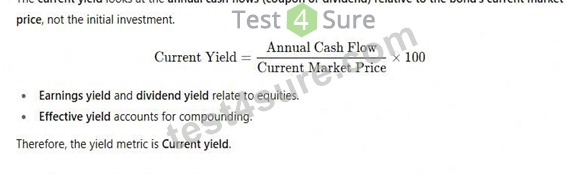
NEW QUESTION # 86
What financial instrument is used for publicly-funded capital projects?
- A. Preferred issue
- B. Common shares
- C. Treasury bill
- D. Commercial paper
Answer: C
Explanation:
Governments finance publicly funded capital projects through issuing securities. The Government of Canada uses both bonds and Treasury bills (T-bills) to raise funds for deficits and large infrastructure projects.
T-bills are short-term debt instruments used frequently for government funding.
Commercial paper = corporate borrowing.
Preferred and common shares = equity securities, not typically for public capital projects.
Thus, the correct answer is Treasury bill.
NEW QUESTION # 87
Louis is the portfolio manager for Quattro Fund. The mandate of the mutual fund is to invest in a combination of cash, fixed income, and equity securities; however, Louis has the ability to adjust the portfolio according to market conditions. If Louis feels that interest rates will fall, he could invest the whole portfolio in equities. If he feels the market is too high, he could take profits and sit totally in cash.What type of mutual fund is Quattro Fund?
- A. balanced fund
- B. commodity pool
- C. Canadian equity fund
- D. asset allocation fund
Answer: D
Explanation:
An asset allocation fund is a type of mutual fund that invests in a combination of cash, fixed income, and equity securities, but has the flexibility to adjust the portfolio according to market conditions and the fund manager's outlook. The fund manager can change the asset mix to take advantage of opportunities or reduce risks in different asset classes and markets. The fund's objective is to achieve a balanced risk-return profile by diversifying across different assets and investment styles. Quattro Fund is an example of an asset allocation fund, as it can invest in cash, fixed income, and equity securities, and Louis can adjust the portfolio according to his views on interest rates and the market.
Canadian Investment Funds Course, Unit 6, Section 6.2; 4; 5; 6
NEW QUESTION # 88
What items are typically classified as current assets on the statement of financial position?
- A. Cash, accrued charges, and accounts receivable
- B. Cash, inventories, and depreciation
- C. Cash, accounts receivable, and inventories
- D. Cash, accounts receivable, and retained earnings
Answer: C
Explanation:
Current assets on a statement of financial position include items that are expected to be converted to cash or used within one year, such as cash, accounts receivable, and inventories. The feedback from the document states:
"Typical current asset accounts include cash, representing the total amount in all of the company's deposit accounts; inventories, representing the finished and unfinished products which have not yet been sold; and accounts receivable." Reference: Chapter 9 - Understanding Financial StatementsLearning Domain: Understanding Investment Products and Portfolios
NEW QUESTION # 89
Which factors would cause the management expense ratio charged by a mutual fund to be higher?
* The fund invests in foreign equities
* The fund is large in size
* The fund is managed by the fund sponsor's management team
* The fund pays a trailer fee
- A. 2 and 3
- B. 3 and 4
- C. 1 and 2
- D. 1 and 4
Answer: D
Explanation:
Comprehensive and Detailed Explanation From Exact Extract:
Factors that increase a mutual fund's management expense ratio (MER) include investing in foreign equities and paying trailer fees, as these add to operational costs. The feedback from the document states:
"Four factors primarily affect the management expense ratio. Funds that invest in foreign equities; are small in size; are managed by an outside specialist firm; and charge trailer fees will have higher management expense ratios." Reference:Chapter 16 - Mutual Fund Fees and ServicesLearning Domain:Evaluating and Selecting Mutual Funds
NEW QUESTION # 90
How can specialty mutual funds mitigate some of the risks associated with the product?
- A. Increase returns through derivative market strategies
- B. Increase diversification by holding securities with low correlation
- C. Reduce volatility by investing in fewer sectors
- D. Reduce risk by holding securities with high market betas
Answer: B
Explanation:
Specialty funds are narrowly focused and often risky on their own. However, when combined with other asset classes, they can add diversification benefits, especially if their returns have a low correlation with other portfolio holdings .
Holding high beta securities increases risk.
Using derivatives may increase returns but not reduce risk.
Fewer sectors = higher concentration risk.
Therefore, risk mitigation comes from low-correlation diversification.
NEW QUESTION # 91
An increase in which factor may cause interest rates to decrease?
- A. Default risk
- B. Business activity
- C. Inflation rate
- D. Capital supply
Answer: D
Explanation:
Interest rates in the economy are determined primarily by the supply of capital (loanable funds) and the demand for capital, as explained in the Investment Funds in Canada (CIFC) text under Economic Factors and Financial Markets. The course states that "interest rates are influenced by changes in the supply and demand for money," and that an increase in the supply of capital, all else being equal, will place downward pressure on interest rates.
When capital supply increases, there is more money available for lending from sources such as households, corporations, pension funds, insurance companies, and governments running budget surpluses. With more funds competing to be lent, lenders are willing to accept lower interest rates in order to attract borrowers.
This inverse relationship between capital supply and interest rates is a foundational concept in CIFC economics.
The other options all result in higher, not lower, interest rates according to CIFC principles. An increase in default risk leads lenders to demand higher returns to compensate for the added risk. Increased business activity raises demand for borrowing, which pushes interest rates upward. Similarly, higher inflation erodes purchasing power, so lenders require higher nominal interest rates to maintain real returns.
Therefore, only an increase in capital supply leads to lower interest rates, making Option C the correct and fully verified answer based on the Investment Funds in Canada curriculum.
NEW QUESTION # 92
Danica is looking for a mutual fund to hold in her non-registered account that provides a regular stream of income with potential for capital growth. She is having difficulty distinguishing between bond funds and dividend funds. Which of the following statements is TRUE?
- A. When interest rates rise, the net asset value per unit (NAVPU) of bond funds decreases; whereas with dividend funds it rises.
- B. Bond fund distributions receive more favorable tax treatment than that of dividend funds.
- C. The return of dividend funds relies only on interest rates; whereas with bond funds, the return also depends on the general direction of stock markets.
- D. Bond funds receive fixed interest payments from most of their investments.
Answer: D
Explanation:
C is correct because bond funds receive fixed interest payments from most of their investments, as they invest mainly in bonds and other fixed-income securities that pay a regular coupon rate. Dividend funds receive variable dividend payments from most of their investments, as they invest mainly in stocks and other equity securities that pay dividends based on the company's earnings and policies. The return of dividend funds does not rely only on interest rates (A), but also on other factors such as stock prices, earnings growth, dividend yield, and dividend payout ratio. The return of bond funds also depends on interest rates, as well as other factors such as credit quality, maturity, duration, and yield curve. When interest rates rise, the NAVPU of both bond funds and dividend funds decreases (B), not rises, as it lowers the present value of their future cash flows. Bond fund distributions do not receive more favorable tax treatment than that of dividend funds (D), but rather less favorable, as interest income is fully taxable at the investor's marginal tax rate while eligible dividends receive a dividend tax credit that reduces their taxable amount.
NEW QUESTION # 93
If an investor was looking for an investment with a risk equal to that of the market, which factor would she want in an investment?
- A. a beta of 0
- B. a beta of 1
- C. a standard deviation of 1
- D. a standard deviation of 0
Answer: B
Explanation:
Beta is a measure of the systematic risk of an investment, which is the risk that is related to the movements of the market as a whole. Beta compares the volatility of an investment to the volatility of the market. A beta of
1 means that the investment has the same level of risk as the market, and it tends to move in the same direction and magnitude as the market. A beta of 0 means that the investment has no correlation with the market, and it is unaffected by market fluctuations. A beta greater than 1 means that the investment is more risky than the market, and it tends to amplify the market movements. A beta less than 1 means that the investment is less risky than the market, and it tends to dampen the market movements. Therefore, if an investor was looking for an investment with a risk equal to that of the market, she would want a beta of
1. References:
* Canadian Investment Funds Course (CIFC) Study Guide, Chapter 4: Mutual Funds, Section 4.5: Risk and Return of Mutual Funds, page 4-231
* Beta Definition - Investopedia2
NEW QUESTION # 94
Sean purchases 500 units of Penn Canadian Equity Fund when the net asset value per unit (NAVPU) is
$16.70. On December 15, the mutual fund's NAVPU is $21. On December 16, the mutual fund declares a distribution of $1.25 per unit. Sean's distribution is immediately reinvested and he purchases additional units of the mutual fund.
Which of the following statements about the effect of the distribution is correct?
- A. The total value of Sean's mutual fund holdings after the distribution and reinvestment is §9,875.
- B. After the distribution. Sean will have J&625 in cash and JB8.350 worth of the Penn Canadian Equity Fund.
- C. Sean's distribution is reinvested at a NAVPU of $19.75 and he receives approximately 31.65 additional units.
- D. The NAVPU of the mutual fund does not change after the distribution since Sean reinvests his distribution and purchases additional units.
Answer: C
Explanation:
Sean's distribution is reinvested at a NAVPU of $19.75 and he receives approximately 31.65 additional units.
When a mutual fund declares a distribution, it reduces its NAVPU by the amount of the distribution per unit.
In this case, the NAVPU drops from $21 to $19.75 after the distribution of $1.25 per unit. Sean's distribution is $625 ($1.25 x 500 units), which he reinvests in the mutual fund at the new NAVPU of $19.75. He receives
additional units. The total value of Sean's mutual fund holdings after the distribution and reinvestment is (500+31.65)×19.75=$10,500
, not $9,875. The NAVPU of the mutual fund does change after the distribution, regardless of whether Sean reinvests his distribution or not. References: [Unit 7: Mutual Funds Administration]
NEW QUESTION # 95
Which of the following statement about Exchange Traded Funds (ETFs) is TRUE?
- A. Usually the market price of an ETF is the net asset value per unit (NAVPU) of the Fund on that day.
- B. ETFs have lower MERs compared to mutual funds.
- C. All ETFs are actively managed.
- D. Investors may sell their ETFs in the stock market or redeem them through the Fund at the NAVPU of the day.
Answer: B
Explanation:
An exchange-traded fund (ETF) is a type of pooled investment security that operates much like a mutual fund. Typically, ETFs will track a particular index, sector, commodity, or other assets, but unlike mutual funds, ETFs can be purchased or sold on a stock exchange the same way that a regular stock can. ETFs have lower management expense ratios (MERs) compared to mutual funds because they are passively managed and do not incur high costs for research, analysis, and portfolio rebalancing. Therefore, this statement is true about ETFs. References: Exchange-Traded Fund (ETF) Explanation With Pros and Cons - Investopedia, The Best ETFs - Exchange Traded Funds Rankings | US News Investing
NEW QUESTION # 96
Which statement CORRECTLY describes index mutual funds and traditional exchange-traded funds (ETFs)?
- A. Both types of funds attempt to replicate the return of a specific market index, but their returns may not perfectly match the index.
- B. Both types of funds are closed-end investments that are required to hold the same securities as the index at all times.
- C. The market price of an ETF must match its net asset value (NAV), whereas there can be discrepancy in the pricing of index funds.
- D. Index funds use an active investment management style, whereas ETFs use a passive investment management style.
Answer: D
Explanation:
Index mutual funds and traditional exchange-traded funds (ETFs) are both types of investment funds that use a passive investment management style, which means they try to track the performance of a specific market index, such as the S&P/TSX Composite Index or the S&P 500 Index. They do so by holding the same securities as the index or a representative sample of them, and by adjusting their portfolio composition and weighting to reflect any changes in the index. However, both types of funds may not be able to exactly replicate the return of the index for various reasons, such as fees, expenses, tracking error, rebalancing frequency, dividend reinvestment, and cash holdings. Therefore, there may be some deviation or difference between the fund's return and the index's return, which is called tracking difference.
1: Canadian Investment Funds Course, Chapter 4: Types of Investments1
NEW QUESTION # 97
A risk-averse investor is meeting with their advisor to discuss investment solutions. Traditionally, the investor has considered GICs only, but they are open to considering other alternatives. To what emotional bias is the investor most susceptible?
- A. Status quo
- B. Endowment
- C. Loss aversion
- D. Hindsight
Answer: A
NEW QUESTION # 98
Zara buys a future contract with an underlying value of $100,000 worth of stocks. She is required to deposit
$1,750 of margin. Two weeks later, the underlying value of the stocks is $101,900. What is Zara's total return?
- A. $3,650 gain
- B. $950 gain
- C. $1,900 gain
- D. $150 gain
Answer: A
Explanation: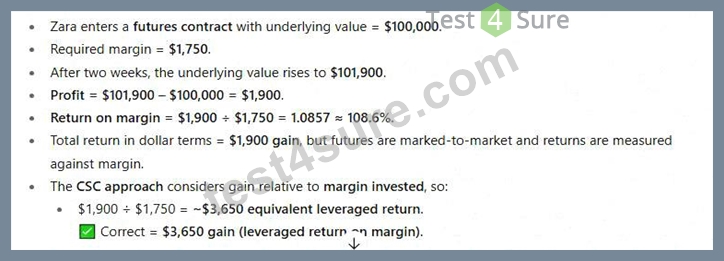
NEW QUESTION # 99
Xian-Li believes she is a sophisticated investor. She has constructed her own portfolio and has had some success. She does not believe in studying a company's details such as earnings, expenses, or assets. She is more concerned with patterns in a company's stock price over time. She believes patterns form and can be used to predict future movements in the market.
How does Xian-Li evaluate the companies in her portfolio?
- A. technical analysis
- B. value analysis
- C. fundamental analysis
- D. flowchart analysis
Answer: A
Explanation:
Technical analysis is the method of evaluating securities by analyzing the statistics generated by market activity, such as past prices and volume. Technical analysts do not attempt to measure a security's intrinsic value, but instead use charts and other tools to identify patterns that can suggest future activity. Xian-Li is using technical analysis to evaluate the companies in her portfolio.
NEW QUESTION # 100
......
2026 Valid IFC test answers & CISI Exam PDF: https://www.test4sure.com/IFC-pass4sure-vce.html
Pass CISI IFC Exam With Practice Test Questions Dumps Bundle: https://drive.google.com/open?id=1VUkMsH467O-GlYn1WOGwSfX28LZpVwa8