

New-Jersey-Real-Estate-Salesperson Exam Study Guide Free Practice Test LAST UPDATED DATE Mar 17, 2026
The New New-Jersey-Real-Estate-Salesperson 2026 Updated Verified Study Guides & Best Courses
NEW QUESTION # 39
A couple who sell their principal residence may take up to $500,000 in federal capital gains tax-free only if:
- A. they have owned and occupied the house for at least 2 of the previous 5 years.
- B. at least one of them has reached the age of 65.
- C. neither has ever used the Homesellers Exclusion in the past.
- D. they buy a replacement home of equal or greater value than the one being sold within a year.
Answer: A
Explanation:
Under IRS Section 121 Exclusion (Home Sale Exclusion Rule):
Married couples filing jointly can exclude up to $500,000 of capital gains.
They must have owned and occupied the property as their primary residence for 2 of the past 5 years.
Age 65 requirement is obsolete (repealed).
They don't need to reinvest in another home.
The exclusion can be used once every 2 years.
Correct answer = D.
Reference: Internal Revenue Code §121; NJ Real Estate Salesperson Study Guide, Chapter on Taxation.
NEW QUESTION # 40
A property was listed for $110,000. It sold for $106,000. A 6.5% fee was split equally between the listing and selling real estate firms. The listing licensee received 55% of the listing office share. How much did the listing licensee receive?
- A. $3,575.00
- B. $1,966.25
- C. $1,894.75
- D. $3,789.50
Answer: C
Explanation: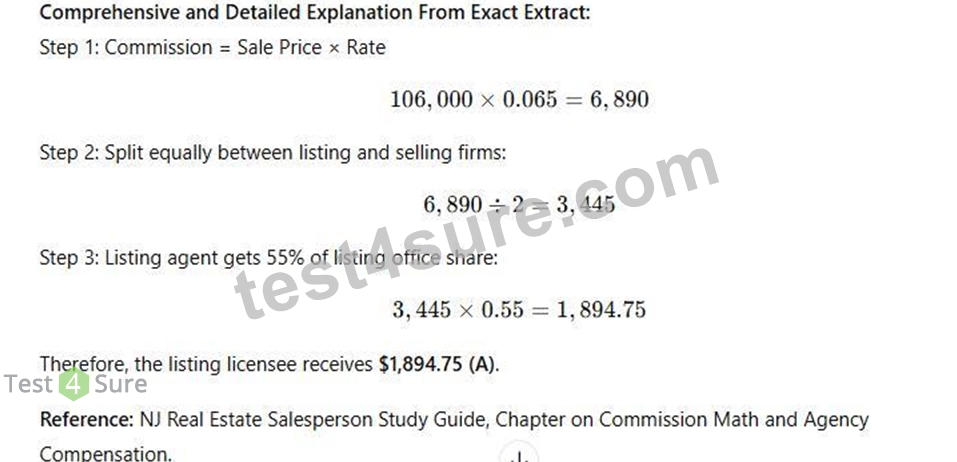
NEW QUESTION # 41
A licensee faxes a list of available properties to prospective buyers. Which of the following is true?
- A. The licensee must include only a phone number to reply.
- B. The fax must contain an opt-out provision for future communications.
- C. The licensee must mail an identical list to all parties.
- D. The licensee's company's name does not need to be listed.
Answer: B
Explanation:
Under the federal Telephone Consumer Protection Act (TCPA) and Junk Fax Prevention Act:
Any unsolicited fax must include a clear opt-out provision allowing the recipient to request no further communications.
The fax must also identify the sender, including company name.
There is no requirement to mail identical lists.
Correct answer = A.
Reference: Telephone Consumer Protection Act (TCPA); Junk Fax Prevention Act; NJ Real Estate Salesperson Study Guide, Chapter on Advertising Rules.
NEW QUESTION # 42
A real estate broker's maintained place of business MUST conspicuously display on the exterior the broker's name and the word(s):
- A. Licensed Realtor
- B. Licensed Real Estate Broker
- C. Realtor
- D. Real Estate Broker
Answer: B
Explanation:
According to N.J.A.C. 11:5-6.1, every broker's main office must have a sign on the exterior that is visible to the public. The sign must display the broker's name and the exact words "Licensed Real Estate Broker." This is a mandatory requirement to ensure public identification of licensed brokerage offices.
Using terms like "Realtor" is optional and only permitted if the broker is a member of the National Association of REALTORS, but the law specifically requires the words Licensed Real Estate Broker.
Reference: NJ Real Estate Commission Rules and Regulations, N.J.A.C. 11:5-6.1 (Office Requirements and Signage).
NEW QUESTION # 43
In surveying, monuments are used to establish:
- A. flood elevation
- B. a common address
- C. historical sites
- D. real estate boundaries
Answer: D
Explanation:
Monuments are fixed physical objects (iron pins, concrete markers, trees, rocks) used by surveyors to establish property boundaries in the metes-and-bounds system.
They do not establish addresses, flood elevations, or historical sites.
Correct answer = B.
Reference: NJ Real Estate Salesperson Study Guide, Chapter on Legal Descriptions and Surveys.
NEW QUESTION # 44
A national company desires a parcel of land which must be 4 times the size of its proposed building. If the building design includes 20,000 square feet, then which of the following minimum sized lots should be purchased?
- A. 4 acres
- B. 1 acre
- C. 8 acres
- D. 2 acres
Answer: C
Explanation: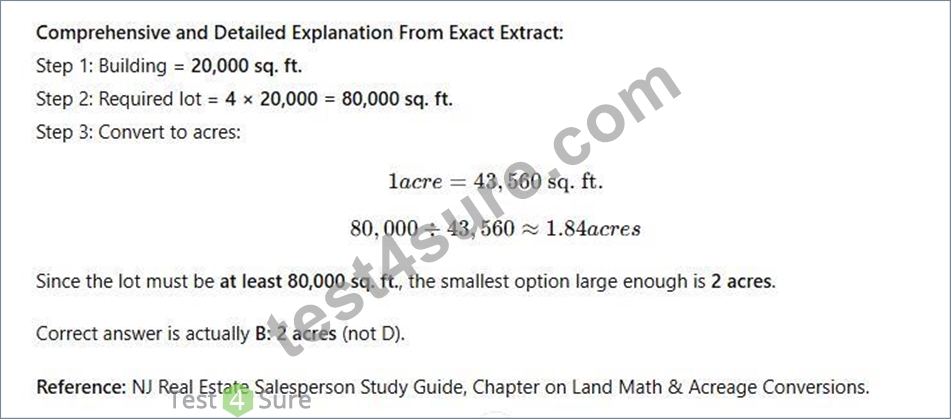
NEW QUESTION # 45
A seller sold a property for $375,000, with the closing on July 1st, in a jurisdiction where the buyer pays for the day of closing. The seller had a mortgage balance at the time of closing of $301,000, and had recently paid invoices of $400 for the second quarter's water and electricity, $1,200 for new appliances, and roofing repairs of $700. Based only on these items, how much will the seller receive at closing?
- A. $72,400
- B. $71,700
- C. $73,600
- D. $74,000
Answer: D
Explanation:
Sale price = $375,000
Mortgage payoff = $301,000
Seller prepaid invoices (utilities, appliances, roof) are already paid and not reimbursable through closing unless agreed. They do not affect the closing statement.
Buyer pays closing day (July 1), so no adjustment required for that day.
375
,
000
#
301
,
000
=
74
,
000
375,000#301,000=74,000
Thus, the seller's net proceeds = $74,000.
Reference: NJ Real Estate Salesperson Study Guide, Chapter on Closings and Settlement Statements.
NEW QUESTION # 46
A salesperson is convicted of a crime which involved activities as a real estate licensee. The Commission obtains a certified copy of the judgment of conviction against the salesperson. According to the New Jersey Real Estate License Law, the Commission MUST:
- A. determine, at its discretion, what disciplinary action to take against the salesperson
- B. notify the salesperson's employing broker of the circumstances pertaining to the conviction
- C. suspend the salesperson's license
- D. revoke the salesperson's license
Answer: A
Explanation:
Under N.J.S.A. 45:15-17, the New Jersey Real Estate Commission (NJREC) has discretionary authority to determine appropriate disciplinary action when a licensee is convicted of a crime related to their licensed activities.
The Commission may choose to suspend, revoke, or otherwise discipline the licensee depending on circumstances.
It is not automatic that the license must be revoked or suspended; the Commission evaluates the case.
Correct answer = C.
Reference: NJ Real Estate Licensing Law, N.J.S.A. 45:15-17; NJ Real Estate Salesperson Study Guide, Chapter on Disciplinary Actions.
NEW QUESTION # 47
According to the New Jersey Real Estate Time Share Act, if a licensee is selling a timeshare located within the state of New Jersey, all of the following are true EXCEPT that the:
- A. licensee must provide the buyer with a copy of the Public Offering Statement.
- B. timeshare must be approved by the Real Estate Commission.
- C. contract of sale must provide notice of a seven calendar day rescission period.
- D. licensee must hold a timeshare sales license.
Answer: D
Explanation:
Under the NJ Real Estate Time Share Act (N.J.S.A. 45:15-16.50 et seq.), timeshares sold in New Jersey must be registered with the NJ Real Estate Commission.
Buyers must be given a Public Offering Statement.
Buyers are entitled to a 7-calendar-day rescission period.
There is no separate "timeshare sales license" - a standard NJ real estate license is sufficient.
Thus, the false statement is A.
Reference: New Jersey Real Estate Time Share Act; NJ Real Estate Salesperson Study Guide, Chapter on Timeshares and Condominiums.
NEW QUESTION # 48
A buyer-broker locates a property that is listed with another broker. The buyer makes an offer through the buyer-broker and an agreement of sale results. In this situation, the buyer-broker is acting as a:
- A. representative of the buyer and owes no fiduciary obligations to the seller
- B. referring broker with the listing broker
- C. subagent of the listing broker
- D. representative of the seller and owes no fiduciary obligations to the buyer
Answer: A
Explanation:
In a buyer agency relationship, the buyer-broker owes fiduciary duties solely to the buyer.
The buyer-broker is not a subagent of the seller's broker unless that is specifically created (rare in NJ).
The buyer-broker represents the buyer, not the seller, and has no fiduciary duty to the seller.
Correct answer = C.
Reference: NJ Real Estate Salesperson Study Guide, Chapter on Buyer Agency and Fiduciary Duties.
NEW QUESTION # 49
The main purpose of a deed is to
- A. convey title.
- B. guarantee clear title.
- C. provide documentation of legal possession.
- D. record and acknowledge title transfer.
Answer: A
Explanation:
Per the Property Ownership & Transfer section of the NJ Real Estate Salesperson Study Guide, the primary purpose of a deed is to transfer ownership (title) from the grantor to the grantee.
* A deed does not guarantee clear title (that would require a warranty or title insurance).
* A deed is not proof of possession; possession may occur without ownership.
* Recording and acknowledgment serve notice, but the deed's legal function is the act of conveyance.
Therefore, the correct answer is A: convey title.
(Reference: NJ Real Estate Salesperson Pre-Licensure Course Study Guide, Transfer of Title-Deeds.) D). verbally inform any buyer's agent of the proposed revision.
NJ Real Estate Agent said:
NEW QUESTION # 50
A real estate licensee is a partial owner of a local inspection company. It is permissible for the licensee to tell all clients to use this company when:
- A. it is in the best interest of the client
- B. the client does not ask for other recommendations
- C. the licensee does not know any of the other title companies in the area
- D. the licensee discloses the interest in the company to the client
Answer: D
Explanation:
Under RESPA Section 8 and NJREC rules:
A licensee with a financial interest in a related service company (e.g., inspections, title, mortgage) must provide full disclosure in writing to the client.
Without disclosure, this is considered a conflict of interest and a violation.
Disclosure allows the client to make an informed decision and choose alternatives.
Correct answer = D.
Reference: RESPA (Real Estate Settlement Procedures Act); NJREC Rules on Conflicts of Interest.
NEW QUESTION # 51
A buyer and broker enter into a 3-month exclusive buyer agency agreement. With regard to the broker's right to be compensated and to work with other clients, this means that during the term of this agreement, the broker
- A. is only due compensation if the buyer purchases one of the broker's listings.
- B. must be compensated by the seller.
- C. is entitled to compensation even if the buyer purchases a property that they locate.
- D. may not show a property to other buyers until the buyer decides if they want to make an offer.
Answer: C
Explanation:
Under an Exclusive Buyer Agency Agreement, the buyer agrees that the broker is their exclusive representative during the term. This creates a contractual right for the broker to be compensated regardless of who finds the property. If the buyer purchases any property during the agreement period (even one they personally locate or one listed by another brokerage), the broker is still entitled to commission as agreed.
The broker is not restricted from showing properties to other buyers at the same time, as fiduciary obligations run individually to each client.
Reference: New Jersey Real Estate Salesperson Pre-Licensure Course Study Guide, Chapter on Agency Relationships; NJREC Buyer Representation Agreements.
NEW QUESTION # 52
Two parcels of land priced at $2,100 per acre were purchased. One parcel was 5 acres in size, and the other was 1 square mile in size. How much should these two parcels have cost together?
- A. $914,760
- B. $1,060,500
- C. $1,354,500
- D. $766,000
Answer: B
NEW QUESTION # 53
Broker P is the sole proprietor of XYZ Realty. P employs five salespersons, all of whom have been practicing real estate for at least two years. Under the license law, if P should die, which of the following actions can be taken?
- A. The most experienced salesperson can act as broker for a maximum of six months until a permanent replacement broker is licensed.
- B. All sales contracts can be declared null and void and all salespersons will lose their licenses until establishing employment with another broker.
- C. The Real Estate Commission can direct an experienced broker with another firm to conclude all pending business.
- D. A salesperson holding a real estate license for at least three years can apply for a temporary broker's license in order to continue the firm's activity.
Answer: D
Explanation:
Under NJ Real Estate Commission (NJREC) licensing rules, when a broker of record dies or becomes incapacitated, a qualified salesperson with at least three years' experience may apply for a temporary broker's license to continue the firm's operations for a limited period while the firm arranges a permanent broker.
Existing agency contracts and transactions do not become void simply because of the broker's death.
* Therefore, D is correct.
* A is incorrect-contracts are not automatically void, and salespersons don't lose their licenses.
* B is not the prescribed process.
* C misstates both who may act and the time period; NJ uses a temporary broker's license mechanism for a qualified salesperson (experience requirement is three years).
(Reference: NJ Real Estate Salesperson Pre-Licensure Course Study Guide, Licensing-Broker of Record Death/Incapacity; NJREC Rules on temporary broker authority.)
NEW QUESTION # 54
A small broker committee in the local county has set up a new marketing idea. They will give every seller the same commission rate and it will not be negotiable. This will allow the consumers to know exactly what it will cost to list a property. This marketing plan is an example of:
- A. consumer protection
- B. apostille
- C. market allocation
- D. price-fixing
Answer: D
Explanation:
Price-fixing occurs when competitors agree to set commission rates or fees rather than allowing them to be independently negotiated.
This practice is a violation of the Sherman Antitrust Act and NJREC regulations.
Market allocation refers to dividing territories or clients.
"Apostille" is irrelevant.
Calling it "consumer protection" is misleading.
Thus, this is an example of price-fixing.
Reference: Sherman Antitrust Act; NJ Real Estate Salesperson Study Guide, Chapter on Antitrust Laws and Commission Practices.
NEW QUESTION # 55
A city has built a new library and has contacted the broker to list and sell the old library building. Which approach should the broker use to estimate the fair market value for the purpose of listing and selling this property?
- A. replacement cost
- B. income approach
- C. gross rent multiplier
- D. sales comparison
Answer: A
Explanation:
For special-purpose properties such as schools, churches, libraries, or government buildings, there are typically few comparable sales and the properties are not income-producing.
In these cases, appraisers use the cost (replacement) approach, which estimates the value by calculating the cost of replacing the structure minus depreciation, plus land value.
Correct answer: C. replacement cost.
Reference: NJ Real Estate Salesperson Study Guide, Chapter on Appraisal Methods (Cost Approach for Special-Purpose Properties).
NEW QUESTION # 56
Under the New Jersey Real Estate Sales Full Disclosure Act, the Act does NOT apply to a development project:
- A. already approved by the Department of Commerce.
- B. consisting of 10 units.
- C. where the purchaser's total financial obligation is less than $5,000.
- D. extending over a 5 year period only.
Answer: C
Explanation:
The NJ Real Estate Sales Full Disclosure Act (RESFDA) regulates sales or leases of subdivided land and certain developments to protect consumers.
Exemptions exist for small-scale projects or when the total financial obligation to the purchaser is less than
$5,000.
Developments with 100+ lots typically require registration and a Public Offering Statement.
Thus, the Act does not apply where the financial obligation is under $5,000.
Reference: NJ Real Estate Sales Full Disclosure Act, N.J.S.A. 45:15-16.27; NJ Real Estate Salesperson Study Guide, Chapter on Land Sales.
NEW QUESTION # 57
Under the New Jersey Real Estate Licensing Law, which of the following is an unlicensed assistant or secretary NOT permitted to do?
- A. Make telephone calls to request rent payments
- B. Follow up on loan applications with lenders
- C. Place signs on properties
- D. Type contracts for approval
Answer: A
Explanation:
Per NJREC rules, unlicensed assistants may:
Perform clerical tasks (typing, filing, placing signs).
Follow up on routine administrative matters with lenders or clients.
They may NOT:
Engage in any activity requiring a license, including solicitation of business, discussing terms, or making calls to request rent payments.
Correct answer = B.
Reference: NJREC Rules, N.J.A.C. 11:5-3.2; NJ Real Estate Salesperson Study Guide, Chapter on Licensing and Activities Requiring a License.
NEW QUESTION # 58
The common area of a condominium development is owned by:
- A. its duly elected Board of Directors.
- B. any individuals who pay a prorated share of the taxes and maintenance.
- C. those owners who were original owners of the units.
- D. all owners as tenants in common.
Answer: D
Explanation:
In a condominium, each unit owner owns their unit in fee simple.
All common areas (hallways, grounds, recreational areas) are owned by all unit owners collectively as tenants in common, with each owner's interest proportional to their ownership share.
The Board of Directors manages, but does not own, the common areas.
Correct answer = D.
Reference: NJ Condominium Act, N.J.S.A. 46:8B-1 et seq.; NJ Real Estate Salesperson Study Guide, Chapter on Common Interest Properties.
NEW QUESTION # 59
The best way to research the previous owners of the property would be to research the:
- A. abstract
- B. grantor
- C. lien records
- D. chain of title
Answer: D
Explanation:
The chain of title is the recorded history of property ownership from one owner to the next. It is the most reliable way to determine prior ownership.
Lien records show financial claims but not ownership sequence.
An abstract of title summarizes the chain of title and liens but is not the original source.
Grantor indexes are tools used in researching title but do not themselves provide the full sequence.
Thus, the best method is the chain of title.
Reference: NJ Real Estate Salesperson Study Guide, Chapter on Title Records and Transfer of Ownership.
NEW QUESTION # 60
A buyer is looking in several different cities for land to purchase for a shopping center. The buyer has decided to hire several real estate licensees, each representing the buyer in that licensee's city. Which type of agreement would protect the buyer from owing multiple commissions?
- A. nonexclusive right-to-lease
- B. exclusive right to sell
- C. exclusive agency representation
- D. nonexclusive buyer-agency
Answer: D
Explanation:
An exclusive agency representation or exclusive right-to-sell type agreement binds the buyer to one broker and could create liability for multiple commissions if multiple brokers are hired.
A nonexclusive buyer-agency agreement allows the buyer to work with multiple brokers. The broker who actually produces the property that results in a purchase is entitled to the commission, avoiding multiple obligations.
Thus, the best option is C: nonexclusive buyer-agency.
Reference: NJ Real Estate Salesperson Study Guide, Chapter on Buyer Representation Agreements.
NEW QUESTION # 61
The Multiple Listing Service (MLS) board members decided that the population of each area of the city would be best served by the brokerages who have offices actually located within those areas. The board established boundaries dividing the city into six districts and voted to limit listings for each district to only those brokerages with offices within the district. Brokerages who tried to advertise beyond their own district would be prohibited from listing properties in the MLS. This action violates what Real Estate Law?
- A. Civil Rights Act
- B. Diversity Jurisdiction
- C. Sherman Anti-trust Act
- D. Housing and Community Development Act of 1974
Answer: C
Explanation:
Restricting brokers to certain areas and dividing territories constitutes market allocation, which is a violation of the Sherman Antitrust Act.
Antitrust laws prohibit price-fixing, group boycotts, and territorial/market allocation among competitors.
Correct answer = C.
Reference: Sherman Antitrust Act (1890); NJ Real Estate Salesperson Study Guide, Chapter on Antitrust Laws.
NEW QUESTION # 62
If a salesperson or broker-salesperson maintains a webpage that is not linked to the webpage of their broker, the licensee's webpage must display the name of the broker as well as the
- A. address of the broker's main office.
- B. address of the branch office from which the licensee operates.
- C. broker's telephone number.
- D. broker's email address.
Answer: A
Explanation:
Under NJREC advertising rules (N.J.A.C. 11:5-6.1), any licensee maintaining an independent website (not directly linked to the broker's official site) must clearly and prominently display:
The name of their employing broker, and
The main office address of the broker.
This ensures the public understands the licensee works under a supervising broker, and prevents misleading advertising. It is not sufficient to only list a branch office or email.
Therefore, the correct answer is C.
Reference: NJREC Rules and Regulations, N.J.A.C. 11:5-6.1 (Advertising Requirements).
NEW QUESTION # 63
Which of the following statements in an advertisement would be an example of non-discriminatory language under HUD's Fair Housing Advertising Guidelines?
- A. female seeking female roommate
- B. apartment available. No pets or children allowed
- C. located within walking distance to a great Catholic school
- D. nice home ideal for any family with children
Answer: D
Explanation:
HUD Fair Housing Advertising Guidelines prohibit words that indicate preference or limitation based on protected classes (race, sex, religion, familial status, etc.).
"Female seeking female roommate" = gender preference # discriminatory.
"No pets or children allowed" = familial status discrimination.
"Catholic school" = religious preference.
"Ideal for any family with children" = permitted because it is descriptive and not exclusionary.
Correct answer = B.
Reference: HUD Fair Housing Advertising Guidelines; NJ Real Estate Salesperson Study Guide, Chapter on Fair Housing.
NEW QUESTION # 64
......
Get Prepared for Your New-Jersey-Real-Estate-Salesperson Exam With Actual 122 Questions: https://www.test4sure.com/New-Jersey-Real-Estate-Salesperson-pass4sure-vce.html
Authentic New-Jersey-Real-Estate-Salesperson Exam Dumps PDF - 2026 Updated: https://drive.google.com/open?id=1cbnph6P6fatcHxNZljfvLDGY9VhR4fEu