

Pass Palo Alto Networks PCNSE exam questions - convert Test Engine to PDF
Pass Your PCNSE Exam Easily - Real PCNSE Practice Dump Updated Apr 11, 2026
The PCNSE exam is a challenging test that requires the candidates to have knowledge of the latest security technologies and trends in the industry. PCNSE exam is designed to test the candidate's comprehension of the networking and security concepts, their ability to analyze and troubleshoot security-related issues, their familiarity with Palo Alto Networks security products, and their experience in configuring and managing security devices.
NEW QUESTION # 86
An engineer needs to see how many existing SSL decryption sessions are traversing a firewall What command should be used?
- A. debug dataplane pool statistics I match proxy
- B. debug sessions I match proxy
- C. show dataplane pool statistics I match proxy
- D. show sessions all
Answer: A
Explanation:
https://knowledgebase.paloaltonetworks.com/KCSArticleDetail?id=kA10g000000ClhdCAC
NEW QUESTION # 87
An engineer is configuring a Protection profile to defend specific endpoints and resources against malicious activity.
The profile is configured to provide granular defense against targeted flood attacks for specific critical systems that are accessed by users from the internet.
Which profile is the engineer configuring?
- A. Vulnerability Protection
- B. Packet Buffer Protection
- C. DoS Protection
- D. Zone Protection
Answer: C
Explanation:
Explanation
The engineer is configuring a DoS Protection profile to defend specific endpoints and resources against malicious activity. A DoS Protection profile is a feature that enables the firewall to detect and prevent denial-of-service (DoS) attacks that attempt to overwhelm network resources or disrupt services. A DoS Protection profile can provide granular defense against targeted flood attacks for specific critical systems that are accessed by users from the internet, such as web servers, DNS servers, or VPN gateways. A DoS Protection profile can be applied to a security policy rule that matches the traffic to and from the protected systems, and can specify the thresholds and actions for different types of flood attacks, such as SYN, UDP, ICMP, or other IP floods12. References: DoS Protection, PCNSE Study Guide (page 58)
NEW QUESTION # 88
What are two best practices for incorporating new and modified App-IDs? (Choose two)
- A. Perform a Best Practice Assessment to evaluate the impact or the new or modified App-IDs
- B. Run the latest PAN-OS version in a supported release tree to have the best performance for the new App-IDs
- C. Study the release notes and install new App-IDs if they are determined to have low impact
- D. Configure a security policy rule to allow new App-lDs that might have network-wide impact
Answer: C,D
Explanation:
https://docs.paloaltonetworks.com/pan-os/10-2/pan-os-upgrade/software-and-content-updates/best-practices-for-app-and-threat-content-updates/best-practices-security-first#id184AH00F06E
NEW QUESTION # 89
Refer to the exhibit.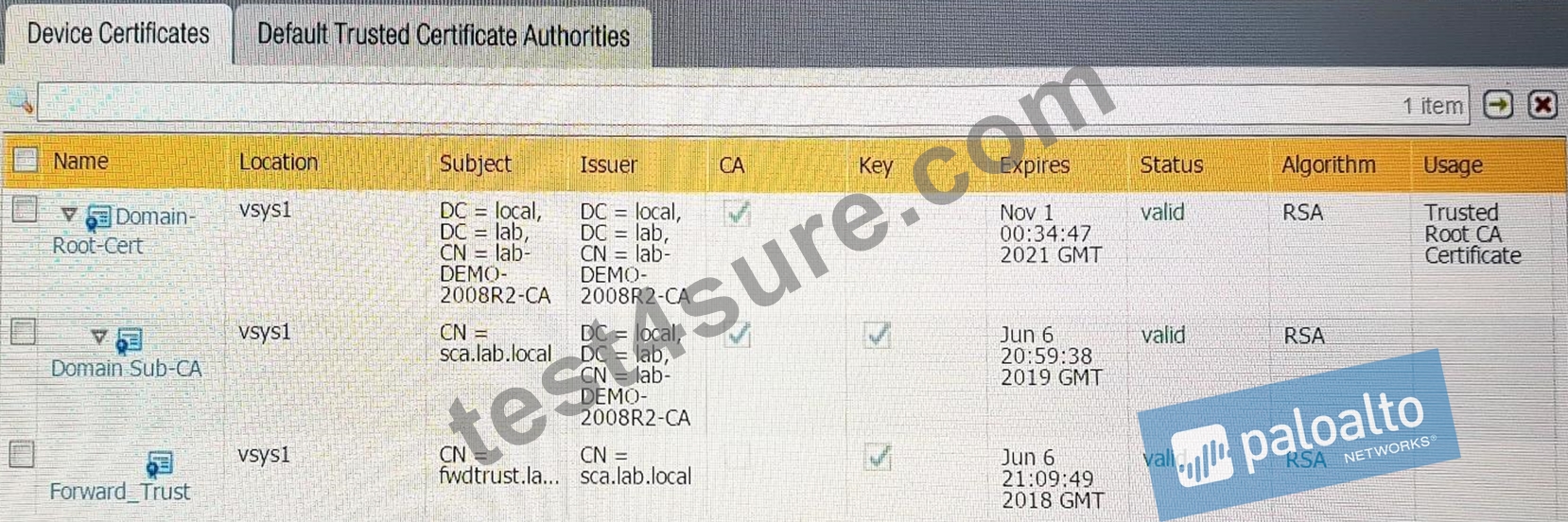
Which certificates can be used as a Forwarded Trust certificate?
- A. Domain Sub-CA
- B. Forward_Trust
- C. Domain-Root-Cert
- D. Certificate from Default Trust Certificate Authorities
Answer: A
NEW QUESTION # 90
A company CISO updates the business Security policy to identify vulnerable assets and services and deploy protection for quantum-related attacks. As a part of this update, the firewall team is reviewing the cryptography used by any devices they manage. The firewall architect is reviewing the Palo Alto Networks NGFWs for their VPN tunnel configurations. It is noted in the review that the NGFWs are running PAN-OS
11.2. Which two NGFW settings could the firewall architect recommend to deploy protections per the new policy? (Choose two)
- A. IPsec with Hybrid ID exchange
- B. IKEv1 only to deactivate the use of public key encryption
- C. IKEv2 with Post-Quantum Pre-shared Keys
- D. IKEv2 with Hybrid Key exchange
Answer: C,D
Explanation:
Quantum-related attack protection requires cryptography resistant to quantum computing, such as post- quantum algorithms. In PAN-OS 11.2, IKEv2 with Hybrid Key Exchange (Option B) combines classical and quantum-resistant algorithms for key exchange, enhancing VPN security. IKEv2 with Post-Quantum Pre- shared Keys (PPK) (Option C) uses pre-shared keys designed to resist quantum attacks, supported in IKEv2 configurations.
Option A (IKEv1 only) weakens security by avoiding PFS and modern cryptography. Option D (IPsec with Hybrid ID exchange) is not a valid PAN-OS feature. Documentation confirms IKEv2 enhancements for quantum resistance.
Reference: PAN-OS 11.2 Administrator's Guide, "VPNs" section - IKEv2 and Quantum-Resistant Cryptography.
NEW QUESTION # 91
Which three authentication services can administrator use to authenticate admins into the Palo Alto Networks NGFW without defining a corresponding admin account on the local firewall? (Choose three.)
- A. Kerberos
- B. SAML
- C. PAP
- D. TACACS+
- E. LDAP
- F. RADIUS
Answer: A,B,E
Explanation:
https://docs.paloaltonetworks.com/pan-os/8-0/pan-os-admin/firewall-administration/manage-firewall-administrators/administrative-authentication
The administrative accounts are defined on an external SAML, TACACS+, or RADIUS server. The server performs both authentication and authorization. For authorization, you define Vendor-Specific Attributes (VSAs) on the TACACS+ or RADIUS server, or SAML attributes on the SAML server. PAN-OS maps the attributes to administrator roles, access domains, user groups, and virtual systems that you define on the firewall. For details, see:
Configure SAML Authentication Configure TACACS+ Authentication Configure RADIUS Authentication
NEW QUESTION # 92
What are two benefits of nested device groups in Panorama? (Choose two.)
- A. All device groups inherit settings form the Shared group
- B. Requires configuring both function and location for every device
- C. Overwrites local firewall configuration
- D. Reuse of the existing Security policy rules and objects
Answer: A,D
Explanation:
Explanation
https://docs.paloaltonetworks.com/panorama/8-0/panorama-admin/panorama-overview/centralized-firewall-conf
NEW QUESTION # 93
An administrator would like to determine which action the firewall will take for a specific CVE. Given the screenshot below, where should the administrator navigate to view this information?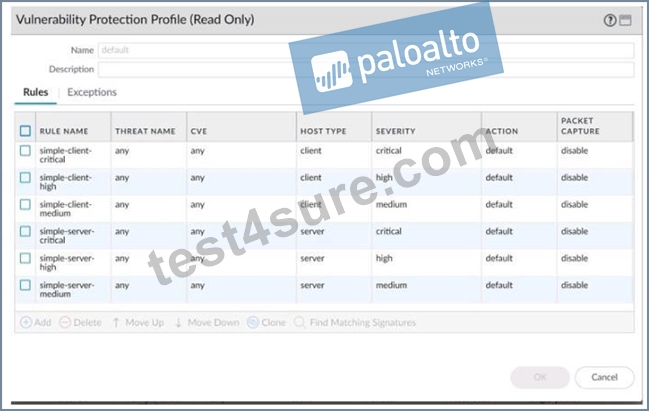
- A. CVE column
- B. The profile rule action
- C. Exceptions lab
- D. The profile rule threat name
Answer: B
NEW QUESTION # 94
If a DNS sinkhole is configured, any sinkhole actions indicating a potentially infected host are recorded in which log type?
- A. Traffic
- B. Data Filtering
- C. Threat
- D. WildFire Submissions
Answer: C
Explanation:
https://docs.paloaltonetworks.com/pan-os/10-0/pan-os-admin/threat-prevention/use-dns-queries- to-identify-infected-hosts-on-the-network/configure-dns-sinkholing
NEW QUESTION # 95
A network administrator is troubleshooting an issue with Phase 2 of an IPSec VPN tunnel. The administrator determines that the lifetime needs to be changed to match the peer.
Where should this change be made?
- A. IKE Gateway profile
- B. IKE Crypto profile
- C. IPSec Crypto profile
- D. IPSec Tunnel settings
Answer: C
Explanation:
The **IKE crypto profile** is used to set up the encryption and authentication algorithms used for the key exchange process in IKE Phase 1, and lifetime of the keys, which specifies how long the keys are valid. To invoke the profile, you must attach it to the IKE Gateway configuration. The **IPSec crypto profile** is invoked in IKE Phase 2. It specifies how the data is secured within the tunnel when Auto Key IKE is used to automatically generate keys for the IKE SAs.
NEW QUESTION # 96
Which DoS protection mechanism detects and prevents session exhaustion attacks?
- A. Resource Protection
- B. Packet Based Attack Protection
- C. Flood Protection
- D. TCP Port Scan Protection
Answer: A
Explanation:
Reference:
In addition to setting IP flood thresholds, you can also use DoS Protection profiles to detect and prevent session exhaustion attacks in which a large number of hosts (bots) establish as many sessions as possible to consume a target's resources. On the profile's Resources Protection tab, you can set the maximum number of concurrent sessions that the device(s) defined in the DoS Protection policy rule to which you apply the profile can receive. When the number of concurrent sessions reaches its maximum limit, new sessions are dropped.
https://docs.paloaltonetworks.com/pan-os/10-0/pan-os-admin/zone-protection-and-dos-protection/zone-defense/dos-protection-profiles-and-policy-rules/dos-protection-profiles.html
NEW QUESTION # 97
An administrator deploys PA-500 NGFWs as an active/passive high availability pair. The devices are not participating in dynamic routing, and preemption is disabled.
What must be verified to upgrade the firewalls to the most recent version of PAN-OS?software?
- A. WildFire update package.
- B. User-ID agent.
- C. Antivirus update package.
- D. Applications and Threats update package.
Answer: D
Explanation:
https://www.paloaltonetworks.com/documentation/80/pan-os/newfeaturesguide/upgrade-to-pan- os-80/upgrade-the-firewall-to-pan-os-80/upgrade-an-ha-firewall-pair-to-pan-os-80
NEW QUESTION # 98
An administrator is using Panorama and multiple Palo Alto Networks NGFWs. After upgrading all devices to the latest PAN-OS?software, the administrator enables log forwarding from the firewalls to Panorama. Pre-existing logs from the firewalls are not appearing in Panorama.
Which action would enable the firewalls to send their pre-existing logs to Panorama?
- A. Use the import option to pull logs into Panorama.
- B. The log database will need to exported form the firewalls and manually imported into Panorama.
- C. A CLI command will forward the pre-existing logs to Panorama.
- D. Use the ACC to consolidate pre-existing logs.
Answer: C
Explanation:
After you upgrade to a Panorama 8.0 or later release, Panorama Log Collectors use a new log storage format.
Because Panorama cannot generate reports or ACC data from logs in the pre-8.0-release log format after you upgrade, you must migrate the existing logs as soon as you upgrade Panorama and its Log Collectors from a PAN-OS 7.1 or earlier release to a PAN-OS 8.0 or later release and you must do this before you upgrade your managed firewalls. Panorama will continue to collect logs from managed devices during the log migration but will store the incoming logs in the new log format after you upgrade to a PAN-OS 8.0 or later release. For this reason, you will see only partial data in the ACC and in Reports until Panorama completes the log migration process.
https://docs.paloaltonetworks.com/panorama/10-0/panorama-admin/set-up-panorama/install- content-and-software-updates-for-panorama/migrate-panorama-logs-to-new-log-format.html
NEW QUESTION # 99
An administrator Just enabled HA Heartbeat Backup on two devices However, the status on tie firewall's dashboard is showing as down High Availability.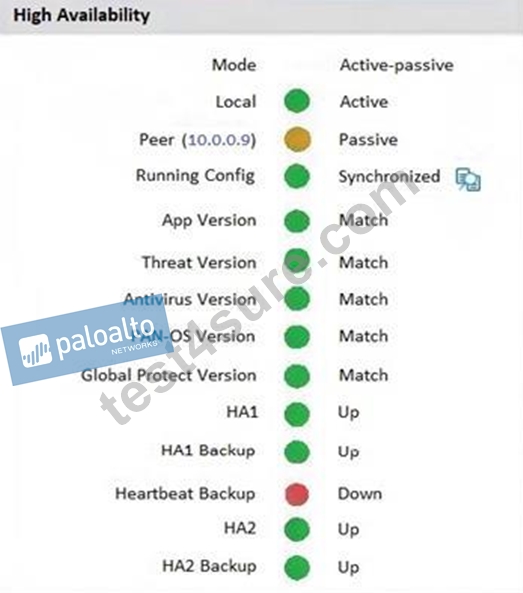
What could an administrator do to troubleshoot the issue?
- A. Go to Device > High Availability > HA Communications> General> and check the Heartbeat Backup under Election Settings
- B. Check peer IP address for heartbeat backup to Device > High Availability > HA Communications > Packet Forwarding settings.
- C. Go to Device > High Availability> General > HA Pair Settings > Setup and configuring the peer IP for heartbeat backup
- D. Check peer IP address In the permit list In Device > Setup > Management > Interfaces > Management Interface Settings
Answer: A
NEW QUESTION # 100
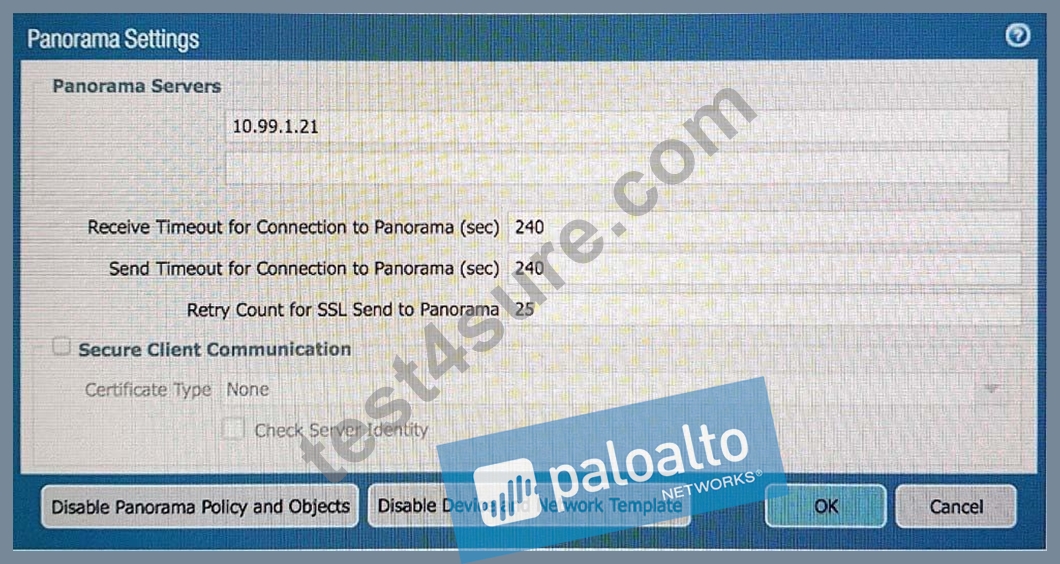
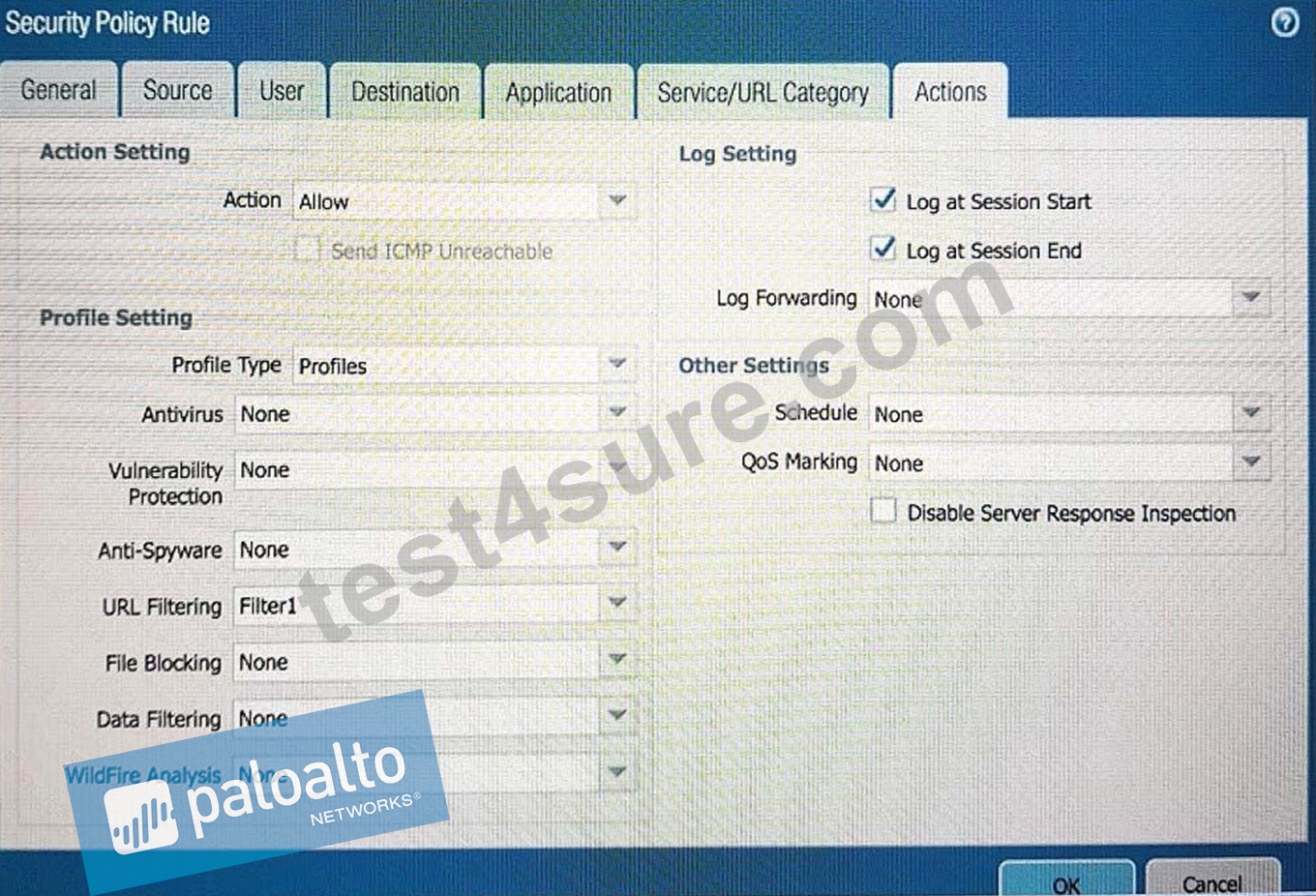
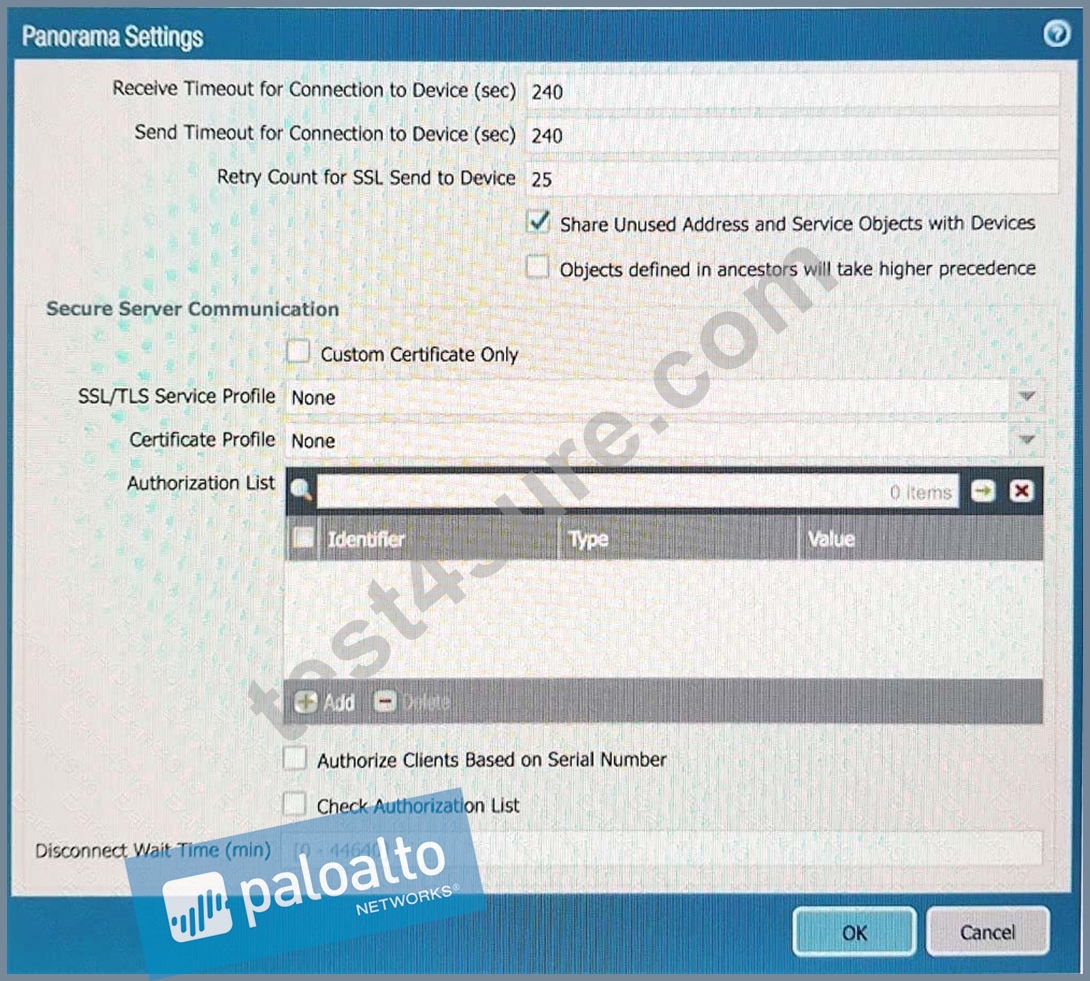
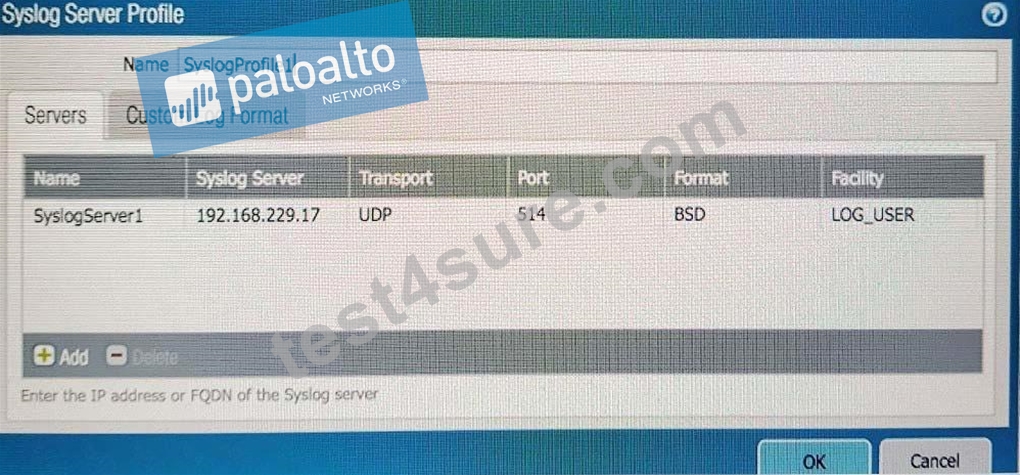
Refer to Exhibit: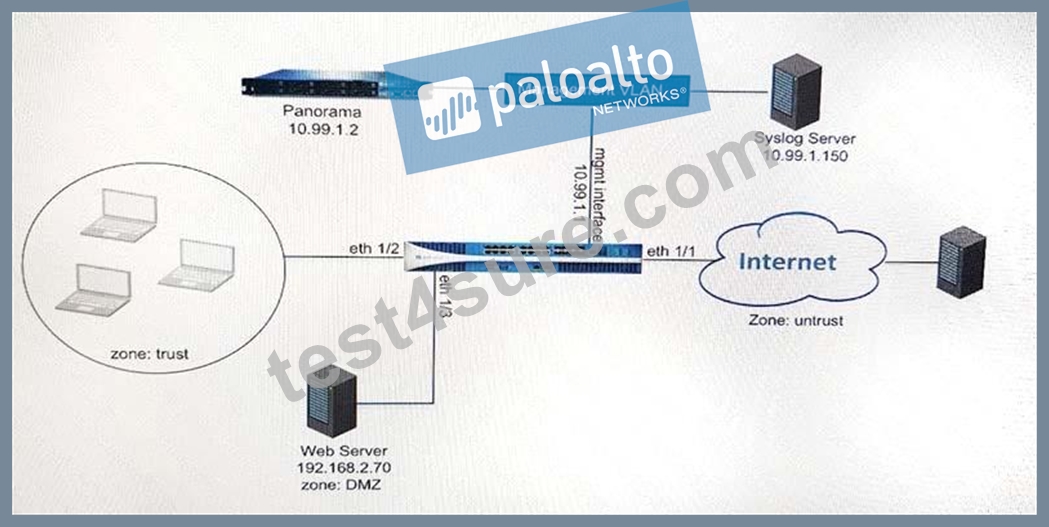
An administrator can not see any Traffic logs from the Palo Alto Networks NGFW in Panorama reports. The configuration problem seems to be on the firewall. Which settings, if configured incorrectly, most likely would stop only Traffic logs from being sent from the NGFW to Panorama?
- A.
- B.
- C.
- D.
Answer: D
NEW QUESTION # 101
An administrator is configuring a Panorama device group
Which two objects are configurable? (Choose two )
- A. SSL/TLS roles
- B. DNS Proxy
- C. Address groups
- D. URL Filtering profiles
Answer: C,D
Explanation:
Explanation
URL filtering is a feature in Palo Alto Networks firewalls that allows administrators to block access to specific URLs[1]. This feature can be configured via four different objects: Custom URL categories in URL Filtering profiles, PAN-DB URL categories in URL Filtering profiles, External Dynamic Lists (EDL) in URL Filtering profiles, and Custom URL categories in Security policy rules. The evaluation order for URL filtering is:
Custom URL categories in URL Filtering profile, PAN-DB URL categories in URL Filtering profile, EDL in URL Filtering profile, and Custom URL category in Security policy rule. This information can be found in the Palo Alto Networks PCNSE Study Guide, which can be accessed here:https://www.paloaltonetworks.com/documentation/80/pan-os/pan-os/resource-library/palo-alto-networks-pc
NEW QUESTION # 102
Which two subscriptions are available when configuring panorama to push dynamic updates to connected devices? (Choose two.)
- A. Antivirus
- B. Content-ID
- C. User-ID
- D. Applications and Threats
Answer: A,D
Explanation:
https://docs.paloaltonetworks.com/pan-os/10-2/pan-os-upgrade/upgrade-panorama/deploy- updates-to-firewalls-log-collectors-and-wildfire-appliances-using-panorama/supported-updates
NEW QUESTION # 103
......
The PCNSE exam covers a wide range of topics, including network security technologies, firewall features and functionality, VPN and remote access technologies, and threat prevention technologies. PCNSE exam also tests the candidate's knowledge of advanced features such as user-ID, App-ID, and content-ID, which are essential for securing modern networks. In addition, the exam includes practical scenarios that require the candidate to apply their knowledge of the Palo Alto Networks platform to solve real-world problems.
PCNSE Real Exam Questions and Answers FREE: https://www.test4sure.com/PCNSE-pass4sure-vce.html
2026 Realistic Verified Free Palo Alto Networks PCNSE Exam Questions: https://drive.google.com/open?id=1X1TP511lj0kHDhiszSAnWVUlr8otMfd5