

Updated Oct-2025 Test Engine to Practice Test for H11-861_V4.0 Exam Questions and Answers!
HCIP-Collaboration V4.0 Certification Sample Questions and Practice Exam
Huawei H11-861_V4.0 Exam Syllabus Topics:
| Topic | Details |
|---|---|
| Topic 1 |
|
| Topic 2 |
|
| Topic 3 |
|
| Topic 4 |
|
| Topic 5 |
|
NEW QUESTION # 31
An endpoint is disconnected from a conference due to a power failure. After the endpoint is powered on again, it is not called to the conference again, and the SMC does not detect that the endpoint is disconnected. The SMC O&M engineer finds that this fault is caused by the "Timeout for hang-up upon no code streams" parameter on the CloudMCU. Which of the following parameter values may cause this fault? (Choose all that apply.)
- A. 0
- B. 1
- C. 2
- D. 3
Answer: A,D
Explanation:
Setting the timeout to 0 or -1 disables the automatic hang-up when no media streams are received, so the MCU never tears down the call and SMC doesn't detect the endpoint has dropped.
NEW QUESTION # 32
After an AVC conference is held, a user logs in to the MCU and runs the debug command. The following information is displayed: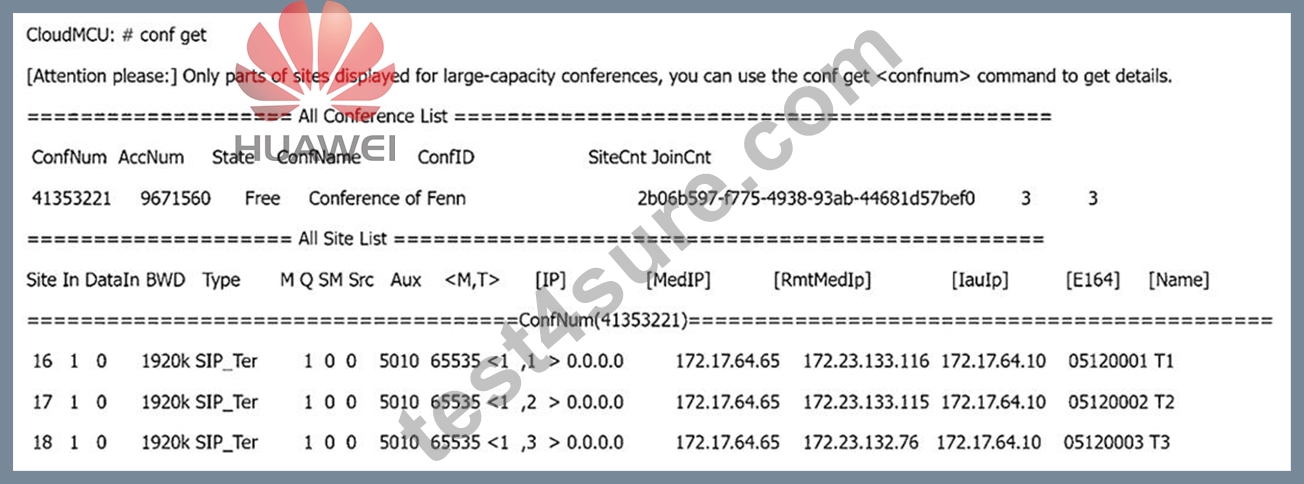
Which of the following is the IP address of site T3?
- A. 172.23.132.76
- B. 172.23.133.116
- C. 172.23.133.115
- D. 172.17.64.65
Answer: A
Explanation:
In the conference site list, Site 18 corresponds to T3 and its remote media IP ([RmtMedIp]) is listed as 172.23.132.76.
NEW QUESTION # 33
By default, the SMC provides six user roles. Default permissions of each user role can be modified or deleted based on site requirements.
- A. FALSE
- B. TRUE
Answer: A
Explanation:
The SMC indeed provides six built-in user roles (system administrator, security administrator, security auditor, program administrator, conference administrator, and common user), but their default permissions are fixed and cannot be modified or removed.
NEW QUESTION # 34
FILL in BLANK
Assume endpoints T1 and T2 are registered with the same SC node zone (signaling routing is disabled on the SC). After T1 calls the number of T2 using H.323, T1 and T2 communicate with each other. In this process, a total of ____________ TCP connection(s) need to be established between T1 and T2. (Enter an Arabic numeral.)
Answer:
Explanation:
2
NEW QUESTION # 35
At an SMC video conferencing system site, the customer wants to deploy a conferencing system with converged firewall ports, with a planned DMZ. The SC1 is deployed on the intranet and SC2 is deployed in the DMZ. In this case, which of the following deployment modes is the most suitable one for SC1 and SC2?
- A. SC1 and SC2 are both proxy SCs.
- B. SC1 is the proxy SC, and SC2 is the registration SC.
- C. SC1 is the registration SC, and SC2 is the proxy SC.
- D. SC1 and SC2 are both registration SCs.
Answer: C
Explanation:
Deploying SC1 as the registration SC on the intranet allows internal endpoints to register directly, while placing SC2 as a proxy SC in the DMZ handles external signaling traversal and secures the demilitarized zone.
NEW QUESTION # 36
Assume that a channel of 4CIF analog TV signal uses a 48-bit color depth. Which of the following is nearest to the stream transmission speed of the signal before compression and encoding?
- A. 238 Mbit/s
- B. 600 Mbit/s
- C. 557 Mbit/s
- D. 446 Mbit/s
Answer: B
Explanation:
4CIF (704×576) at 30 fps gives 704 × 576 × 30 ≈ 12.17 million pixels/s. At 48 bits per pixel, that's 12.17 M × 48 ≈ 584 Mbit/s, which is nearest to 600 Mbit/s.
NEW QUESTION # 37
Which of the following statements are true about personal virtual meeting room (VMR) provisioning?
- A. The SMC can provision personal VMRs to conference users one by one or in batches.
- B. The SMC can provision personal VMRs to conference rooms one by one or in batches.
- C. The SMC can provision personal VMRs to conference rooms only one by one.
- D. The SMC can provision personal VMRs to conference users only one by one.
Answer: A,B
Explanation:
The SMC's service provisioning functions include both single-item and batch modes for personal VMR assignment, whether you're binding VMRs to conference rooms or to individual users, you can provision them one by one or import a list and provision them in bulk.
NEW QUESTION # 38
Which of the following network elements can be utilized to centrally manage and control, remotely schedule shutdowns, and perform batch OTA upgrades for 10,000 IdeaHub ES2 Plus devices?
- A. eSight
- B. SMC
- C. IdeaManager
- D. iManager U2000
Answer: C
Explanation:
The IdeaManager platform is designed for large-scale IdeaHub device management, offering centralized control, remote shutdown scheduling, and batch over-the-air upgrades for fleets of up to millions of devices, including 10,000 ES2 Plus units.
NEW QUESTION # 39
Which of the following information is displayed when you run the CloudMCU debugging command "mswt-media allflow"?
- A. Bit rates of all ongoing streams
- B. Conference and participant numbers of the ongoing conferences on the MCU
- C. Current system information of the CloudMCU
- D. MCU operation logs
Answer: A
Explanation:
The mswt-media allflow command reports the bit rates of all ongoing media streams on the CloudMCU; it does not display conference/participant counts, system info, or logs.
NEW QUESTION # 40
Which of the following conference parameters need to be obtained by engineers when locating conference faults on the SMC video conferencing system? (Choose all that apply.)
- A. Conference resolution and frame rate
- B. Conference bandwidth
- C. Conference type
- D. Conference video protocol
Answer: A,B,C,D
Explanation:
When troubleshooting conferences, engineers must know the video protocol in use, the conference type, the resolution and frame rate being delivered, and the bandwidth allocation - each of these parameters directly impacts session behavior and helps pinpoint faults.
NEW QUESTION # 41
In an SVC hybrid conference (scheduled on the SFU and IAU), when an AVC participant views continuous presence of an SVC participant, dynamic codec resources on the IAU are consumed. When an AVC participant views continuous presence of other AVC participants, no dynamic codec resources are consumed.
- A. FALSE
- B. TRUE
Answer: B
Explanation:
Displaying SVC streams to AVC endpoints requires IAU decoding and encoding, consuming dynamic codec resources; forwarding native AVC streams uses SFU without engaging IAU resources.
NEW QUESTION # 42
Which of the following statements are true about the SC cluster reconstruction deployment scenario? (Choose all that apply.)
- A. If the number of SIP endpoints is much greater than that of H.323 endpoints, an SC cluster can be deployed for SIP and H.323 endpoint access.
- B. If the number of SIP endpoints is far less than that of H.323 endpoints, you are advised not to deploy the SC cluster.
- C. If the number of SIP endpoints is much greater than that of H.323 endpoints, an SC cluster can be deployed for SIP endpoint access. The non-cluster registration SC is reserved for H.323 endpoint access.
- D. If the number of connected extranet soft clients is greater than 2000, you are advised to reconstruct a non-cluster proxy SC into a proxy SC cluster.
Answer: B,C,D
Explanation:
When SIP endpoints greatly outnumber H.323 endpoints, you deploy an SC cluster to serve the SIP devices while leaving a standalone SC for the H.323 endpoints.
If SIP registrations are much fewer than H.323 registrations, clustering the SC for SIP isn't recommended, as the scale doesn't justify the added complexity.
A proxy SC supports up to 2,000 external soft-client registrations; if you exceed this, you should rebuild it as a proxy-SC cluster to handle the extra load.
NEW QUESTION # 43
When the MCU has two service network ports, you can use the IP address bound to bond0 or bond1 to access the MCU web interface.
- A. FALSE
- B. TRUE
Answer: A
Explanation:
The MCU's web management interface listens only on the service-network bond (bond0); the second port group (bond1) is dedicated to media traffic and does not provide web access.
NEW QUESTION # 44
FILL in BLANK
The SMC small- and medium-sized network (SMC and SC co-deployed) supports a maximum of ____________ concurrent calls. (Enter Arabic numerals.)
Answer:
Explanation:
59
Explanation:
In a small- and medium-sized deployment with SMC and SC co-deployed on the same server, a single device supports up to 1,000 concurrent calls.
NEW QUESTION # 45
The new and old MCU architectures differ in bandwidth and codec resource usage during cascading. The new architecture supports multiple working modes, such as MCU, SFU, and IAU. The old architecture does not provide different working modes of the MCU. Which of the following statements is false about MCU cascading?
- A. When MCUs of the new architecture are cascaded, both the cascading channel and proxy channel consume bandwidth and codec resources.
- B. When MCUs of the old architecture are cascaded, the cascading channel consumes bandwidth and codec resources.
- C. When the MCU of the old architecture is cascaded with the MCU of the new architecture, the proxy channel consumes bandwidth and codec resources.
- D. When the MCU of the old architecture is cascaded with the MCU of the new architecture, the cascading channel consumes bandwidth and codec resources.
Answer: D
Explanation:
When cascading an old-architecture MCU with a new-architecture MCU, only the proxy channel on the new side consumes bandwidth and codec resources - the legacy MCU's cascading channel is not used.
NEW QUESTION # 46
SIP and SDP are independent of each other. SIP can implement multimedia calls independently to add new applications or media easily.
- A. FALSE
- B. TRUE
Answer: A
Explanation:
SIP relies on SDP for session description in multimedia calls; it cannot negotiate media parameters independently of SDP.
NEW QUESTION # 47
......
Certification dumps HCIP-Video Conference H11-861_V4.0 guides - 100% valid: https://www.test4sure.com/H11-861_V4.0-pass4sure-vce.html
100% Pass Your H11-861_V4.0 HCIP-Collaboration V4.0 at First Attempt with Test4Sure: https://drive.google.com/open?id=1T2HH0_3il1IjKMKtlnSu-xe6DiqAYcsg