

Updated Oct 24, 2025 Certification Exam NSE7_SDW-7.2 Dumps - Practice Test Questions
Updated Verified NSE7_SDW-7.2 dumps Q&As - Pass Guarantee or Full Refund
Fortinet NSE7_SDW-7.2 Exam Syllabus Topics:
| Topic | Details |
|---|---|
| Topic 1 |
|
| Topic 2 |
|
| Topic 3 |
|
| Topic 4 |
|
| Topic 5 |
|
NEW QUESTION # 48
Refer to the exhibit.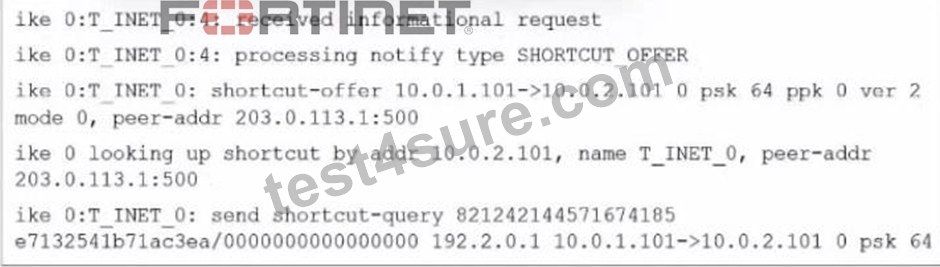
Which statement about the role of the ADVPN device in handling traffic is true?
- A. This is a hub that has received an offer from a spoke and has forwarded it to another spoke.
- B. Two spokes. 192.2. 1 and 10.0.2.101. establish a shortcut.
- C. This is a spoke that has received an offer from a remote hub.
- D. An IKE session is established between 10.0.1.101 and 10.0.2.101 in the process of forming a shortcut tunnel.
Answer: C
NEW QUESTION # 49 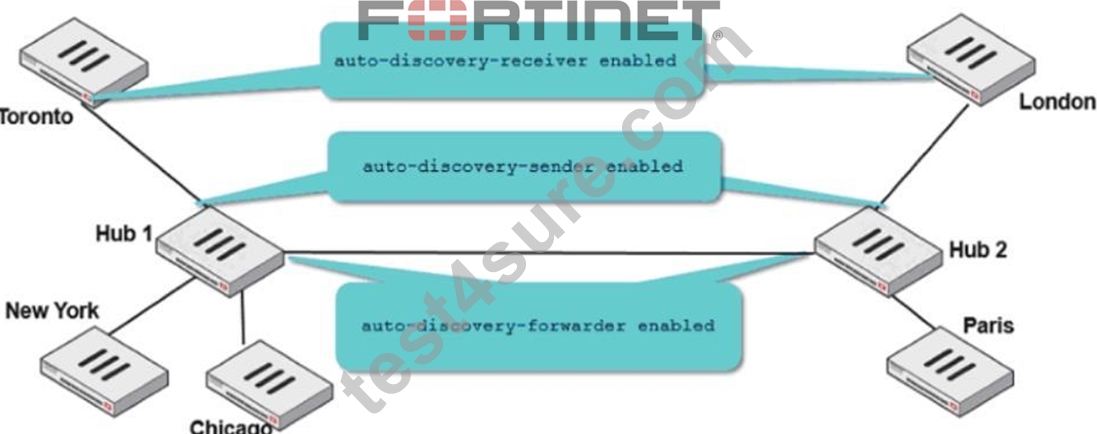
Two hub-and-spoke groups are connected through a site-to-site IPsec VPN between Hub 1 and Hub 2. The administrator configured ADVPN on both hub-and-spoke groups.
Which two outcomes are expected if a user in Toronto sends traffic to London? (Choose two.)
- A. Toronto needs to establish a site-to-site tunnel with Hub 2 to bypass Hub 1.
- B. The first packets from Toronto to London are routed through Hub 1 then to Hub 2.
- C. Traffic from Toronto to London triggers the dynamic negotiation of a direct site-to-site VPN.
- D. London generates an IKE information message that contains the Toronto public IP address.
Answer: B,C
NEW QUESTION # 50
Which two statements about SLA targets and SD-WAN rules are true? (Choose two.)
- A. Member metrics are measured only if an SLA target is configured.
- B. SD-WAN rules use SLA targets to check if the preferred members meet the SLA requirements.
- C. SLA targets are used only by SD-WAN rules that are configured with Lowest Cost (SLA) or Maximize Bandwidth (SLA) as strategy.
- D. When configuring an SD-WAN rule, you can select multiple SLA targets of the same performance SLA.
Answer: A,B
NEW QUESTION # 51
Refer to the exhibit.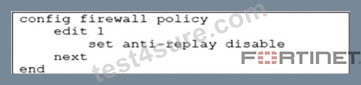
In a dual-hub hub-and-spoke SD-WAN deployment, which is a benefit of disabling theanti-replaysetting on the hubs?
- A. It instructs the hub to not check the ESP sequence numbers on IPsec traffic, to improve performance.
- B. It instructs the hub to disable TCP sequence number check, which is required for TCP sessions originated from spokes to fail over back and forth between the hubs.
- C. It instructs the hub to skip content inspection on TCP traffic, to improve performance.
- D. It instructs the hub to disable the reordering of TCP packets on behalf of the receiver, to improve performance.
Answer: B
NEW QUESTION # 52
Refer to the exhibit.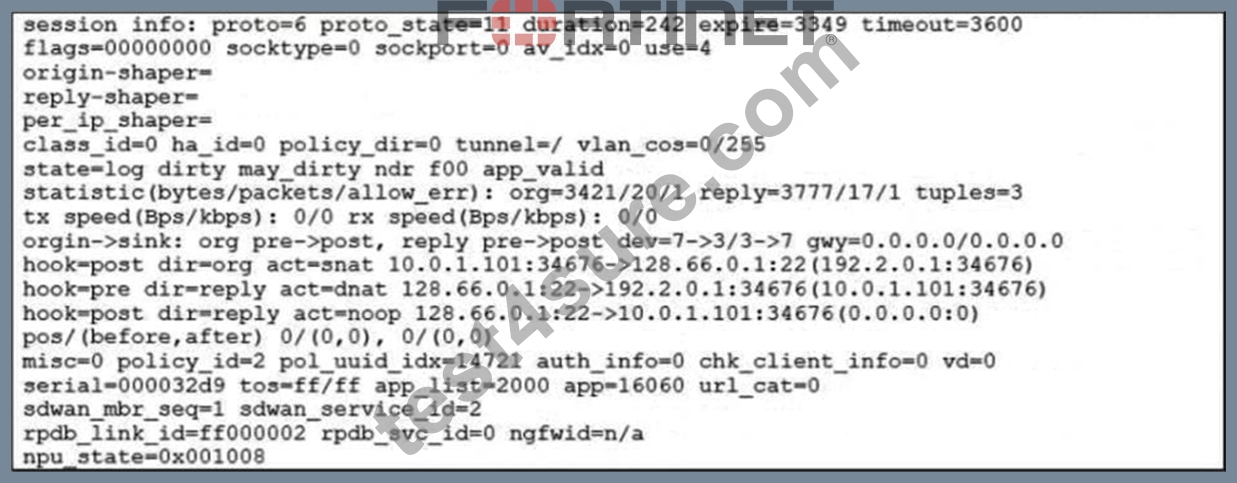
Which statement explains the output shown in the exhibit?
- A. FortiGate must re-evaluate the session due to routing change.
- B. FortiGate will not re-evaluate the session following a firewall policy change.
- C. FortiGate performed standard FIB routing on the session.
- D. FortiGate used 192.2.0.1 as the gateway for the original direction of the traffic.
Answer: A
Explanation:
The snat-route-change option is enabled by default. This option enables FortiGate to re-evaluate the routing table and select a new egress interface if the next hop IP address changes. This option only applies to sessions in the dirty state. Sessions in the log state are not affected by routing changes.
NEW QUESTION # 53
Refer to the exhibit.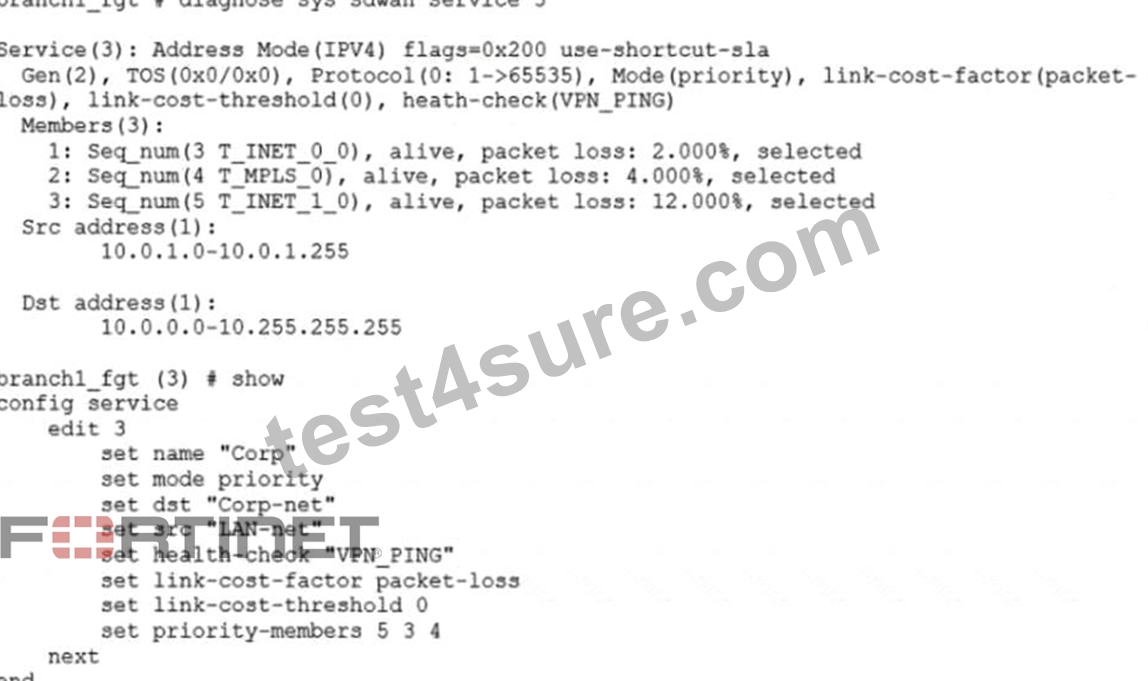
The exhibit shows the SD-WAN rule status and configuration.
Based on the exhibit, which change in the measured packet loss will make T_INET_1_0 the new preferred member?
- A. When T_INET_0_0 has 4% packet loss.
- B. When T_INET_0_0 has 12% packet loss.
- C. When T_INET_1_0 has 4% packet loss.
- D. When all three members have the same packet loss.
Answer: C
NEW QUESTION # 54
Refer to the exhibits.
Exhibit A -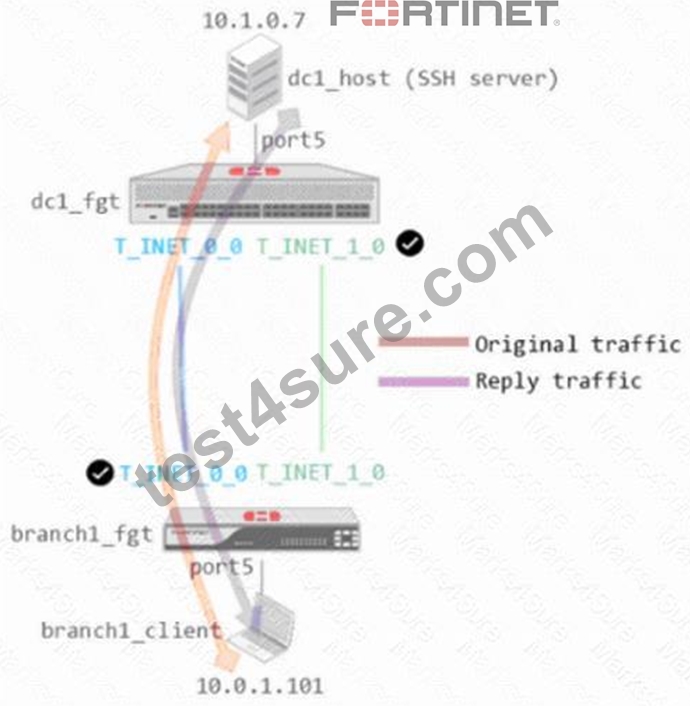
Exhibit B -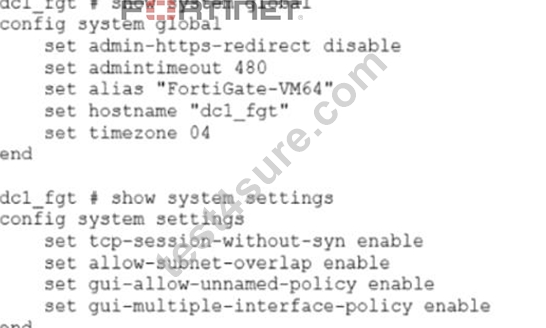
Exhibit A shows a site-to-site topology between two FortiGate devices: branch1_fgt and dc1_fgt. Exhibit B shows the system global and system settings configuration on dc1_fgt.
When branch1_client establishes a connection to dc1_host, the administrator observes that, on dc1_fgt, the reply traffic is routed over T_INET_0_0, even though T_INET_1_0 is the preferred member in the matching SD-WAN rule.
Based on the information shown in the exhibits, what configuration change must be made on dc1_fgt so dc1_fgt routes the reply traffic over T_INET_1_0?
- A. Disable tp-session-without-syn under config system settings.
- B. Enable auxiliary-session under config system settings.
- C. Disable allow-subnet-overlap under config system settings.
- D. Enable snat-route-change under config system global.
Answer: B
NEW QUESTION # 55
Refer to the exhibits.
Exhibit A
Exhibit B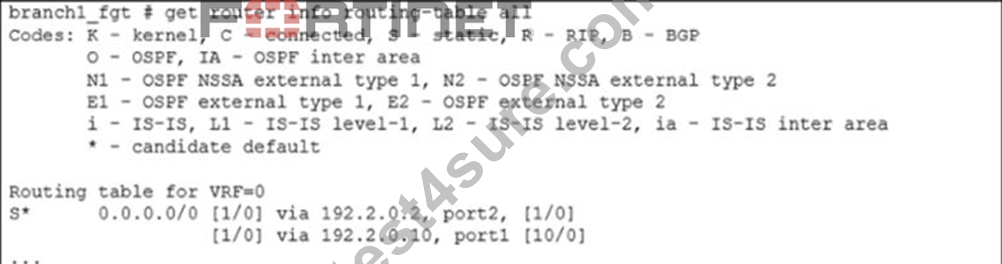
Exhibit A shows the source NAT (SNAT) global setting and exhibit B shows the routing table on FortiGate.
Based on the exhibits, which two actions does FortiGate perform on existing sessions established over port2, if the administrator increases the static route priority on port2 to 20? (Choose two.)
- A. FortiGate performs a route lookup for the original traffic only.
- B. FortiGate continues routing the sessions with no SNAT, over port2.
- C. FortiGate updates the gateway information of the sessions with SNAT so that they use port1 instead of port2.
- D. FortiGate flags the sessions as dirty.
Answer: B,C
NEW QUESTION # 56
Which statement about using BGP routes in SD-WAN is true?
- A. Learned routes can be used as dynamic destinations in SD-WAN rules.
- B. You must use BGP to route traffic for both overlay and underlay links.
- C. You must configure AS path prepending.
- D. You must use external BGP.
Answer: A
NEW QUESTION # 57
What are two reasons for using FortiManager to organize and manage the network for a group of FortiGate devices? (Choose two.)
- A. It reduces WAN usage on FortiGate devices by acting as a local FortiGuard server.
- B. It acts as a policy compliance entity to review all managed FortiGate devices.
- C. It simplifies the deployment and administration of SD-WAN on managed FortiGate devices.
- D. It sends probe signals as health checks to the beacon servers on behalf of FortiGate.
- E. It improves SD-WAN performance on the managed FortiGate devices.
Answer: A,C
NEW QUESTION # 58
Refer to the exhibits.
Exhibit A -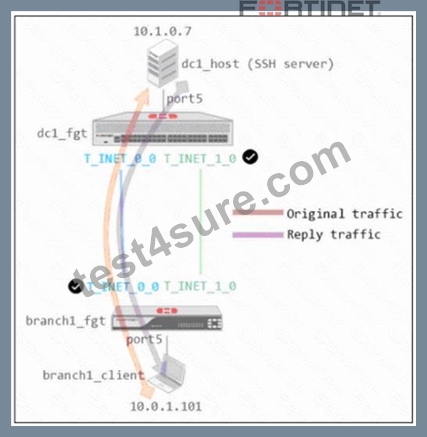
Exhibit B -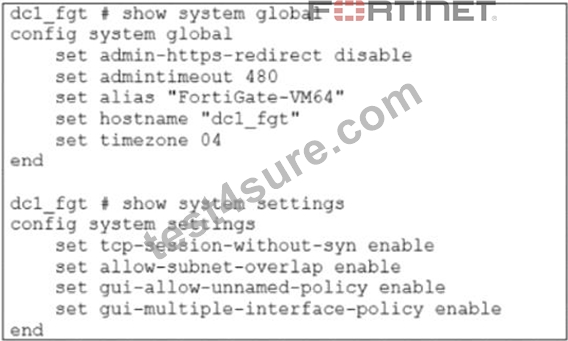
Exhibit A shows a site-to-site topology between two FortiGate devices: branch1_fgt and dc1_fgt. Exhibit B
shows the system global and system settings configuration on dc1_fgt.
When branch1_client establishes a connection to dc1_host, the administrator observes that, on dc1_fgt, the
reply traffic is routed over T_INET_0_0, even though T_INET_1_0 is the preferred member in the matching
SD-WAN rule.
Based on the information shown in the exhibits, what configuration change must be made on dc1_fgt so
dc1_fgt routes the reply traffic over T_INET_1_0?
- A. Enable auxiliary-session under config system settings.
- B. Disable allow-subnet-overlap under config system settings.
- C. Enable snat-route-change under config system global.
- D. Disable tp-session-without-syn under config system settings.
Answer: D
NEW QUESTION # 59
Refer to the Exhibits: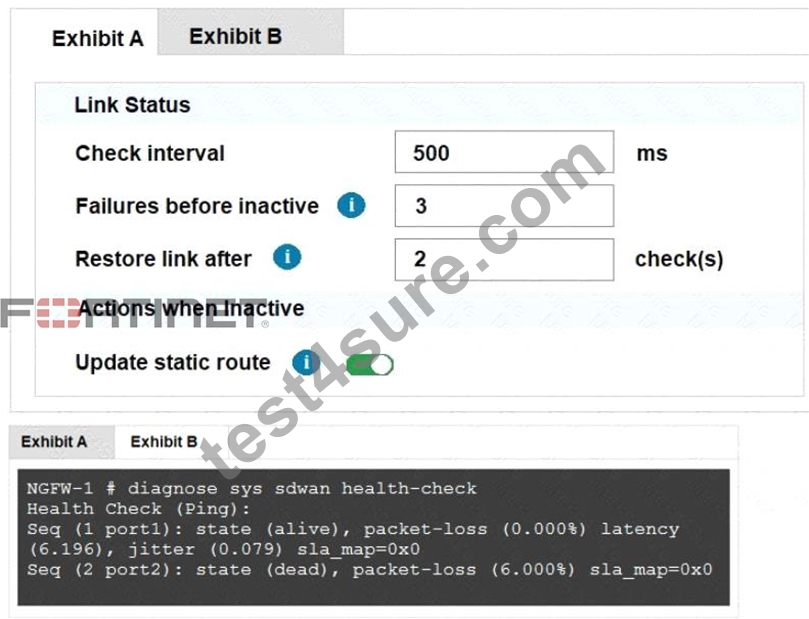
Exhibit A, which shows the SD-WAN performance SLA and exhibit B shows the health of the participating SD-WAN members.
Based on the exhibits, which statement is correct?
- A. Static routes using port2 are active in the routing table.
- B. FortiGate has not received three consecutive requests from the SLA server configured for port2.
- C. The dead member interface stays unavailable until an administrator manually brings the interface back.
- D. Port2 needs to wait 500 milliseconds to change the status from alive to dead.
Answer: A
NEW QUESTION # 60
Refer to the exhibit.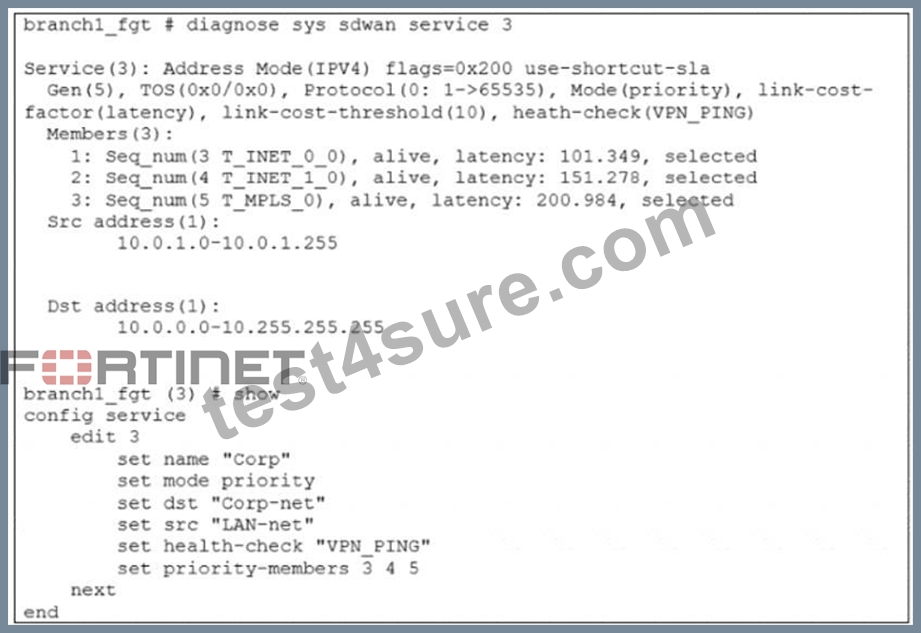
The exhibit shows the SD-WAN rule status and configuration.
Based on the exhibit, which change in the measured latency will make T_MPLS_0 the new preferred member?
- A. When T_INET_0_0 and T_MPLS_0 have the same latency.
- B. When T_N1PLS_0 has a latency of 80 ms.
- C. When T_MPLS_0 has a latency of 100 ms.
- D. When T_INET_0_0 has a latency of 250 ms.
Answer: B
NEW QUESTION # 61
What does enabling theexchange-interface-ipsetting enable FortiGate devices to exchange?
- A. The name of their IPsec interfaces
- B. The gateway address of their IPsec interfaces
- C. The IP address of their IPsec interfaces
- D. The tunnel ID of their IPsec interfaces
Answer: C
NEW QUESTION # 62
Refer to the exhibit.
Based on the exhibit, which two actions does FortiGate perform on sessions after a firewall policy change?
(Choose two.)
- A. FortiGate evaluates new sessions.
- B. FortiGate flushes all sessions.
- C. FortiGate does not change existing sessions.
- D. FortiGate terminates the old sessions.
Answer: A,C
Explanation:
FortiGate not to flag existing impacted session as dirty by setting firewall-session-dirty to check new. The results is that FortiGate evaluates only new session against the new firewall policy.
NEW QUESTION # 63
Refer to the exhibit.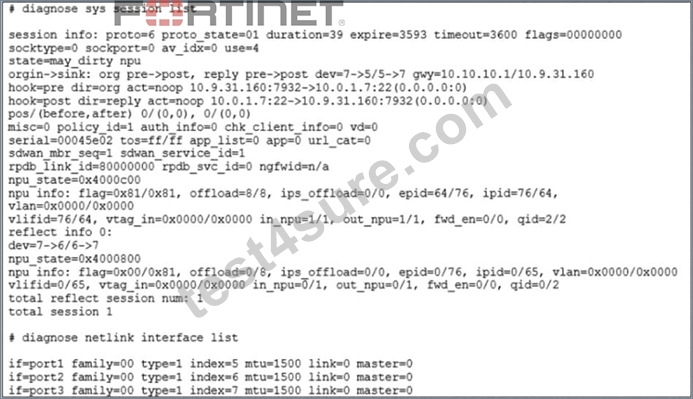
The exhibit shows the details of a session and the index numbers of some relevant interfaces on a FortiGate appliance that supports hardware offloading. Based on the information shown in the exhibits, which two statements about the session are true? (Choose two.)
- A. The main session cannot be offloaded to hardware.
- B. The original direction of the symmetric traffic flows from port3 to port2.
- C. The reply direction of the asymmetric traffic flows from port2 to port3.
- D. The auxiliary session can be offloaded to hardware.
Answer: C,D
NEW QUESTION # 64
Refer to the exhibit.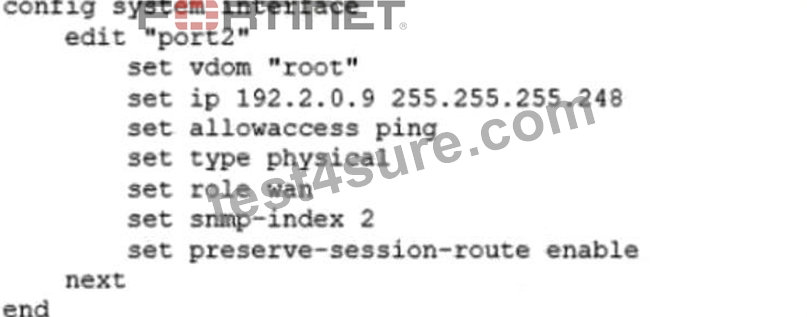
Based on the exhibit, which two actions does FortiGate perform on traffic passing through port2? (Choose two.)
- A. FortiGate performs routing lookups for new sessions only, after a route change.
- B. FortiGate flushes all routing information from the session table, after a route change.
- C. FortiGate always blocks all traffic, after a route change.
- D. FortiGate does not change the routing information on existing sessions that use a valid gateway, after a route change.
Answer: A,D
NEW QUESTION # 65
Refer to the exhibits.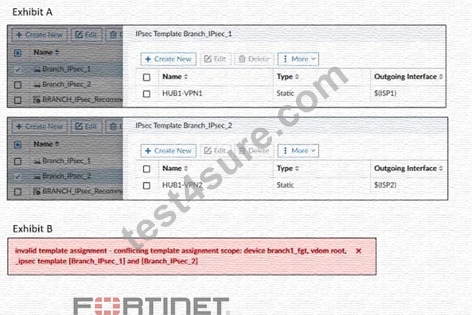
Exhibit A shows two IPsec templates to define Branch_IPsec_1 and Branch_IPsec_2. Each template defines a VPN tunnel.
Exhibit B shows the error message that FortiManager displayed when the administrator tried to assign the second template to the FortiGate device.
Which statement best explain the cause for this issue?
- A. You can assign only one IPsec template to each FortiGate device.
- B. You should review the branch1_fgt configuration for the already configured tunnel with the name HUB1-VPN2.
- C. You can define only one IPsec tunnel from branch devices to HUB1.
- D. You can assign only one template with a tunnel of fype static to each FortiGate device
Answer: B
Explanation:
The error message indicates that there is a conflict between the IPsec templates Branch_IPsec_1 and Branch_IPsec_2 for the device branch1_fgt. This means that the device already has an IPsec tunnel with the name HUB1-VPN2 configured, and the second template is trying to assign the same name to another tunnel.
This is not allowed, as each IPsec tunnel must have a unique name. Therefore, the administrator should review the branch1_fgt configuration and either delete or rename the existing tunnel with the name HUB1-VPN2 before assigning the second template. References = IPsec tunnel templates, IPsec VPN template
6.4.3, Understand and Use Debug Commands to Troubleshoot IPsec, L2L VPN TroubleShooting :"IPSec policy invalidated proposal with error ...
NEW QUESTION # 66
......
Exam Engine for NSE7_SDW-7.2 Exam Free Demo & 365 Day Updates: https://www.test4sure.com/NSE7_SDW-7.2-pass4sure-vce.html
NSE7_SDW-7.2 PDF Questions and Testing Engine With 101 Questions: https://drive.google.com/open?id=13YtcTA5IjYxy8T4dyy3wwOCe8uiVSGSM