

NCS-Core Dumps (2025) Prepare Your Exam With 310 Questions
New NCS-Core Dumps - Real Nutanix Exam Questions
The NCS-Core certification is suitable for a range of IT professionals, including system administrators, network administrators, storage administrators, and virtualization administrators. It is also suitable for those who are responsible for managing Nutanix deployments in the cloud or on-premises. Nutanix Certified Services Core Infrastructure Professional certification is a valuable asset for those who work for organizations that have adopted Nutanix enterprise cloud solutions or plan to do so in the future.
Nutanix NCS-Core Certification Exam is a valuable certification for IT professionals looking to enhance their skills and knowledge in core infrastructure solutions. Nutanix Certified Services Core Infrastructure Professional certification is recognized globally and is highly valued by organizations looking for skilled professionals to manage their IT infrastructure. NCS-Core exam covers a wide range of topics and is designed to test the expertise of candidates in various areas of infrastructure solutions, including virtualization, networking, storage, and cloud computing.
Nutanix NCS-Core is a certification exam that validates the skills and knowledge of professionals in the field of core infrastructure services for Nutanix enterprise cloud solutions. NCS-Core exam is designed to test the ability of candidates to deploy, configure, and manage Nutanix core infrastructure services such as storage, networking, and virtualization. Nutanix Certified Services Core Infrastructure Professional certification is intended for those who aspire to become Nutanix Certified Services Core Infrastructure Professionals.
NEW QUESTION # 109
A consultant is deploying a new Nutanix cluster. The nodes have the following network interfaces.
# 2x 10G NICS
# 2x 25G NICS
The consultant is using the default virtual switch configurations for AHV. After creating 10 VMs, the consultant observes inconsistent network speeds from the VMs on the AHV host.
What should the consultant do to resolve this issue?
- A. Configure a separate virtual switch with 10G NICs on vs o and 256 NICs on vs.
- B. Configure load balancing on the virtual switch for both 106 and 25G interfaces.
- C. Configure Active/Backup for both the 10G and 25G interfaces.
- D. Configure all network interfaces with LACP on the same virtual switch.
Answer: D
Explanation:
To resolve inconsistent network speeds from the VMs on an AHV host equipped with both 10G and 25G NICs, the consultant should configure all network interfaces with Link Aggregation Control Protocol (LACP) on the same virtual switch. This configuration will allow for better load balancing and bandwidth aggregation across multiple network interfaces, improving overall network throughput and reducing bottlenecks.
References:
* Nutanix University - NCS-Core 6.8 Learning Path
* The Nutanix Bible, Networking chapter (https://www.nutanixbible.com/)
NEW QUESTION # 110
A consultant deploys a four-node VMware ESXi cluster and vCenter server. An HA/DRS cluster is configured for all four nodes. The customer deploys five new VMs on the cluster.
During the knowledge Transfer, a network cable on one node is removed to demonstrate HA and migration of the VMs to another host. In the HA/DRS cluster settings, the VM Restart Priority for all CVMs is set to Disabled. The customer observes warnings that the CVM on the ejected host is no longer powered on.
Which ESXi HA/DRS cluster setting is missing?
- A. Disable Automation Level on all CVMs.
- B. Enable EVC for the cluster.
- C. Enable Host Monitoring.
- D. Disable VM Monitoring on all CVMs.
Answer: C
Explanation:
The issue indicated is that the VMs, specifically the CVMs (Controller VMs), do not restart on the remaining nodes after a network cable is removed, demonstrating a failure of HA (High Availability). The setting that should be verified is "Host Monitoring" within the ESXi HA/DRS settings. This setting enables the host to monitor the state of other hosts in the cluster and take necessary actions like VM restarts on other hosts in the event of failures. If it's disabled, the cluster wouldn't automatically manage the failover of VMs upon host disconnection. References: Nutanix Bible (https://www.nutanixbible.com/), Nutanix Official YouTube Training Series
NEW QUESTION # 111
A consultant has completed a cluster build according to the following requirements:
*Syslog Setup with ERROR level Logging
*Proxy Setup
*SNMP v3 Trap setup
When adding the cluster to an existing Prism Central with a proxy setup, the following error is triggered in the Prism Gateway logs:
Caused by: corn.nutanix.util .base.ValidationException: Prism Central is unreachable What configuration is likely missing?
- A. Whitelist of Prism Central OSIP inside of Prism Element and all Prism Element CVMs inside of Prism Central
- B. Whitelist of Prism Central DSIP inside of Prism Element
- C. Whitelist of Prism Central VIP inside of Prism Element and Prism Element VIP inside of Prism Central
- D. Whitelist of AHV Host IP addresses in Prism Central
Answer: C
Explanation:
The error stating "Prism Central is unreachable" when trying to add a cluster to an existing Prism Central with a proxy setup is likely due to incorrect or missing network routing configurations or firewall rules that do not allow communication between Prism Element and Prism Central. The most likely configuration that is missing and needed to resolve this issue is the whitelist of Prism Central VIP inside of Prism Element and Prism Element VIP inside of Prism Central. Whitelisting these Virtual IP addresses ensures that network traffic between these crucial components of the Nutanix architecture is permitted, thus enabling successful communication and registration of the cluster with Prism Central.References: Nutanix Network Configuration Guide, Nutanix Prism Central Administration.
NEW QUESTION # 112
During a technical call with a customer, it is identified that this installation will be software only on Dell servers. The out-of-band management interfaces will not be given IP addresses until the consultant is onsite.
Which Foundation method should be used for this type of installation?
- A. Bare metal using node serial numbers.
- B. Bare metal using block serial numbers.
- C. Bare metal using LAN MAC addresses.
- D. Bare metal using iDRAC MAC addresses.
Answer: D
NEW QUESTION # 113
What is the minimum number of nodes required for a Nutanix Cluster to support Replication Factor 3 (RF3) on a storage container?
- A. 0
- B. 1
- C. 2
- D. 3
Answer: B
NEW QUESTION # 114
The following alert appears on the file server alerts tab in the file server dashboard:
Which two events can generate this alert? (choose two)
- A. A node failed in a three-node cluster.
- B. A Nutanix file with four hie server VMs is deployed on a three-node duster.
- C. A three-node duster hosting the file server is undergoing AOS upgrade.
- D. A node is set to the maintenance mode in a three node cluster.
Answer: A,D
Explanation:
An alert of this nature in the file server dashboard usually indicates issues related to node availability within a cluster. Specifically, the failure of a node in a three-node cluster (Option B) can lead to insufficient resources to handle all tasks, which might trigger such an alert. Additionally, setting a node to maintenance mode in a three-node cluster (Option D) also disrupts service availability and could generate a similar alert, as the remaining nodes might struggle to handle the load or maintain data redundancy.References: Nutanix AOS User Guide, Nutanix Files Documentation.
NEW QUESTION # 115
A CEO asks the IT administrator to provide a list of required resources to protect current workloads and the two new SQL servers from a disaster. The Nutanix environment is managed by Prism Central.
Which option explains how to meet the CEO's request?
- A. In Capacity Runway, select Optimize Resources and select all VMs that must be protected.
- B. Create a new project and assign the VMs to it to get compute and storage requirements.
- C. Create a new Recovery policy by selecting the VM that needs to be protected and get hardware requirements.
- D. Create a new scenario based on a new cluster based on a VM Profile and select Recommend.
Answer: C
Explanation:
In a Nutanix environment managed by Prism Central, protecting workloads and SQL servers from a disaster involves creating a recovery policy. A recovery policy in Nutanix is a set of rules that define how data is protected and recovered in the event of a disaster1.
Creating a new recovery policy involves selecting the virtual machines (VMs) that need to be protected and specifying the hardware requirements for the recovery environment1. This includes the compute and storage resources needed to run the protected VMs in the recovery site1.
Once the recovery policy is created, Nutanix's built-in data protection and disaster recovery capabilities can ensure that the protected VMs can be quickly and efficiently recovered in the event of a disaster2. This includes capabilities such as efficient snapshot, cloning, and replication capabilities to provide a higher level of protection at a lower cost2.
Therefore, to meet the CEO's request, the IT administrator should create a new Recovery policy by selecting the VM that needs to be protected and get hardware requirements.
References:
* Designing, Optimizing and Scaling Microsoft SQL Server - Nutanix
* Nutanix Data Disaster Recovery - Protect Apps & Data | Nutanix
* Recommendations For Leap And Supported Service-level ... - Nutanix
* Cloud Disaster Recovery Services | Nutanix
* Nutanix - High Availability and Data Protection
NEW QUESTION # 116
An administrator is configuring an All Flash cluster to support the following workloads:
* Full clone virtual desktops
* Hadoop
* Write heavy databases
Whichthree correct configuration options should the administrator use to meet the item requirements? (Choose three.) For each procedure, indicate whether it is a correct or incorrect procedure that must be configured to meet the item requirements using the drop-down option.
Answer:
Explanation: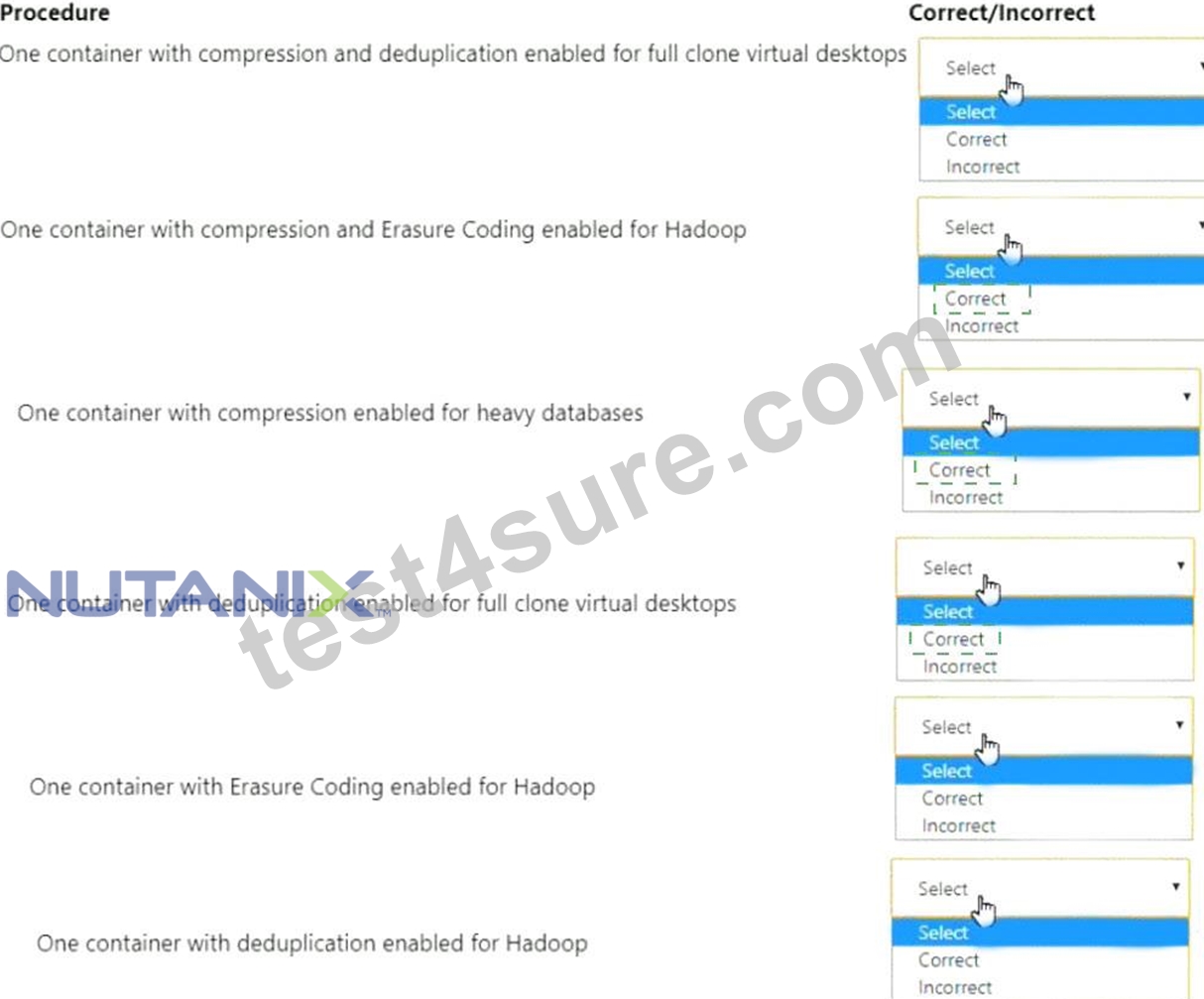
Explanation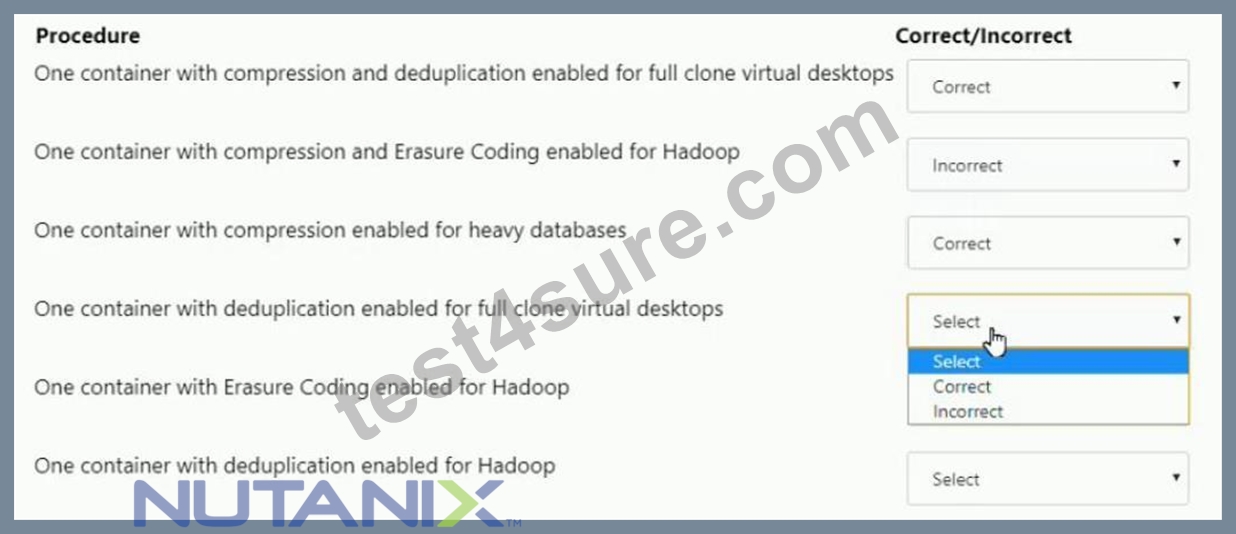
Ref:
NEW QUESTION # 117
Refer to the exhibit.
Which IP addresses can be configured for the Foundation VM and Consultant Laptop?
- A. FVM: 10.170.1.2/20, Laptop: 10.170.1.12/20
- B. FVM: 10.170.25.2/24, Laptop: 10.170.25.12/24
- C. FVM: 10.170.25.15/24, Laptop: 10.170.25.16/24
- D. FVM: 10.170.16.15/20,: 10.170.16.16/20
Answer: B
Explanation:
Based on the subnet assignments from the exhibit provided, the Hypervisor Management IP addresses fall within the 10.170.0.5, 10.170.0.6, 10.170.0.7 range with a subnet mask of 255.255.240.0, indicating a /20 subnet. However, the Foundation VM (FVM) and the Consultant Laptop should ideally be on the same subnet as the Controller Virtual Machine (CVM) to facilitate easy access and management. The CVM IP addresses indicated are 10.170.0.4, 10.170.0.9, and 10.170.0.10 with subnet 255.255.240.0 (/20). Thus, the appropriate choice for the FVM and Laptop that matches the subnet without overlapping with existing IPs and allows network configuration without conflicts would be in the same /24 range as suggested in option D, i.e., FVM:
10.170.25.2/24, Laptop: 10.170.25.12/24.
References:
* Nutanix Networking and Foundation Setup Guidelines
NEW QUESTION # 118
An administrator responsible for a VDI environment needs to investigate reports of slow logins.
Theadministrator finds that increasing the number of vCPUs from 2 to 4 will reduce the login times.
Production workloads are consuming 75% of the host CPU on the cluster. The administrator increases the vCPU count on all of the VDI VMs.
What are two impacts on the cluster? (Choose two.)
- A. Increase memory utilization%
- B. Increase CPU utilization%
- C. Increase CPU ready%
- D. Increasing CPU counts will decrease memory utilization
Answer: B,C
NEW QUESTION # 119
A customer has the following requirement for a Nutanix cluster:
* Must support high-performance Nutanix Volumes iSCSI workloads
* Must utilize AHV nodes
* Must use 10 GbE interface
How should the customer optimize networking?
- A. Convert Cluster to ESXi and enable Jumbo Frame on Host and CVM
- B. Enable the use of Jumbo Frame on Host and CVM
- C. Enable Jumbo Frame on just the Host
- D. Enable Jumbo Frames on just the CVM
Answer: C
NEW QUESTION # 120
A systems administrator needs to add more VMs to their Nutanix cluster.
Which two actions should the administrator perform to determine if the current cluster can accommodate the new VMs? (Choose two.)
- A. Perform an Inventory with Life Cycle Management.
- B. Determine utilization with Cluster Runway.
- C. Enable Deduplication and Erasure Coding.
- D. Utilize Optimize Resources for VM efficiency.
Answer: B,D
Explanation:
Ref:
NEW QUESTION # 121
Which container advanced setting should be configured to prevent ISO container images from exceeding a
100GB limit.
- A. Erasure coding
- B. Compression
- C. Advertised capacity
- D. Reserved capacity
Answer: C
Explanation:
The correct container advanced setting to configure in order to prevent ISO container images from exceeding a 100GB limit is "Advertised Capacity." This setting allows administrators to set a maximum storage capacity that is visible and available to the user, irrespective of the actual physical capacity available, thereby preventing over-allocation and management issues in environments where strict capacity limits are required.
References:
* Nutanix Certified Services - Core (NCS-Core) Learning Documents
* Nutanix Bible: https://www.nutanixbible.com
NEW QUESTION # 122
An administrator needs to deploy an application with a large amount of data connected via Nutanix Volumes.
Which two actions should the administrator take when designing the Volume Group? (Choose two.)
- A. Enable RSS (Receive Side Scaling)
- B. Use multiple subnets for iSCSI traffic
- C. Enable thick provisioning on the Volume Group(s)
- D. Distribute workload across multiple virtual disks
Answer: A,D
Explanation:
NEW QUESTION # 123
While creating an image placement policy on the organizations AOS 5.15-based Nutanix cluster, the administrator wants to ensure there are no restrictions on using the selected images on clusters outside of the identified set.
What type of Policy Enforcement must the administrator choose?
- A. Soft
- B. Internal
- C. External
- D. Hard
Answer: A
Explanation:
NEW QUESTION # 124
Refer to the exhibit.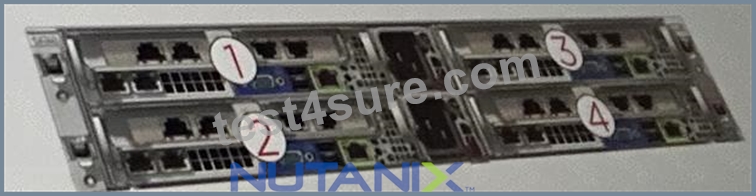
The customer has an existing NX-3160 block and is adding a second node into it.
Where should the node be installed?"
- A. 0
- B. 1
- C. 2
- D. 3
Answer: A
Explanation:
Based on the exhibit which shows an NX-3160 block with marked slots, the correct slot for installing a new node in the existing NX-3160 block is slot 2. This configuration is typically aligned with the chassis' design for orderly expansion and maintaining balanced power and cooling distribution among the nodes.References:
Nutanix Bible, Nutanix University NCS-Core 6.8 learning materials
NEW QUESTION # 125
Imaging fails for one or more nodes in the cluster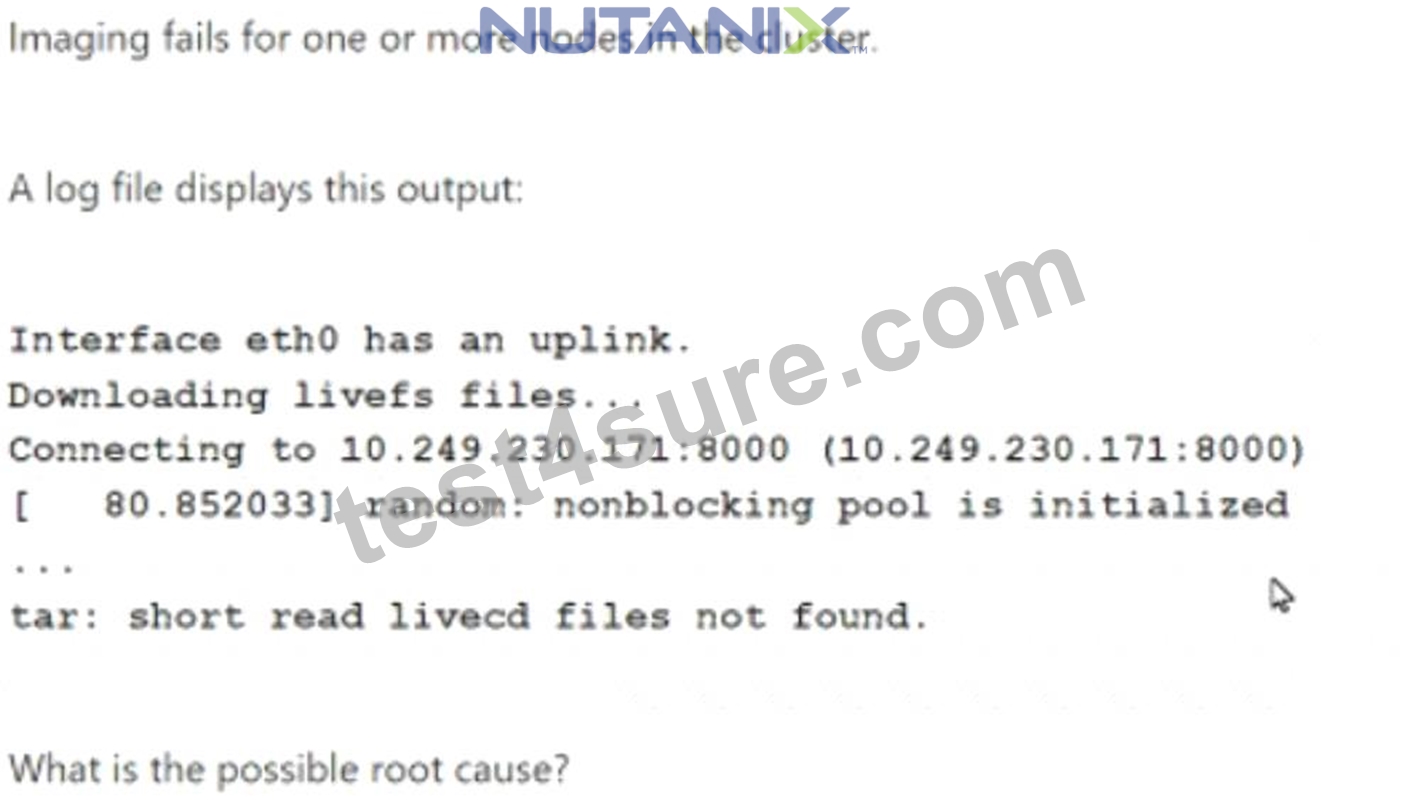
A log file displays this output:
Interface ethO has an uplink.
Downloading livefs files... Connecting to 10.249.230.171:8000 (10.249.230.171:8000) [80.852033] random:
nonblocking pool is initialized
tar: short read livecd files not found.
What is the possible root cause?
- A. Hypervisor version is not on the whitelist (iso_whitelist. j son).
- B. IPMI credentials are invalid.
- C. There is a problem connecting to the Foundation VM.
- D. AOS version is incompatible.
Answer: C
Explanation:
The log file output indicating a failure in downloading livefs files and problems finding the livecd files during node imaging suggests there is a problem connecting to the Foundation VM. The specific error "tar: short read livecd files not found" typically points to an interrupted or failed download process, which can be caused by connectivity issues between the nodes and the Foundation VM. Ensuring robust network connectivity or verifying network settings in the Foundation VM could resolve this issue.References: Nutanix Foundation Tool Error Messages, Nutanix Troubleshooting Documentation.
NEW QUESTION # 126
A Nutanix cluster is deployed with the following configuration:
* Three four-node blocks (A, B, and C)
* All Flash Redundancy Factor 2
What is the effect of simultaneous disk failures on two nodes located in block A?
- A. Each node with a failed disk is marked as degraded.
- B. VMs on the nodes with failed disks are unable to write data
- C. VM read and write operations continue normally.
- D. VMs are migrated off of the nodes with disk failures.
Answer: C
Explanation:
Ref: https://next.nutanix.com/how-it-works-22/redundancy-factor-vs-replication-factor-37486
NEW QUESTION # 127
A VM is exhibiting one or more of the following baseline values based on the past 30 days:
* CPU usage < 20%
* CPU ready time < 5%
* Memory usage < 50% (moderately) or < 20% (severely)
* Memory swap rate = 0 Kbps
Which type of VM is being described?
- A. Inactive VM
- B. Bully VM
- C. Over-Provisioned VM
- D. Constrained VM
Answer: C
Explanation: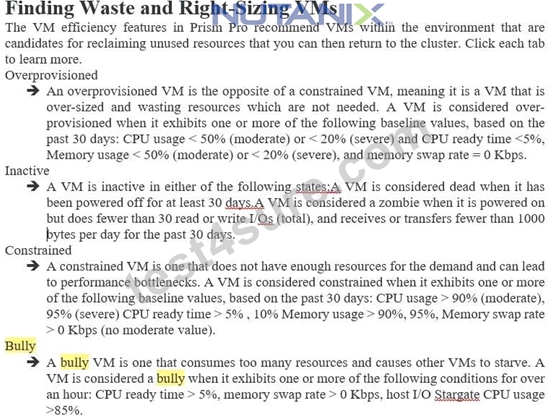
NEW QUESTION # 128
......
Get Ready with NCS-Core Exam Dumps: https://www.test4sure.com/NCS-Core-pass4sure-vce.html
Dependable NCS-Core Exam Dumps to Become Nutanix Certified: https://drive.google.com/open?id=16DDwn3nKn2q_dk9Ivjj1OYsHw4Ah171S