

Prepare L4M2 Question Answers - L4M2 Exam Dumps
Real CIPS L4M2 Exam Questions [Updated 2024]
CIPS L4M2 Exam covers a range of topics including procurement strategy development, market analysis, stakeholder management, risk management, and contract management. It is a comprehensive exam that requires candidates to have a deep understanding of the procurement process and the ability to apply this knowledge to real-world scenarios. Successful completion of L4M2 exam demonstrates that a candidate has the necessary knowledge and skills to develop effective procurement strategies that align with the business needs of an organization.
NEW QUESTION # 11
Which of the following specific markets is most likely to have product shortage by nature?
- A. Construction
- B. Retail
- C. Financial
- D. Agriculture
- E. Services
Answer: D
Explanation:
Products used in agriculture can be subject to shortage due to natural disasters.
Reference:
LO 2, AC 2.1
NEW QUESTION # 12
What is the purpose of sending value engineering analysis to external suppliers?
- A. To standardise production processed
- B. To improve early supplier involvement
- C. To improve the existing products
- D. To analyse the supply market
Answer: B
Explanation:
Value engineering is often applied to new products or services. Early supplier involvement (ESI) is the involvement of a supplier in the product development process from a very stage in order to use the supplier's experience and expertise. ESI can bring cost reduction opportunities, process improvements, supply chain improvements and reduce supply risk. Both processes focus on development of new product or service. They tend to work the best if they are used together.
LO 3, AC 3.1 & AC 3.4
NEW QUESTION # 13
Which of the following sources of information are considered as primary data? Select TWO that apply.
- A. The collection of data from surveying customers
- B. Commercial publishers of market reports
- C. The information about specific market sectors from trade associations
- D. RFI
- E. Reports in business magazines
Answer: A,D
Explanation:
The aim of this question is to check students' understanding of different types of data. There are 2 types of data:
- Primary data is the collection of original or raw data which are generated from field research. In this case, only RFI and surveys from customers are considered as primary data.
- On the other hand, secondary data is public information that has been collected by others. It is typically free or inexpensive to obtain and can act as a strong foundation to any research project - provided you know where to find it and how to judge its worth and relevance. Examples of secondary data are government statistics, industry associations, trade publications, published market reports, etc.
Reference:
LO 1, AC 1.2
NEW QUESTION # 14
When analyzing direct and indirect costs of potential suppliers for negotiations and planning pur-chasing budget, the procurement manager collects reports from specialist organisations like Mintel, Gartner and Forrester. Which kind of information source is used by the procurement manager?
- A. RFI
- B. Market data
- C. Technical data
- D. Company annual report
Answer: B
Explanation:
Using Porter's value chain helps procurement professionals know what are direct and indirect costs of supplier. Information on direct and indirect costs will have been collected as part of the market analysis. Information sources that may help include the following:
- Company annual reports
- Market data
- Technical data
- Request for information
- Plan visits
- Discount lists
Market data is the information that is collected and analysed by specialist organisations like Mintel, Gartner, Forrester,...
Reference:
LO 2, AC 2.3
NEW QUESTION # 15
When a procurement manager considers a substitution, the number and nature of additional func-tions that substitute provides should be taken into account carefully. Which of the following ratio could help the procurement manager to make the right decision?
- A. Price to book value ratio
- B. Value to price ratio
- C. Price to Earnings ratio
- D. Reserve requirement ratio
Answer: B
Explanation:
One product substitutes for another if it offers buyers an inducement to switch that exceeds the cost or overcomes the resistance to doing so. A substitute offers an inducement to switch if the substitute provides the buyer with more value relative to its price than the product currently being used. There is always some cost of switching to a substitute because of the disruption and potential reconfiguration of buyer activities that must result, however. The threat of a substitute will vary depending on the size of the inducement relative to the required switching costs.
In addition to relative value to price and switching cost, the pattern of substitution is influenced by what I term the buyer's propensity to switch. Faced with equivalent economic inducements for substitution, different buyers will often evaluate substitution differently. The threat of substitution, then, is a function of three factors:
* The relative value/ price of a substitute compared to an industry's product
* The cost of switching to the substitute
* The buyer's propensity to switch
Porter, Michael E.. Competitive Advantage: Creating and Sustaining Superior Performance (p. 278). Free Press. Kindle Edition.
The price-to-book ratio compares a company's market value to its book value. The market value of a company is its share price multiplied by the number of outstanding shares. The book value is the net assets of a company.
The price-to-earnings ratio (P/E ratio) is the ratio for valuing a company that measures its current share price relative to its earnings per share (EPS). The price-to-earnings ratio is also sometimes known as the price multiple or the earnings multiple.
The reserve ratio is the portion of reservable liabilities that commercial banks must hold onto, rather than lend out or invest. This is a requirement determined by the country's central bank, which in the United States is the Federal Reserve. It is also known as the cash reserve ratio.
LO 2, AC 2.2
NEW QUESTION # 16
Which kind of these following costs belong to fixed costs? Select TWO that apply.
- A. The costs of leasing or purchasing capital equipment
- B. The depreciation of capital inputs
- C. The packaging and distribution costs
- D. Energy consumption in manufacturing
- E. The annual income tax charged by local authorities
Answer: A,B
Explanation:
Based on variability, the costs has been classified into three categories, they are fixed, variable and semi variable. Fixed costs, as its name suggests, is fixed in total i.e. irrespective of the number of output produced. Variable costs vary with the number of output produced. Semi-variable is the type of costs, which have the characteristics of both fixed costs and variable costs (Source: Key Differences).
Among above costs, leasing and depreciation are relatively static and do not change if volume of business activities increase or reduce.
Packaging, utilities and annual business rate (tax) are variable costs.
Reference:
LO 1, AC 1.2
NEW QUESTION # 17
What is the document that defines the activities, deliverables and timelines a supplier must carry out during contract performance?
- A. Framework agreement
- B. Work instruction
- C. Statement of work
- D. Project initial document
Answer: C
Explanation:
Statement of Work (SoW) is the document that captures and defines all aspects of your project. You'll note the activities, deliverables and the timetable for the project. It's an extremely detailed document as it will lay the groundwork for the project plan.
Project Initial Document is an important document and should precede any specification writing project. It sets out the scope of the project and it is the team's mandate from senior management Work instructions are also called work guides, Standard Operating Procedures (SOPs), job aids or user manuals, depending on the situation. In any case, the purpose of work instructions is to clearly explain how a particular work task is performed.
Framework agreements are arrangements between one or more buyers and one or more suppliers that provide the terms governing contracts to be established for a certain period of time, in particular with regard to price and, where necessary, the quantity envisaged.
Reference:
LO 3, AC 3.1
NEW QUESTION # 18
This is the information on an organisation's activities over the past year
* Sale were $5,000,000. The value of accounts receivable was $450,000 at the start of the year and $525,000 at the end of the year
* The value of direct costs was $2,500,000 and 75% of this was bought on credit
* Indirect costs were $3,000,000 and 25% of this was bought on credit
* During the year the organization spent $1,500,000 on new assets and sold $150,000 of old assets. $1,000,000 of the spend on assets was funded by a bank loan
* The organization declared a dividend of $200,000 at the end of the year but this was not paid for another two months
* Opening balance was $175,000
Which of the following is the bank balance of that organization at the end of the year?
- A. $2,025,000
- B. $1,700,000
- C. $1,675,000
- D. $1,875,000
Answer: D
Explanation:
In this question, you should understand the concept of cash flow and formula of cash flow. Cash flow calculates the physical money moving in and out a company's bank balance. The cash flow from sale activity is:
cash flow from sale = account receivable at beginning of the year + revenue - account receivable at the end of the year = $450,000 + $5,000,000 - $525,000 = $4,925,000
75% of direct costs was bought by credit, therefore, the company spent 25% on direct cost: -$2,500,000*25/100 = -$625,000
25% of indirect costs was bought on credit. Cash flow out on indirect costs is: -$3,000,000*75/100 = -$2,250,000 Company spent $1,500,000 on new assets funded by a loan of $1,000,000. Cash flow out from this activity is -$500,000 Company received $150,000 from selling old assets Dividends have not been paid for another 2 months, thus, they are not accounted as cash flow out.
The bank balance at the end of the year is: $175,000 + $4,925,000 - $625,000 - $2,250,000 - $500,000 + $150,000 = $1,875,000 LO 1, AC 1.4
NEW QUESTION # 19
In 2016, ANA Airlines had to cancel some of its flight. The airline said it had discovered the cracks to the jet engine turbine blades. What should ANA procurement team do next to solve this problem?
- A. Assess the risks
- B. Collect data to identify the root cause
- C. Define the ideal solution
- D. Analyse the situation and draw conclusion
- E. Generate options addressing the issue
Answer: B
Explanation:
Cracks on the jet engine is a closed-end problem. A typical problem solving process has 8 steps:
Step 1: Define the Problem
- What is the problem?
- How did you discover the problem?
- When did the problem start and how long has this problem been going on?
- Is there enough data available to contain the problem and prevent it from getting passed to the next process step? If yes, contain the problem.
Step 2: Clarify the Problem
- What data is available or needed to help clarify, or fully understand the problem?
- Is it a top priority to resolve the problem at this point in time?
- Are additional resources required to clarify the problem? If yes, elevate the problem to your leader to help locate the right resources and form a team.
- Consider a Lean Event (Do-it, Burst, RPI, Project).
- Ensure the problem is contained and does not get passed to the next process step.
Step 3: Define the Goals
- What is your end goal or desired future state?
- What will you accomplish if you fix this problem?
- What is the desired timeline for solving this problem?
Step 4: Identify Root Cause of the Problem
- Identify possible causes of the problem.
- Prioritize possible root causes of the problem.
- What information or data is there to validate the root cause?
Step 5: Develop Action Plan
- Generate a list of actions required to address the root cause and prevent problem from getting to others.
- Assign an owner and timeline to each action.
- Status actions to ensure completion.
Step 6: Execute Action Plan
- Implement action plan to address the root cause.
- Verify actions are completed.
Step 7: Evaluate the Results
- Monitor and Collect Data.
- Did you meet your goals defined in step 3? If not, repeate th 8-Step Process.
- Were there any unforeseen consequences?
- If problem is resolved, remove activities that were added previously to contain the problem.
Step 8: Continuously Improve
- Look for additional opportunities to implement solution.
- Ensure problem will not come back and communicate lessons learned.
- If needed, repeat the 8-Step Problem Solving Process to drive further improvements.
ANA has already known what is going on, the next step they should adopt is collecting more infor-mation on the problem. If the airline is hurry to the solution, it may choose 'Generate options ad-dressing the issue'. The crack on turbine blade can be welded, or the airline replaces a new blade. However, jumping to solution without knowing the root cause does not completely solve the prob-lem. The root cause is unaddressed, then it may occur in the future. Therefore, the airline should still collect information to find the root cause, then remove it.
Reference:
LO 1, AC 1.1
NEW QUESTION # 20
Dana is an automobile manufacturer. It has a new electrification strategy that aims at making eco-friendly electric pick-up trucks. To implement this strategy, the procurement department must source new categories of parts that make motors, sensors, solenoids and stators. He starts to analyse the market by identifying specific supply market segments for those parts and finding suppliers who have the best capabilities in those segment. He intends to segment the market based on specific features of the products. Which variable is used by Dana procurement manager to shape and manage supply market?
- A. Buyer segments
- B. Product segments
- C. Geographical segments
- D. Channel segments
Answer: B
Explanation:
In sales and marketing, market segmentation is the process of trying to understand clusters of cus-tomers in terms of their buying behavior and their buying characteristics. There are some traditional segmentation approaches: geography, demography, types of industry and the benefits. Then there are newer segmentation approaches: behavioral, situational, and psychographic.
Procurement professionals can learn market segmentation from sales and marketing. Segmenting the market can help them to shape and manage the supply market effectively. According to Michael Porter, a market can be segment with array of products and buyers.
Source: Porter, Michael E.. Competitive Advantage: Creating and Sustaining Superior Performance (p. 234). Free Press. Kindle Edition.
In the scenario, the products that Dana needs to source is distinct in their features. The best way is to segment the market by product varieties.
Reference:
LO 2, AC 2.1
NEW QUESTION # 21
Which of the following are typical environmental considerations throughout the contract life cycle? Select the TWO that apply.
- A. Waste management
- B. Health and safety
- C. Pollution control
- D. Modern slavery
- E. Inequality
Answer: A,C
Explanation:
All procurement has some level of impact on the environment that needs to be minimised to ensure sustainable procurement practices.
The greatest opportunity to influence environmental outcomes is by selecting products and services with the least ongoing environmental impacts, such as use of water, electricity and fuel, waste/disposal management, and impact on human health over the life of the product or service.
Lifecycle stages that impact on the environment:
Most goods and services will have an element of environment impact in a number of areas. The five main impact areas are listed in the following table.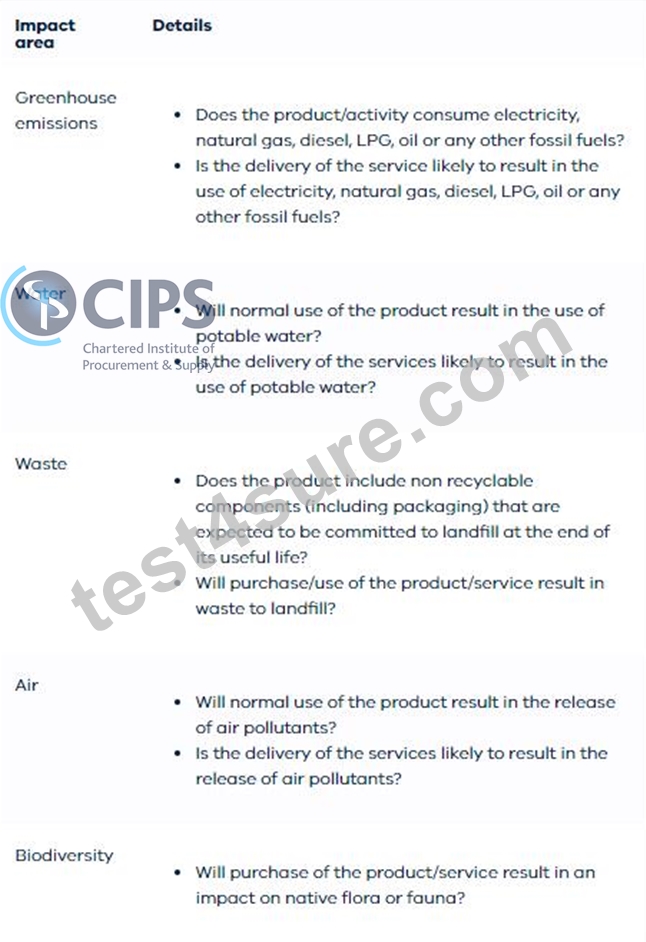
Source: Buying for Victoria
Reference:
LO 3, AC 3.2
NEW QUESTION # 22
Which of the following is the core of value analysis process?
- A. Evaluate
- B. Gather information
- C. Carry out functional analysis
- D. Be creative
- E. Develop
Answer: C
Explanation:
Value Analysis (VA) is concerned with existing products. It involves a current product being ana-lysed and evaluated by a team, to reduce costs, improve product function or both. Value Analysis exercises use a plan which step-by-step, methodically evaluates the product in a range of areas. These include costs, function, alternative components and design aspects such as ease of manufac-ture and assembly.
According to the Value Methodology standard, there are 6 phases to a Value Analysis:
- Information
- Function Analysis
- Creative
- Evaluation
- Development
- Presentation
1. Information
In this first phase, the team attempts to understand why the project exists and who or what it is to produce. They obtain project data, present the original design or product concepts, and understand the project scope. Schedule, costs, budget, risk, and other non-monetary issues are studied until the team is comfortable with the concept of the project, what it is to produce, and who its end users are.
This step also includes things like site visits and meetings with the project team, if required. Project documents like plans, drawings, specifications, and reports are obtained and the value engineering team becomes familiar with them.
2. Function Analysis
This step represents the meat and potatoes (core) of the value analysis. The team attempts to determine the functions the project serves. Functions come in two forms:
- Primary functions are those that represent the reason for the project's existence, for example, a building project might have adequate plumbing as a primary function.
- Secondary functions are those that the project serves without being core to the project. For example, a building project might have as a secondary function maintaining the view of the neighboring building.
The functions are described in verb/noun pairs, such as "supply water to all suites," or "Maintain view of adjacent park." For a project like this, the team should come up with 10 - 15 functions. You might be surprised how many secondary functions exist for most projects. Subject matter experts would be a great resource, but in their absence an appropriate level of brainstorming and analysis are necessary.
The team should also identify value-mismatched functions to focus the improvements on. For ex-ample, maybe a large obstruction is preventing the view of the adjacent park from too many suites resulting in a potential mismatch of the cost vs. functional benefit. This is investigated in the next step.
3. Creative
This phase represents the generation of improvement ideas. The team develops alternative ways that the project can perform the functions that have been identified. At this step, the functions are looked at individually and each one gets a list of alternative ways to perform the function. There is no judging between the importance of the various functions.
4. Evaluation
At this stage, a priority is given to each project improvement idea. The ideas are discussed and potential costs are determined. Once the risk-reward profile of each idea is itemized, the team has determined which ideas are worth implementing into the project or feature.
A few years ago, there was a pedestrian bridge built near my home which was originally designed for emergency vehicles. Although this type of design is standard practice for the bridges of this type, the value engineering team identified that emergency vehicle passage was not needed (verb/noun pair = 'maintain passage for emergency vehicles'). Also, a second major outcome of this value analysis was to change the design to an aesthetic, curved bridge because it was in a prominent location. The redesign of the bridge cost some money but this was more than made up by the cost of the bridge construction. Thus, the value analysis paid for itself about 10 times over in the reduced construction cost, and the bridge was significantly more aesthetic.
5. Development
Once the value improvement options have been whittled down to the ones that make sense, the value engineering team develop the options to the point of passing them back to the original project team. They must be clearly written and explained so that the project owner and stakeholders can understand how it benefits the project and act on it. Any potential negative factors are identified. Potential costs and cost savings are itemized.
6. Presentation
This last phase represents the presentation of the alternatives to the stakeholders. Often value engineering represents a change in the normal practices that people are used to, an "out of the box thinking." Thus the best salesperson on the team is often the best one to do the presentation.
Some typical products of a value engineering analysis are a briefing document, risk analy-sis, present worth analysis, advantages vs. disadvantages, etc.
Reference:
LO 3, AC 3.4
NEW QUESTION # 23
A company has a lists of items that make up 15% of total spend. These items also do not largely impact on quality of final product. The supply continuity is secured. Which of the following will be the most appropriate managing approach to purchase these items?
- A. Drive down cost based on market competition
- B. Simplify procurement process
- C. Enhance supply continuity
- D. Build partnership with suppliers
Answer: B
Explanation:
Those items make up small portion of spend and the supply risk is low. So it is tactical item according to Kraljic portfolio matrix. Procurement should bundle these items into larger contracts, simplify procurement process.
LO 2, AC 2.1
NEW QUESTION # 24
A procurement manager is discussing with other stakeholders about the scope and the implementation of the upcoming construction project. A stakeholder argues that the construction projects are often risky as the overall scope of the work can't be accurately estimated from the beginning. Furthermore, the project spans over a long period, the costs of materials can fluctuate widely. The procurement manager suggests that the pricing structure should be able to cover the supplier's costs plus 10% markup on total costs. This arrangement is known as...?
- A. Cost-plus incentive fee contracts
- B. Cost-plus award fee
- C. Cost-plus fixed-fee
- D. Cost-plus Fixed percentage
Answer: D
Explanation:
As you can see from the scenario, the procurement manager is suggesting to use cost plus pricing arrangement.
A cost-plus contract is an agreement to reimburse a company for expenses incurred plus a specific amount of profit, usually stated as a percentage of the contract's full price. These type of contracts are primarily used in construction where the buyer assumes some of the risk but also provides a degree of flexibility to the contractor.
Cost-plus contracts can be separated into four categories. They each allow for the reimbursement of costs as well as an additional amount for profit:
1. Cost-plus award fee contracts allow the contractor to be awarded a fee usually for good per-formance.
2. Cost-plus fixed-fee contracts cover both direct and indirect costs, in addition to a fixed fee.
3. Cost-plus incentive fee contracts happen when the contractor is given a fee if his or her perfor-mance meets or exceeds expectations.
4. Cost-plus percent-of-cost contracts allow the amount of reimbursement to rise if the contrac-tor's costs rise.
In the scenario, the procurement manager suggests a pricing structure that covers supplier's costs and adds 10% markup. This is cost-plus fixed-percentage.
Reference:
- Cost-Plus Contract Definition (investopedia.com)
- CIPS study guide page 30-36
LO 1, AC 1.2
NEW QUESTION # 25
Which of the following is the purpose of benchmarking?
- A. To resist continuous improvement
- B. To identify and adapt the best practices to improve organisation's performance
- C. To copy other organisation's intellectual properties, processes and practices
- D. To coerce all suppliers to sacrifice their profit
Answer: B
Explanation:
According to US Department of the Navy, Benchmarking is a strategic and analytic process of continuously measuring an organisation's products, services, and practices against a recognised leader in the studied area.
Successful benchmarking will help you:
- Find who does the process best and close the gap
- Recognise the leading organisations in a process or activity
- Create performance standards derived from an analysis of the best in business
- Ensure that comparisons are relevant
- Measure your performance, your processes, and your strategies against best in business
- Measure business processes
- Assess performance over time
- Accelerate continuous process improvement (CPI)
- Establish more credible goals for CPI
- Establish actionable objectives
- Discover and clarify new goals
- Establish customer expectations of business standards set by the best suppliers in industry
- Help your organisation achieve breakthrough improvements
- Create a sense of urgency for change
- Increase customer satisfaction
- Become direction setting
- Provide a positive, proactive structured process
Benchmarking does not:
- Copy the other's processes
- Steal other business confidentiality
- Stop. Benchmarking is a continuous process.
Reference:
- CIPS study guide page 49-51
- The Department of the Navy Benchmarking Handbook
LO 1, AC 1.3
NEW QUESTION # 26
Which of the following standards specifies requirements for a quality management system?
- A. ISO 27001
- B. ISO 9001:2015
- C. ISO 22000:2018
- D. ISO 14001:2015
Answer: B
Explanation:
ISO 9001:2015 specifies requirements for a quality management system.
ISO 14001:2015 specifies the requirements for an environmental management system that an or-ganization can use to enhance its environmental performance. ISO 14001:2015 is intended for use by an organization seeking to manage its environmental responsibilities in a systematic manner that contributes to the environmental pillar of sustainability.
ISO 22000:2018 specifies food safety management systems - Requirements for any organization in the food chain ISO 27001 provides requirements for an information security management system.
LO 3, AC 3.1
NEW QUESTION # 27
......
CIPS L4M2 (Defining Business Needs) Certification Exam is a globally recognized certification that assesses the knowledge and skills required to identify, analyze and define business needs in organizations. L4M2 exam is designed for professionals who work in or aspire to work in the field of business analysis. Defining Business Needs certification exam covers a wide range of topics, including business process analysis, stakeholder management, requirements elicitation, and solution assessment and validation.
L4M2 Exam Dumps Pass with Updated 2024: https://www.test4sure.com/L4M2-pass4sure-vce.html
Free L4M2 Exam Dumps to Pass Exam Easily: https://drive.google.com/open?id=175RWo8JDD-F7YjCmKaveRaK3efS2R4Wc