

Use the best ways of preparing for AZ-400 Exam Dumps with Test4Sure Microsoft AZ-400 dump PDF [2021]
Microsoft AZ-400 exam candidates will surely pass the Exam if they consider the AZ-400 dumps learning material presented by Test4Sure.
NEW QUESTION 132
You need to ensure that Microsoft Visual Studio 2017 can remotely attach to an Azure Function named fa-11566895.
To complete this task, sign in to the Microsoft Azure portal.
- A. Enable Remote Debugging
Before we start a debugging session to our Azure Function app we need to enable the functionality.
* Navigate in the Azure portal to your function app fa-11566895
* Go to the "Application settings"
* Under "Debugging" set Remote Debugging to On and set Remote Visual Studio version to 2017. - B. Enable Remote Debugging
Before we start a debugging session to our Azure Function app we need to enable the functionality.
* Navigate in the Azure portal to your function app fa-11566895
* Go to the "Application settings"
* Under "Debugging" set Remote Debugging to On and set Remote Visual Studio version to 2017.
Answer: A
Explanation:
Reference:
https://www.locktar.nl/uncategorized/azure-remote-debugging-manually-in-visual-studio-2017/
NEW QUESTION 133
You company uses Azure DevOps to deploy infrastructures to Azure.
Pipelines are developed by using YAML.
You execute a pipeline and receive the results in the web portal for Azure Pipelines as shown in the following exhibit.
Use the drop-down menus to select the answer choice that completes each statement based on the information presented in the graphic.
NOTE: Each correct selection is worth one point.
Answer:
Explanation:
Explanation
Reference:
https://dev.to/rajikaimal/azure-devops-ci-cd-yaml-pipeline-4glj
NEW QUESTION 134
You currently use JIRA, Jenkins, and Octopus as part of your DevOps processes.
You plan to use Azure DevOps to replace these tools.
Which Azure DevOps service should you use to replace each tool? To answer, select the appropriate options in the answer area.
NOTE: Each correct selection is worth one point.
Answer:
Explanation:
Explanation
JIRA: Release pipelines
Atlassian's Jira Software is a popular application that helps teams to plan, track, and manage software releases, whereas Octopus Deploy helps teams automate their development and operations processes in a fast, repeatable, and reliable manner. Together, they enable teams to get better end-to-end visibility into their software pipelines from idea to production.
Jenkins: Repos
One way to integrate Jenkins with Azure Pipelines is to run CI jobs in Jenkins separately. This involves configuration of a CI pipeline in Jenkins and a web hook in Azure DevOps that invokes the CI process when source code is pushed to a repository or a branch.
Octopus: Build pipelines
References:
https://octopus.com/blog/octopus-jira-integration
https://www.azuredevopslabs.com/labs/vstsextend/jenkins/
NEW QUESTION 135
You need to create deployment files for an Azure Kubernetes Service (AKS) cluster. The deployments must meet the provisioning storage requirements shown in the following table.
Which resource type should you use for each deployment? To answer, select the appropriate options in the answer area.
NOTE: Each correct selection is worth one point.
Answer:
Explanation:
Explanation
Deployment 1: Kubernetes.io/azure-file
You can use Azure Files to connect using the Server Message Block (SMB) protocol.
Deployment 2: Kubernetes.io/azure-disk
Deployment 3: azurekeyvault-flexvolume
azurekeyvault-flexvolume: Key Vault FlexVolume: Seamlessly integrate your key management systems with Kubernetes.
Secrets, keys, and certificates in a key management system become a volume accessible to pods. Once the volume is mounted, its data is available directly in the container filesystem for your application.
NEW QUESTION 136
You are implementing a package management solution for a Node.js application by using Azure Artifacts.
You need to configure the development environment to connect to the package repository. The solution must minimize the likelihood that credentials will be leaked.
Which file should you use to configure each connection? To answer, drag the appropriate files to the correct connections. Each file may be used once, more than once, or not at all. You may need to drag the split bar between panes or scroll to view content NOTE: Each correct selection is worth one point.
Answer:
Explanation:
Explanation
All Azure Artifacts feeds require authentication, so you'll need to store credentials for the feed before you can install or publish packages. npm uses .npmrc configuration files to store feed URLs and credentials. Azure DevOps Services recommends using two .npmrc files.
Feed registry information: The .npmrc file in the project
One .npmrc should live at the root of your git repo adjacent to your project's package.json. It should contain a
"registry" line for your feed and it should not contain credentials since it will be checked into git.
Credentials: The .npmrc file in the user's home folder
On your development machine, you will also have a .npmrc in $home for Linux or Mac systems or
$env.HOME for win systems. This .npmrc should contain credentials for all of the registries that you need to connect to. The NPM client will look at your project's .npmrc, discover the registry, and fetch matching credentials from $home/.npmrc or $env.HOME/.npmrc.
References:
https://docs.microsoft.com/en-us/azure/devops/artifacts/npm/npmrc?view=azure-devops&tabs=windows
NEW QUESTION 137
You use Azure DevOps to manage the build and deployment of an app named App1.
You have a release pipeline that deploys a virtual machine named VM1.
You plan to monitor the release pipeline by using Azure Monitor
You need to create an alert to monitor the performance of VM1. The alert must be triggered when the average CPU usage exceeds 70 percent for five minutes. The alert must calculate the average once every minute.
How should you configure the alert rule? To answer, select the appropriate options in the answer area.
Answer:
Explanation:
Explanation
Box 1: 5 minutes
The alert must calculate the average once every minute.
Note: We [Microsoft] recommend choosing an Aggregation granularity (Period) that is larger than the Frequency of evaluation, to reduce the likelihood of missing the first evaluation of added time series Box 2: Static Box 3: Greater than Example, say you have an App Service plan for your website. You want to monitor CPU usage on multiple instances running your web site/app. You can do that using a metric alert rule as follows:
* Target resource: myAppServicePlan
* Metric: Percentage CPU
* Condition Type: Static
* Dimensions
* Instance = InstanceName1, InstanceName2
* Time Aggregation: Average
* Period: Over the last 5 mins
* Frequency: 1 min
* Operator: GreaterThan
* Threshold: 70
* Like before, this rule monitors if the average CPU usage for the last 5 minutes exceeds 70%.
* Aggregation granularity
Reference:
https://docs.microsoft.com/en-us/azure/azure-monitor/platform/alerts-metric-overview
NEW QUESTION 138
You have a private GitHub repository.
You need to display the commit status of the repository on Azure Boards.
What should you do first?
- A. Configure multi-factor authentication (MFA) for your GitHub account.
- B. Create a GitHub action in GitHub.
- C. Add the Azure Pipelines app to the GitHub repository.
- D. Add the Azure Boards app to the repository.
Answer: D
Explanation:
To connect Azure Boards to GitHub.com, connect and configure from Azure Boards. Or, alternatively, install and configure the Azure Boards app from GitHub. Both methods have been streamlined and support authenticating and operating via the app rather than an individual.
Note (see step 4 below):
Add a GitHub connection:
Sign into Azure Boards.
Choose (1) Project Settings, choose (2) GitHub connections and then (3) Connect your GitHub account.
If this is your first time connecting to GitHub from Azure Boards, you will be asked to sign in using your GitHub credentials. Choose an account for which you are an administrator for the repositories you want to connect to.
The Add GitHub Repositories dialog automatically displays and selects all GitHub.com repositories for which you are an administrator. Unselect any repositories that you don't want to participate in the integration.
Reference:
https://docs.microsoft.com/en-us/azure/devops/boards/github/connect-to-github
NEW QUESTION 139
You are building a Microsoft ASP.NET application that requires authentication. You need to authenticate users by using Azure Active Directory (Azure AD). What should you do first?
- A. Create an app registration in Azure AD.
- B. Assign an enterprise application to users and groups.
- C. Create a membership database in an Azure SQL database.
- D. Create a new OAuth token from the application.
- E. Configure the application to use a SAML endpoint.
Answer: A
Explanation:
Register your application to use Azure Active Directory. Registering the application means that your developers can use Azure AD to authenticate users and request access to user resources such as email, calendar, and documents.
Reference:
https://docs.microsoft.com/en-us/azure/active-directory/manage-apps/developer-guidance-for-integrating-applications
https://docs.microsoft.com/en-us/azure/active-directory/develop/quickstart-v2-aspnet-webapp
NEW QUESTION 140
You have an Azure DevOps project that contains a build pipeline. The build pipeline uses approximately 50 open source libraries.
You need to ensure that the project can be scanned for known security vulnerabilities in the open source libraries.
What should you do? To answer, select the appropriate options in the answer area.
NOTE: Each correct selection is worth one point.
Answer:
Explanation:
Explanation
Box 1: A Build task
Trigger a build
You have a Java code provisioned by the Azure DevOps demo generator. You will use WhiteSource Bolt extension to check the vulnerable components present in this code.
* Go to Builds section under Pipelines tab, select the build definition WhiteSourceBolt and click on Queue to trigger a build.
* To view the build in progress status, click on ellipsis and select View build results.
Box 2: WhiteSource Bolt
WhiteSource is the leader in continuous open source software security and compliance management.
WhiteSource integrates into your build process, irrespective of your programming languages, build tools, or development environments. It works automatically, continuously, and silently in the background, checking the security, licensing, and quality of your open source components against WhiteSource constantly-updated denitive database of open source repositories.
References:
https://www.azuredevopslabs.com/labs/vstsextend/whitesource/
NEW QUESTION 141
You use Azure Artifacts to host NuGet packages that you create.
You need to make one of the packages available to anonymous users outside your organization. The solution must minimize the number of publication points.
What should you do?
- A. Create a new feed for the package
- B. Publish the package to a public NuGet repository.
- C. Change the feed URL of the package.
- D. Promote the package to a release view.
Answer: A
NEW QUESTION 142
You need to increase the security of your team's development process.
Which type of security tool should you recommend for each stage of the development process? To answer, drag the appropriate security toots to the correct stages. Each security tool may be used once, more than once, or not at all. You may need to drag the split bar between panes or scroll to view content NOTE: Each correct selection is worth one point.
Answer:
Explanation:
Explanation:
Box 1: Threat modeling
Threat modeling's motto should be, "The earlier the better, but not too late and never ignore." Box 2: Static code analysis Validation in the CI/CD begins before the developer commits his or her code. Static code analysis tools in the IDE provide the first line of defense to help ensure that security vulnerabilities are not introduced into the CI/CD process.
Box 3: Penetration testing
Once your code quality is verified, and the application is deployed to a lower environment like development or QA, the process should verify that there are not any security vulnerabilities in the running application. This can be accomplished by executing automated penetration test against the running application to scan it for vulnerabilities.
References:
https://docs.microsoft.com/en-us/azure/devops/articles/security-validation-cicd-pipeline?view=vsts
Topic 1, Overview
Existing Environment
Litware, Inc. an independent software vendor (ISV) Litware has a main office and five branch offices.
Application Architecture
The company' s primary application is a single monolithic retirement fund management system based on ASP.NE T web forms that use logic written in V8.NET. Some new sections of the application are written in C#.
Variations of the application are created for individual customers. Currently, there are more than 80 have code branches in the application's code base.
The application was developed by using Microsoft Visual Studio. Source code is stored in Team Foundation Server (TFS) in the main office. The branch offices access of the source code by using TFS proxy servers.
Architectural Issues
Litware focuses on writing new code for customers. No resources are provided to refactor or remove existing code. Changes to the code base take a long time, AS dependencies are not obvious to individual developers.
Merge operations of the code often take months and involve many developers. Code merging frequently introduces bugs that are difficult to locate and resolve.
Customers report that ownership costs of the retirement fund management system increase continually. The need to merge unrelated code makes even minor code changes expensive.
Requirements
Planned Changes
Litware plans to develop a new suite of applications for investment planning. The investment planning Applications will require only minor integration with the easting retirement fund management system.
The investment planning applications suite will include one multi-tier web application and two iOS mobile applications. One mobile application will be used by employees; the other will be used by customers.
Litware plans to move to a more agile development methodology. Shared code will be extracted into a series of package.
Litware has started an internal cloud transformation process and plans to use cloud based services whenever suitable.
Litware wants to become proactive m detecting failures, rather than always waning for customer bug reports.
Technical Requirements
The company's investment planning applications suite must meet the following technical requirements:
* New incoming connections through the firewall must be minimized.
* Members of a group named Developers must be able to install packages.
* The principle of least privilege must be used for all permission assignments
* A branching strategy that supports developing new functionality in isolation must be used.
* Members of a group named Team leaders must be able to create new packages and edit the permissions of package feeds
* Visual Studio App Center must be used to centralize the reporting of mobile application crashes and device types in use.
* By default, all App Center must be used to centralize the reporting of mobile application crashes and device types in use.
* Code quality and release quality are critical. During release, deployments must not proceed between stages if any active bugs are logged against the release.
* The mobile applications must be able to call the share pricing service of the existing retirement fund management system. Until the system is upgraded, the service will only support basic authentication over HUPS.
* The required operating system configuration tor the test servers changes weekly. Azure Automation State Configuration must be used to ensure that the operating system on each test servers configured the same way when the servers are created and checked periodically.
Current Technical
The test servers are configured correctly when first deployed, but they experience configuration drift over time. Azure Automation State Configuration fails to correct the configurations.
Azure Automation State Configuration nodes are registered by using the following command.
NEW QUESTION 143
Your company has a project in Azure DevOps for a new web application.
The company uses Service Now for change management.
You need to ensure that a change request is processed before any components can be deployed to the production environment.
What are two ways to integrate into the Azure DevOps release pipeline? Each correct answer presents a complete solution.
NOTE: Each correct selection is worth one point.
- A. Define a deployment control that invokes the Service Now SOAP API.
- B. Define a post deployment gate after the deployment to the QA stage.
- C. Define a deployment control that invokes the ServiceNow REST API.
- D. Define a pre deployment gate before the deployment to the Prod stage.
Answer: B,D
Explanation:
Explanation
An example of a release pipeline that can be modeled through a release pipeline in shown below:
In this example, a release of a website is created by collecting specific versions of two builds (artifacts), each from a different build pipeline. The release is first deployed to a Dev stage and then forked to two QA stages in parallel. If the deployment succeeds in both the QA stages, the release is deployed to Prod ring 1 and then to Prod ring 2. Each production ring represents multiple instances of the same website deployed at various locations around the globe.
References: https://docs.microsoft.com/en-us/azure/devops/pipelines/release
Topic 1, Case Study: 2Overview
Existing Environment
This is a case study Case studies are not limed separately. You can use as much exam time at you would like to complete each case. However there may be additional case studies and sections on this exam. You must manage your time to ensure that you are able to complete all questions included on this exam in the time provided.
To answer the questions included in a case study, you will need to reference information that is provided m the case study Case studies might contain exhibits and other resources that provide more information about the scenario that is described in the case study. Each question is independent of the other questions in this case study.
At the end of the case study, a review screen will appear. This screen allows you to review your answers and to mate changes before you move to the next section of the exam, After you begin a new section, you cannot return to this section.
To start the case study
To display the first question in this case study, click the Next button. Use the buttons in the left pane to explore the content of the case study before you answer the questions. Clicking these buttons displays information such as business requirements, existing environment and problem statements. If the case study has an All Information tab, note that the information displayed on identical to the Information displayed on the subsequent tabs. When you are ready to answer a question, click the Question button to return to the question.
Requirements
Contoso plans to improve its IT development and operations processes implementing Azue DevOps principles.
Contoso has an Azure subscription and creates an Azure DevOPs organization.
The Azure DevOps organization includes:
* The Docker extension
* A deployment pool named Pool7 that contains 10 Azure virtual machines that run Windows Server
2016.
The Azure subscription contains an Azure Automation account.
Planned Changes
Contoso plans to create projects in Azure DevOps as shown in the following table.
Technical Requirements
Contoso identities the following technical requirements:
* Implement build agents rot Project 1.
* Whenever possible, use Azure resources
*Avoid using deprecated technologies
* Implement a code flow strategy for Project2 that will:
*Enable Team 2 to submit pull requests for Project2.
* Enable Team 2 to work independently on changes to a copy of Project?
* Ensure that any intermediary changes performed by Tram2 on a copy of Project2 will be subject to the same restrictions as the ones defied in the build policy of Project2.
* Whenever possible. Implement automation and minimize administrative effort.
* Implement Protect3, Project5, Project6, and Project7 based on the planned changes.
* Implement Project4 and configure the project to push Docker images to Azure Container Reentry.
NEW QUESTION 144
Your company has four projects. The version control requirements for each project are shown in the following table.
You plan to use Azure Repos for all the projects.
Which version control system should you use for each project? To answer, drag the appropriate version control systems to the correct projects. Each version control system may be used once, more than once, or not at all.
You may need to drag the split bar between panes or scroll to view content.
NOTE: Each correct selection is worth one point.
Answer:
Explanation:
Explanation
Box 1: Team Foundation Version Control
TFVC lets you apply granular permissions and restrict access down to a file level.
Box 2: Git
Git is the default version control provider for new projects. You should use Git for version control in your projects unless you have a specific need for centralized version control features in TFVC.
Box 3: Subversion
Note: Xcode is an integrated development environment (IDE) for macOS containing a suite of software development tools developed by Apple Box 4: Git Note: Perforce: Due to its multitenant nature, many groups can work on versioned files. The server tracks changes in a central database of MD5 hashes of file content, along with descriptive meta data and separately retains a master repository of file versions that can be verified through the hashes.
References:
https://searchitoperations.techtarget.com/definition/Perforce-Software
https://docs.microsoft.com/en-us/azure/devops/repos/git/share-your-code-in-git-xcode
https://docs.microsoft.com/en-us/azure/devops/repos/tfvc/overview
NEW QUESTION 145
Your company plans to deploy an application to the following endpoints:
* Ten virtual machines hosted in Azure
* Ten virtual machines hosted in an on-premises data center environment All the virtual machines have the Azure Pipelines agent.
You need to implement a release strategy for deploying the application to the endpoints.
What should you recommend using to deploy the application to the endpoints? To answer, drag the appropriate components to the correct endpoints. Each component may be used once, more than once, or not at all. You may need to drag the split bar between panes or scroll to view content.
NOTE: Each correct selection is worth one point.
Answer:
Explanation:
Explanation:
Box 1: A deployment group
When authoring an Azure Pipelines or TFS Release pipeline, you can specify the deployment targets for a job using a deployment group.
If the target machines are Azure VMs, you can quickly and easily prepare them by installing the Azure Pipelines Agent Azure VM extension on each of the VMs, or by using the Azure Resource Group Deployment task in your release pipeline to create a deployment group dynamically.
Box 2: A deployment group
References: https://docs.microsoft.com/en-us/azure/devops/pipelines/release/deployment-groups
NEW QUESTION 146
You have an Azure Kubermets Service (AKS) implementation that is RBAC-enabled You plan to use Azure Container Instances as a hosted development environment to run containers in the AKS implementation.
You need to conjure Azure Container Instances as a hosted environment for running me containers in AKS.
Which three actions should you perform m sequence?
To answer, move the appropriate actions from the list of actions to the answer area and arrange them in the correct order.
Answer:
Explanation:
Explanation
Step 1: Create a YAML file.
If your AKS cluster is RBAC-enabled, you must create a service account and role binding for use with Tiller.
To create a service account and role binding, create a file named rbac-virtual-kubelet.yaml Step 2: Run kubectl apply.
Apply the service account and binding with kubectl apply and specify your rbac-virtual-kubelet.yaml file.
Step 3: Run helm init.
Configure Helm to use the tiller service account:
helm init --service-account tiller
You can now continue to installing the Virtual Kubelet into your AKS cluster.
References: https://docs.microsoft.com/en-us/azure/aks/virtual-kubelet
NEW QUESTION 147
How should you configure the release retention policy for the investment planning applications suite? To answer, select the appropriate options in the answer area.
NOTE: Each correct selection is worth one point.
Answer:
Explanation:
Explanation
Scenario: By default, all releases must remain available for 30 days, except for production releases, which must be kept for 60 days.
Box 1: Set the default retention policy to 30 days
The Global default retention policy sets the default retention values for all the build pipelines. Authors of build pipelines can override these values.
Box 2: Set the stage retention policy to 60 days
You may want to retain more releases that have been deployed to specific stages.
References: https://docs.microsoft.com/en-us/azure/devops/pipelines/policies/retention
NEW QUESTION 148
How should you configure the filters for the Project5 trigger? To answer, select the appropriate option in the answer area.
NOTE: Each correct selection is worth one point.
Answer:
Explanation:
Explanation
Scenario:
References: https://docs.microsoft.com/en-us/azure/devops/pipelines/build/triggers
NEW QUESTION 149
You use Azure Pipelines lo manage the build and deployment of apps.
You are planning the release strategies for a new app. You need to choose strategies for the following scenarios:
* Releases will be made available to users who are grouped by their tolerance for software faults.
* Code will be deployed to enable functionality that will be available in later releases of the app.
* When a new release occurs, the existing deployment will remain active to minimize recovery time if a return to the previous version is required.
Answer:
Explanation: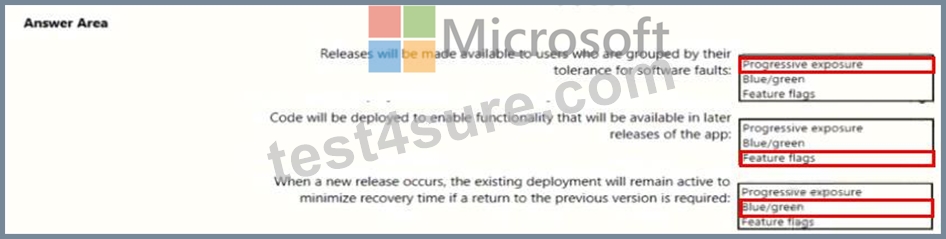
Reference:
https://docs.microsoft.com/en-us/azure/devops/learn/what-is-continuous-delivery
https://docs.microsoft.com/en-us/azure/devops/migrate/phase-features-with-feature-flags
https://medium.com/@denniszielke/continuous-kubernetes-blue-green-deployments-on-azure-using-nginx-appgateway-or-trafficmanager-4490bce29cb
NEW QUESTION 150
......
Full AZ-400 Practice Test and 329 unique questions with explanations waiting just for you, get it now: https://drive.google.com/open?id=1UMbkblE9gUnGpurU0ifhcYCNLS71uVY4
Accurate & Verified Answers As Seen in the Real Exam here: https://www.test4sure.com/AZ-400-pass4sure-vce.html