

2024 PEGAPCDC87V1 Premium Files Test pdf - Free Dumps Collection
Get ready to pass the PEGAPCDC87V1 Exam right now using our Pega PCDC Exam Package
The PEGAPCDC87V1 exam is a certification offered by Pegasystems for those seeking to become a Certified Pega Decisioning Consultant. PEGAPCDC87V1 exam is designed to test the candidate's knowledge and skills related to Pega Decisioning, and to ensure that they are capable of utilizing Pega's decisioning tools to create effective and efficient business solutions. Certified Pega Decisioning Consultant (PCDC) 87V1 certification is recognized globally and is highly valued by employers seeking professionals with expertise in Pega Decisioning.
NEW QUESTION # 79
To calculate the total number of customer responses of four actions in a group, you must use________________.
- A. four Set Property components
- B. one Set Property component
- C. one Group By component
- D. four Group By components
Answer: C
Explanation:
Grouping Actions: To calculate the total number of customer responses of four actions in a group, you need to use one Group By component. This component can aggregate responses across multiple actions within a strategy.
Implementation: Add a Group By component to the decision strategy, configure it to group by the desired property, and aggregate the responses from the four actions.
NEW QUESTION # 80
Reference module: Creating engagement strategies using customer credit score.
MyCo, a mobile company, uses a scorecard rule in a decision strategy to compute the postpaid credit limit for a customer. MyCo updated their scorecard to include a new property in the calculation: customer annual income.As a Strategy Designer, what changes do you need to make to the decision strategy for the updated scorecard to take effect?
- A. Add a Set-Property component to set the annual customer income
- B. Configure a new proposition filter in the strategy to filter on annual customer income
- C. No change required
- D. Remap the <Customer.annual customer income> property in the decision strategy
Answer: C
Explanation:
Context of Scorecard Update:
* MyCo updated their scorecard rule to include a new property, customer annual income, for computing the postpaid credit limit.
* This update affects how the scorecard calculates the credit limit.
Impact on Decision Strategy:
* The scorecard rule automatically includes the new property in its calculations.
* The decision strategy references the scorecard rule as a whole, not individual properties.
Reason for No Change Required:
* Since the scorecard rule is updated independently, the decision strategy using this rule will automatically reflect the new calculations.
* There is no need to manually update the decision strategy to accommodate this change.
Verification from Pega Documentation:
* Pega's documentation confirms that updates to scorecard rules are automatically integrated into decision strategies using those rules.
NEW QUESTION # 81
MyCo, a telecom company, wants to send promotional emails to give away phone accessories. The accessories can only be given away in batches of 50. When the stock in a batch is completed, a new batch can be promoted again.
You have decided to use volume constraint to limit the number of actions in a batch. To meet the business requirement, what Reset Interval setting do you select?
- A. When accessed
- B. Daily
- C. Reset Interval does not matter for this scenario
- D. Manual
Answer: D
NEW QUESTION # 82
Through analysis of customer lifecycles, Next-Best-Action ________
- A. identifies global sales targets
- B. provides fulfillment services
- C. anticipates retention issues
- D. provides future sales reports
Answer: C
Explanation:
Next-Best-Action leverages customer lifecycle analysis to anticipate retention issues. By analyzing patterns and trends in customer behavior, Next-Best-Action strategies can proactively address potential retention problems and enhance customer engagement to prevent churn.
NEW QUESTION # 83
A volume constraint is configured to apply constraints to actions as a group rather than for each action individually. A customer qualifies for 3 actions, and the volume limit on the top-ranked action is above zero, the limits on the 2 lower-ranked actions have been reached. Given this scenario, how many actions will be selected for the customer in the outbound run?
- A. 0
- B. 1
- C. 2
- D. 3
Answer: C
Explanation:
Understanding Volume Constraints:
* Volume constraints can be applied to limit the number of actions offered to customers.
* Constraints can be set to apply to actions as a group or individually.
Scenario Analysis:
* In the given scenario, a customer qualifies for three actions.
* The top-ranked action has not reached its volume limit, but the lower-ranked actions have.
* Since the constraints are applied as a group, if the top-ranked action is available, it will be selected.
* The lower-ranked actions, having reached their limits, will not be selected.
Conclusion:
* Only the top-ranked action will be selected for the customer in the outbound run.
NEW QUESTION # 84
U+ Bank, a retail bank, wants to send promotional emails related to credit card offers to their qualified customers. You have already created an action flow template with the desired flow pattern and reused it for all the credit card actions.
What must you do to ensure that this action is not selected for any customers?
- A. Set the action availability to Always
- B. Set the action availability to Within a defined time period
- C. Set the action availability to Never
- D. Set the action availability to Template
Answer: C
Explanation:
Action Availability Configuration: To ensure that a specific action is not selected for any customers, you need to set its availability to "Never." This setting ensures that the action will not be available for selection in any campaign or strategy, effectively preventing its use.
Implementation: Navigate to the action configuration settings and set the availability to "Never." This will ensure that the action is not picked up by the decision strategy or any outbound run.
NEW QUESTION # 85
In a Decisioning Strategy, which decision component is required to enable access to the Customer properties like age, income, etc.?
- A. Proposition Data
- B. Data Import
- C. Set Property
- D. None, properties are available
Answer: B
Explanation:
To enable access to customer properties such as age, income, etc., in a decision strategy, the Data Import component is required. This component imports the relevant customer data into the strategy so it can be utilized for decision-making processes.
NEW QUESTION # 86
Reference module: Essentials of always-on outbound.
A U+ bank customer tries to initiate a fund transfer. Due to a slow internet connection, the transfer ends abruptly. The bank then sends an email with a link to continue the incomplete transaction. Which type of outbound interaction is this?
- A. Customer event
- B. Priority communication
- C. Security event
- D. Scheduled update
Answer: A
NEW QUESTION # 87
U+ Bank uses Pega Customer Decision Hub to display an offer to its customers on the U+ Bank website.
The bank wants to ensure that Silver credit cards are not offered to customers under 27 years of age. They also want to ensure that Platinum cards are offered only to customers who had a positive balance in the last year.
What do you configure in the Next-Best-Action Designer to achieve this outcome?
- A. Arbitration rules
- B. Customer segments
- C. Contact policy rules
- D. Engagement policies
Answer: D
NEW QUESTION # 88
U+ Bank, a retail bank, uses the Business Operations Environment to perform its Business changes. The bank carries out these changes in the Pega Customer Decision Hub portal by using revision management features or the 1:1 operations Manager Portal.
Customers see credit card offers based on various engagement policies on the U+ Bank website. The bank wants to update the underlying decision strategy of an engagement policy condition. In which portal do you create the change request to fulfill new business requirement?
- A. Pega Customer Decision Hub Portal
- B. 1:1 Operations Manager Portal
- C. Dcv studio portal
- D. Development Manager Portal
Answer: B
Explanation:
To update the underlying decision strategy of an engagement policy condition, the change request should be created in the 1:1 Operations Manager Portal. This portal is designed for business users to manage changes and revisions in a controlled environment.
* Understanding the Portals:
* 1:1 Operations Manager Portal: This portal allows business users to manage and implement business changes, such as updating decision strategies and engagement policies.
* Pega Customer Decision Hub Portal: This portal is used for overall customer decision management but not specifically for creating change requests.
* Dev Studio Portal: This portal is more technical and used for developing and configuring applications.
* Development Manager Portal: This is generally used for deployment and managing development pipelines.
* Steps to Create a Change Request:
* Step 1: Log into the 1:1 Operations Manager Portal.
* Step 2: Navigate to the section where you can create a new change request.
* Step 3: Specify the details of the change request, including the engagement policy and the decision strategy that needs to be updated.
* Step 4: Submit the change request for approval and implementation.
* Benefits:
* Using the 1:1 Operations Manager Portal ensures that changes are tracked, reviewed, and approved through a formal process, maintaining governance and control over business operations.
* Example:
* U+ Bank wants to update the decision strategy for credit card offers. A change request is created in the 1:1 Operations Manager Portal, detailing the required updates to the engagement policy conditions.
References:
* Pega-Customer-Decision-Hub-User-Guide-85.pdf: "Managing business-as-usual changes with Pega 1:1 Operations Manager" section.
* Pega documentation on "Revision management and change request process".
NEW QUESTION # 89
U+ Bank, a retail bank, uses the always-on outbound approach to send outbound messages on different channels such as email, SMS, and push notifications. There are a variety of action flow patterns in use to meet various business and channel integrations requirements.
Due to technical reasons, the bank wants to temporarily suspend sending outbound messages and instead write the selected customers and action details to a database table for later offline processing.
What is the most efficient way to meet this requirement?
- A. Add a new Send shape in all the action flows.
- B. Update the Send shape with Finalization.
- C. Set up a secondary schedule.
- D. Bypass action flow processing.
Answer: D
NEW QUESTION # 90
To access a property from an unconnected component, you use the____________.
- A. customer-dot-property construct
- B. dot-property value directly
- C. component-dot-property construct
- D. property value
Answer: C
NEW QUESTION # 91
A customer contacts a bank to resolve a credit card dispute. After dispute resolution, Next-Best-Action displays a set of sales offers that a Customer Service Representative can present to the customer.
Which feature of Next-Best-Action helps the Customer Service Representative decide on the offer to present to the customer?
- A. Offers ranking
- B. Interaction history
- C. Dispute handling strategy
- D. Call intent detection
Answer: A
NEW QUESTION # 92
U+ Bank wants to offer credit cards only to low-risk customers. The customers are divided into various risk segments from Good to Very Poor. The risk segmentation rules that the business provides use the Average Balance and the customer Credit Score.
As a decisioning consultant, you decide to use a decision table and a decision strategy to
accomplish this requirement in Pega Customer Decision Hub.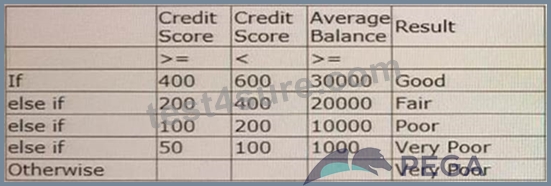
Which property allows you to use the risk segment computed by the decision table in the decision strategy?
- A. pxSegment
- B. pxResu/t
- C. pxOutcome
- D. pxRiskSegment
Answer: A
NEW QUESTION # 93
Myco, a telecom company, uses Pega Customer Decision Hub to present offers to qualified customers. The business recently decided to send offer messages through the email channel. The Design department has designed an email treatment which includes dynamic placeholders.
As a decisioning consultant, what do you use in order to test the visualization and the rendering of the email content, including replacing of the placeholders with customer information?
- A. a seed list from the Test Message tab
- B. a list of customer email addresses from the Test Message tab
- C. preview section from the email content editor
- D. schedule an outbound run with a limited number of customers
Answer: A
NEW QUESTION # 94
DRAG DROP
You are a strategy designer on a next-best-action project and are responsible for designing
and implementing decision strategies.
Select each component on the left and drag it to the correct requirement on the right.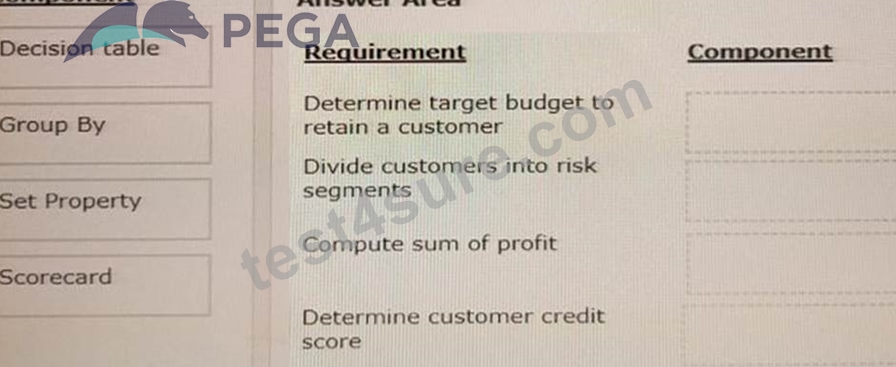
Answer:
Explanation: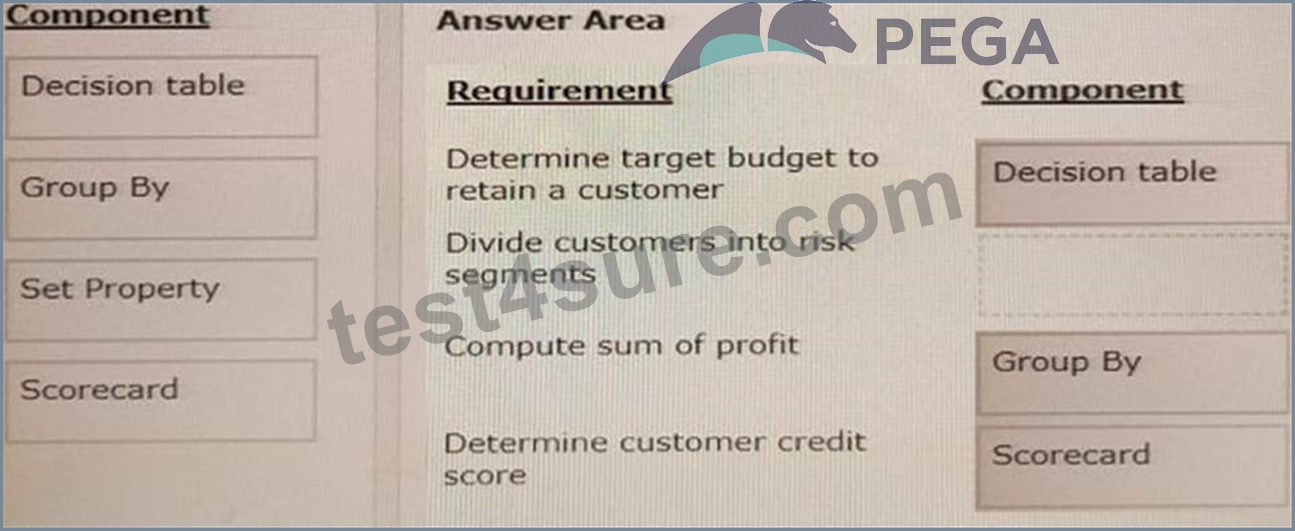
NEW QUESTION # 95
MyCo, a mobile company, uses Pega Customer Decision Hub to display offers to customers on its website.
The company wants to present more relevant offers to customers based on customer behavior. The following diagram is the action hierarchy in the Next-Best-Action Designer.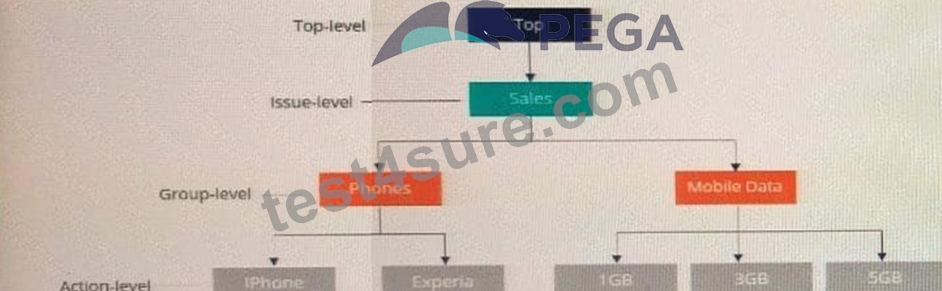
The company wants to present offers from both the groups and arbitrate across the two groups to select the best offer based on customer behavior.
As a decisioning consultant, what must you do to present offers from the two groups?
- A. Enable an engagement policy for the second group.
- B. Map a real-time container to the Top-level or Issue-level.
- C. Set contact limits for both the groups.
- D. Create a decision strategy at the Issue-level.
Answer: D
NEW QUESTION # 96
What does a solid arrow from a "Set Property" component to a "Filter" component mean?
- A. There is a one-to-one relationship between a "Set Property" and a "Filter" component.
- B. A property from the "Set Property" component is referenced by the "Filter" component.
- C. To evaluate the "Set Property" component, the "Filter" component is evaluated first.
- D. Information from the "Set Property" component is copied over to the "Filter" component.
Answer: B
Explanation:
A solid arrow from a "Set Property" component to a "Filter" component in a Pega decision strategy indicates that a property set by the "Set Property" component is being referenced or used by the "Filter" component.
This relationship ensures that the data set in the "Set Property" component influences the filtering criteria in the "Filter" component, allowing for more dynamic and contextually relevant decisions.
NEW QUESTION # 97
U+, a retail bank, does not want to offer a Gold card to customers who already have a Platinum card. Which engagement policy condition best suits this requirement?
- A. Applicability
- B. Suitability
- C. Eligibility
Answer: A
Explanation:
Addressing Test Failures: When persona tests fail after adding new engagement policy conditions, the appropriate step is to analyze the test case failures, update the tests as necessary, and re-execute them until all tests pass. This ensures that the changes made are correctly reflected in the tests and the system functions as expected.
Implementation: Review the failing tests to understand why they failed, adjust the conditions or the expected results, and run the tests again to validate the changes.
NEW QUESTION # 98
To reference a customer property in a strategy, you need to prefix the property name with the keyword______________.
- A. "Customer."
- B. No prefix. Use directly the property name.
- C. "Data."
- D. '' .''
Answer: A
NEW QUESTION # 99
In Pega Customer Decision Hub, the characteristics of an action are defined by using
- A. banners
- B. plain text
- C. properties
- D. logos
Answer: C
NEW QUESTION # 100
Reference module: Analyzing customer distribution using Pega Value Finder.
Myco, a telco, is working on implementing a project in which post-paid offers are presented to qualified customers. In the build stage of the ideation, the business wants to look for new opportunities to improve marketing. As a Decisioning Consultant, which simulation do you run to meet the requirement?
- A. Pega Value Finder
- B. Distribution Test
- C. Audience Simulation
- D. Pega Scenario Planner
Answer: A
Explanation:
Understanding the Requirement:
* Myco wants to find new opportunities to improve marketing during the ideation stage of a project for presenting post-paid offers.
* This involves identifying gaps and underserved customer segments that can be targeted with new or improved offers.
Pega Value Finder:
* Pega Value Finder is designed to analyze the distribution of actions across different customer segments.
* It helps identify customers who are not receiving any actions or are receiving only low-propensity actions, thus highlighting opportunities to improve the strategy.
Running the Simulation:
* In Pega Value Finder, you can run simulations to discover underserved customers.
* The tool provides insights into customer groups that are not well-engaged, allowing businesses to adjust their strategies and create more relevant actions or treatments.
Steps to Run Value Finder:
* Log in to the Pega Customer Decision Hub portal.
* Navigate to Discovery -> Value Finder.
* Create a new simulation and select the relevant issue and group.
* Run the simulation to analyze customer distribution and identify underserved segments.
Verification from Pega Documentation:
* The Pega Customer Decision Hub User Guide details the process and benefits of using Value Finder to discover gaps and opportunities in customer engagement strategies.
NEW QUESTION # 101
U+ Bank a retail bank, uses the Business Operations Environment to perform its business changes The bank carries out these changes m the Pega Customer Decision Hub portal by using revision management features or the V1 Operations Manager portal For each task, select the correct portal in which the tasks are performed based on best practices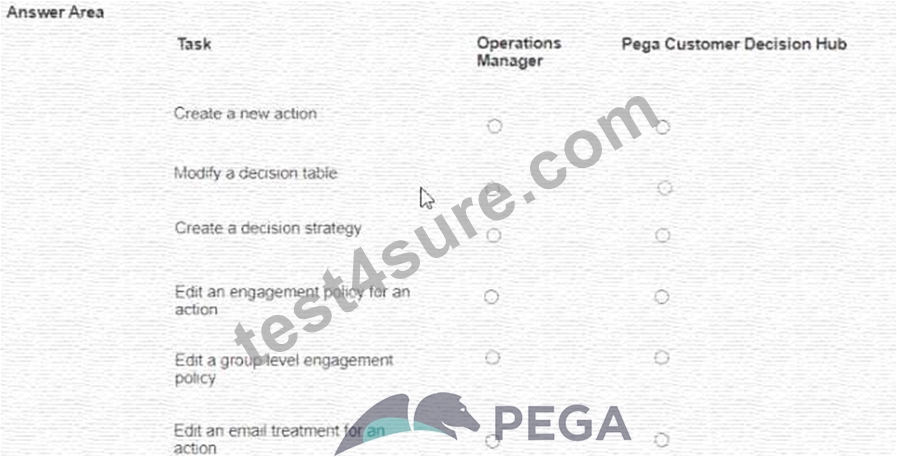
Answer:
Explanation: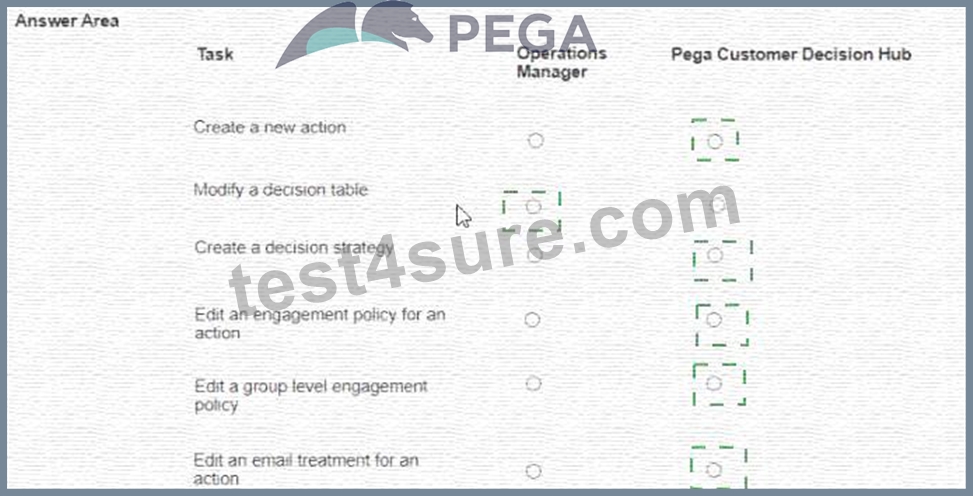
Explanation:
Task: Create a new action
* Portal: Pega Customer Decision Hub
Task: Modify a decision table
* Portal: Operations Manager
Task: Create a decision strategy
* Portal: Pega Customer Decision Hub
Task: Edit an engagement policy for an action
* Portal: Pega Customer Decision Hub
Task: Edit a group level engagement policy
* Portal: Pega Customer Decision Hub
Task: Edit an email treatment for an action
* Portal: Pega Customer Decision Hub
* Create a new action:
* Pega Customer Decision Hub: Creating new actions is typically performed within the Pega Customer Decision Hub where users can manage and configure actions that will be part of the
* decisioning strategies.
NEW QUESTION # 102
......
Pegasystems PEGAPCDC87V1 certification is a valuable asset for individuals looking to establish themselves as experts in Pega decision management. It is an internationally recognized credential that demonstrates proficiency in using the Pega Customer Decision Hub to design, develop and deploy decision strategies. A certified consultant can help organizations drive better business outcomes by leveraging the power of the platform, making it a valuable investment for both individuals and their employers.
Earning the Pega Certified Decisioning Consultant certification demonstrates to potential employers and clients that you have the skills and expertise required to design and implement complex decisioning solutions using Pega Decisioning. Certified Pega Decisioning Consultant (PCDC) 87V1 certification is ideal for professionals in roles such as decisioning architects, business analysts, decisioning developers, and technical architects who work with Pega Decisioning. By earning this certification, you can enhance your career prospects and become a valuable asset to any organization that uses Pega Decisioning.
Master 2024 Latest The Questions Pega PCDC and Pass PEGAPCDC87V1 Real Exam!: https://www.test4sure.com/PEGAPCDC87V1-pass4sure-vce.html
A fully updated 2024 PEGAPCDC87V1 Exam Dumps exam guide from training expert Test4Sure: https://drive.google.com/open?id=1OxBbRgNuYV300Afket1pDZrqwK2zcytu